










BMW Ventures Says Fabrication Expansion May Need Rs 5 Crore
Key highlights
- BMW Ventures reported 500 tons per month of fabrication dispatches against 2,000 tons of monthly capacity, equal to 25% utilisation.
- Management said a potential fabrication expansion could require around Rs 5 crore, mainly for machinery.
- BMW Ventures said it would plan additional capacity at roughly 60% to 70% utilisation, or 1,200 to 1,400 tons per month.
- Management stated a fabrication order book of Rs 76 crore, including Rs 50 crore in PEB and Rs 25 crore in railway orders.
powered by IRIS
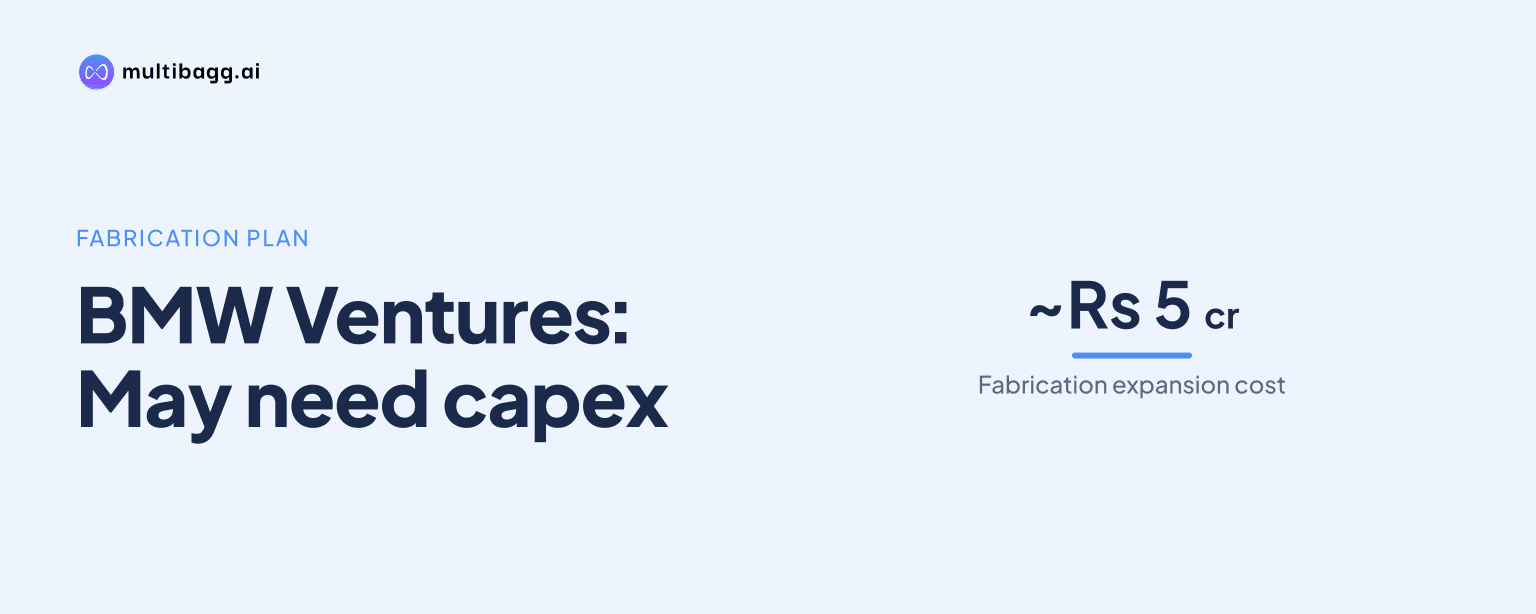
BMW Ventures Limited said on November 4, 2026 that a potential fabrication-capacity expansion may require about Rs 5 crore, largely for machinery, after utilisation reaches 60% to 70% of its 2,000-ton monthly capacity. Management said existing land and equipment shared across PEB and railway fabrication would limit the incremental capital requirement.
Know BMW Ventures inside out
Results, valuation, peers and who's buying, in one view.
How much capex could BMW Ventures need for fabrication expansion?
BMW Ventures said a required fabrication expansion could need around Rs 5 crore, with the spending directed toward machinery rather than land. Management said it already has land parcels available and would need to invest in equipment if demand requires capacity beyond the current 2,000 tons per month.
The Rs 5 crore figure is an indicative estimate, not an announced capital-expenditure programme. Management said it would begin planning before current capacity is exhausted if utilisation rises to roughly 60% to 70% and it expects a capacity shortfall in the following 2 to 6 months. The stated purpose is to preserve delivery timelines for fabrication orders.
What is BMW Ventures' current fabrication utilisation?
BMW Ventures is dispatching 500 tons per month against fabrication capacity of 2,000 tons per month, which management described as 25% utilisation. That leaves 1,500 tons per month of capacity available before the company would need a machinery-led expansion.
Management said it aims to reach 60% utilisation in PEB, or pre-engineered building, and railway fabrication. At the disclosed 2,000-ton monthly capacity, 60% would equal 1,200 tons per month, or 700 tons above the 500 tons currently dispatched. Management expects to use existing infrastructure over the next 2 to 3 years before considering further capacity.
Why can BMW Ventures limit expansion spending to machinery?
BMW Ventures said 70% to 80% of its fabrication machinery can be used for both PEB and railway work, allowing the same equipment to serve either segment. Management said this flexibility means a future expansion would require machinery investment rather than separate equipment sets for the two fabrication activities.
The company also identified available land, including 43 acres in Purnea, 17 acres associated with a proposed housing project and 15 acres of registered land in Calcutta. Management said no final decision has been taken on using the 43-acre Purnea site or the Calcutta land for fabrication, although a Calcutta unit could be considered after local utilisation is completed.
The available land does not amount to an approved expansion project. Management also referred to housing plans on 17 acres and said it had bought 1 acre opposite its yard, while separately studying container-related opportunities. The Rs 5 crore estimate therefore applies to potential machinery purchases, not to a confirmed land, building or site-development programme.
Got a follow-up? Ask IRIS
What order book and demand does BMW Ventures report for fabrication?
BMW Ventures stated that its fabrication order book was Rs 76 crore on November 4, 2026, comprising Rs 50 crore in PEB work and Rs 25 crore in railway work. The two disclosed components total Rs 75 crore, Rs 1 crore below the stated total, and management did not explain the difference during the call.
Management said fabrication turnover had increased 20% in the current year and that dispatch volumes and orders were rising. It also cited government infrastructure work and railway fabrication opportunities in Bihar and the North-East. These are management comments on demand and do not represent a quantified revenue forecast or a committed expansion timetable.
How does BMW Ventures expect higher utilisation to affect margins?
BMW Ventures expects fabrication margins to improve as output rises because management said fixed costs at 500 tons would also support production closer to 2,000 tons. Management did not disclose a PEB or railway fabrication margin percentage, so the expected improvement is an operational view rather than formal margin guidance.
Management also said BMW Ventures buys steel directly from Tata Steel, while competitors may buy through dealers or distributors. It said project-specific pricing may be considered by the supplier for large projects, but did not disclose purchase-price savings or the effect on gross margin. Separately, management attributed a decline in EBITDA, or earnings before interest, tax, depreciation and amortisation, margin during the quarter to machine sales.
Conclusion
BMW Ventures' expansion framework is to increase usage of existing fabrication capacity before buying more equipment. Dispatches of 500 tons per month currently represent 25% of its stated 2,000-ton capacity, while management has identified 60% to 70% utilisation, or 1,200 to 1,400 tons per month, as the level at which it would plan ahead for additional machinery.
The next point to watch is whether dispatches move toward the 1,200-ton monthly level over management's stated 2-to-3-year period. Management said it would act in advance if capacity appeared likely to become insufficient within 2 to 6 months, and investors can also watch for a formal machinery plan, site selection and clarification of the Rs 1 crore difference in the disclosed fabrication order-book figures.