










BMW Ventures targets 10% EBITDA mix from fabrication by FY28
Key highlights
- BMW Ventures targets fabrication to contribute 5% to 7% of revenue and 10% of EBITDA by FY28.
- BMW Ventures had a Rs 76.5 crore fabrication order book as of September 30, 2026.
- BMW Ventures has 24,000 metric tonnes of fabrication capacity, split equally between railway and PEB applications.
- BMW Ventures reported Q2 FY27 revenue of Rs 731 crore, up 46% from Rs 502 crore in Q2 FY26.
powered by IRIS
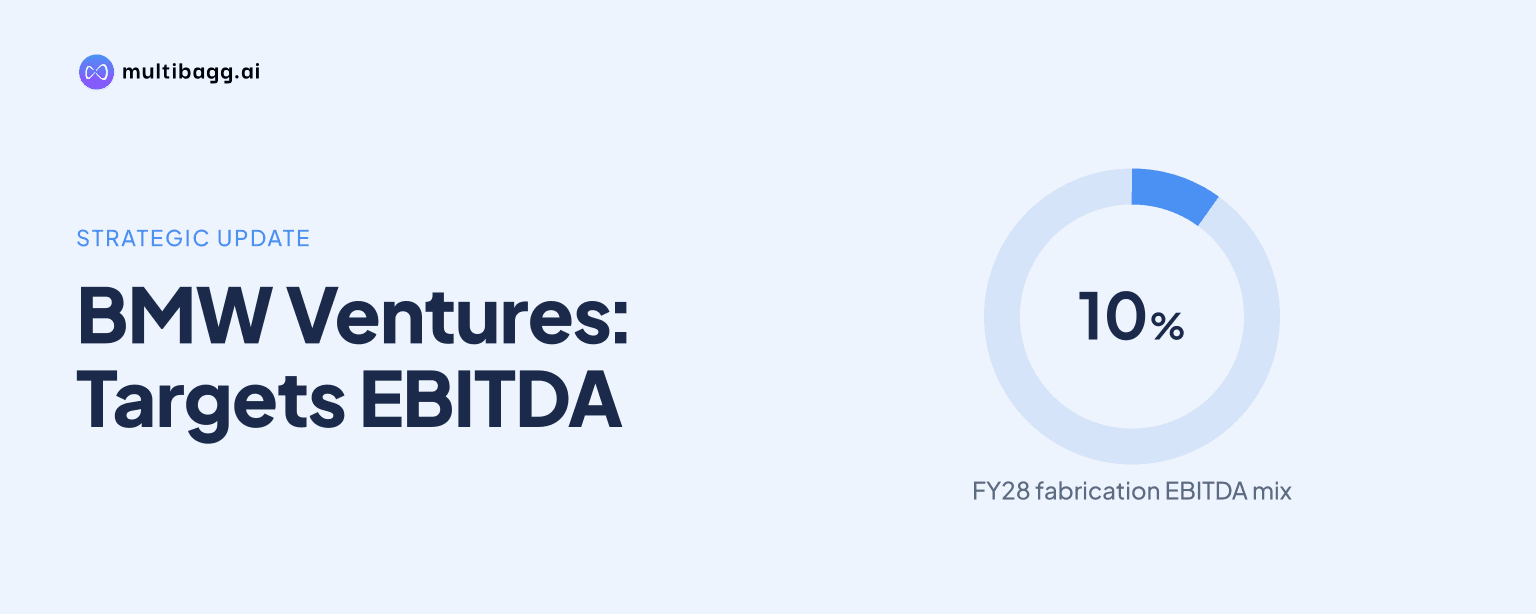
BMW Ventures Limited aims for fabrication to contribute 10% of earnings before interest, tax, depreciation and amortisation, or EBITDA, by FY28, while targeting 5% to 7% of revenue from the business. The plan is supported by a Rs 76.5 crore fabrication order book as of September 30, 2026, and 24,000 metric tonnes of installed capacity in Purnea.
Know BMW Ventures inside out
Results, valuation, peers and who's buying, in one view.
What is BMW Ventures targeting from fabrication by FY28?
BMW Ventures is targeting 5% to 7% of company revenue and 10% of EBITDA from fabrication by FY28, according to Chairman Bijay Kumar Kishorepuria on the November 4, 2026 earnings call. Management presented the target as part of a broader effort to add value-added operations alongside the core steel-distribution business, which it said carries lower profit margins despite high sales volume. The fabrication operation supplies tailor-made reinforcement bars, pre-engineered building, or PEB, structures and railway-related steel structures.
Management said fabrication can earn an EBITDA margin of around 10% to 12%, compared with the lower margin profile of primary steel distribution. Finance head Neeraj Bangur separately put the fabrication EBITDA-margin range at 9% to 11%, indicating that the stated range reflects management expectations rather than a reported segment result. In a later question, the chairman also said BMW Ventures aims to scale PEB and railway fabrication to 10% of total revenue, including both material-inclusive work and conversion-only jobs. The call did not specify whether that later 10% revenue comment carries the same FY28 timing as the earlier 5% to 7% target.
How much fabrication capacity and work does BMW Ventures have?
BMW Ventures has installed fabrication capacity of 24,000 metric tonnes at Purnea, split equally between 12,000 tonnes for railway applications and 12,000 tonnes for PEB structures. The company has an operational fabrication area of about 87,000 square feet and began the business in November 2022. This dedicated capacity is intended to serve two different demand streams, rather than relying only on the company’s established steel-distribution network.
The fabrication order book stood at Rs 76.5 crore on September 30, 2026. Of this amount, Rs 50.8 crore related to PEB and railway orders, while Rs 25.7 crore came from orders at the Bihar Railway RDSO-approved unit. Management cited railway bridges, the Patna airport hangar structure and a steel-mould project in Purnea as examples of fabrication work. It also said BMW Ventures is an approved vendor for Bihar Railways and sees opportunity in industrial warehousing, logistics infrastructure, highways, bridges, railways, metro, airport and port projects.
Why does fabrication matter to BMW Ventures' earnings mix?
Fabrication matters because BMW Ventures said it changes its role from supplying steel to delivering ready-to-use products made to customer designs. In tailor-made reinforcement bars, management said fabrication can reduce labour requirements at construction sites and shorten delivery-to-installation time. The chairman cited one recent project in which a customer said ready-made bars saved two months of construction time. This service element is the mechanism management identified for seeking higher margins than in primary steel distribution.
The revenue mix remains heavily weighted toward distribution: management said about 66% of revenue comes through direct dealer retail sales, with Tata Steel setting prices and BMW Ventures retaining warehouse margins. The company has about 1,200 dealers across Bihar. For fabrication, management described two models: work supplied with steel material and conversion work without material. The chairman said conversion work can have a 20% to 25% margin, but adding steel material lowers the blended percentage because steel itself has a lower margin. Therefore, the 9% to 12% fabrication EBITDA-margin expectation should not be read as applying uniformly to every order type.
Got a follow-up? Ask IRIS
How did BMW Ventures perform while pursuing this shift?
BMW Ventures reported Q2 FY27 revenue of Rs 731 crore, up 46% from Rs 502 crore in Q2 FY26. Gross profit rose 24% to Rs 64.6 crore from Rs 52 crore, while EBITDA increased 11% to Rs 22.1 crore from Rs 20 crore. The comparison shows revenue growing faster than gross profit and EBITDA during the quarter, even as management outlined a plan to increase the proportion of fabrication and other value-added activities over time.
Profit before tax rose 50% to Rs 15 crore in Q2 FY27 from Rs 10 crore a year earlier, and profit after tax rose 48% to Rs 10.5 crore from Rs 7.1 crore. The reported profit-after-tax margin was 1.4%, while gross-profit margin was 8.8%. During the call, the chairman attributed pressure on margin to a Rs 2 crore loss associated with machines sent for fabrication work in Uttarakhand and subsequently sold, including a depreciation impact. Management said fuller machine utilisation should address the EBITDA effect, but it did not provide a date or quantified forecast for that improvement.
What will determine whether BMW Ventures reaches the fabrication target?
BMW Ventures' progress depends on converting the Rs 76.5 crore order book, utilising its 24,000-tonne fabrication capacity and securing more PEB and railway work. Management linked future opportunity to infrastructure activity in eastern India and cited the Central Government’s PM GatiShakti initiative. Those demand comments are management’s outlook, not reported order inflow, and the company did not disclose fabrication revenue for Q2 FY27 or its current share of consolidated EBITDA.
The company also plans to use Purnea as a base for adjacent activities. Management said it has two Purnea land parcels of 16 acres and 43 acres, with a proposed housing project on the 16-acre plot after acquiring adjoining land and an industrial-park plan for the 43-acre plot. A welding-electrode plant in Purnea was built and was scheduled to start commercial production in November 2026. These initiatives could add manufacturing and real-estate activity, but the call provided no capital expenditure, revenue or profit projections for them.
Conclusion
BMW Ventures is seeking to make fabrication a more material contributor to earnings while retaining steel distribution as its principal business. Its FY28 objective is 5% to 7% of revenue and 10% of EBITDA from fabrication, underpinned by 24,000 metric tonnes of capacity and a Rs 76.5 crore order book at September 30, 2026. Q2 FY27 revenue rose 46%, but EBITDA rose 11%, making the margin mix central to management’s stated strategy.
The next indicators are execution of the Rs 50.8 crore PEB and railway order component, utilisation of the Purnea facility and the planned November 2026 start of commercial welding-electrode production. Investors can also watch for management disclosure on actual fabrication revenue, order-book conversion and whether the machine-related Rs 2 crore loss remains an earnings factor as utilisation changes.