










BMW Ventures guides 25% FY27 revenue growth, omits EBITDA target
Key highlights
- BMW Ventures guided for 25% average FY27 revenue growth.
- Management said FY27 profit could increase 20%, then referred to 25% growth in PBT and PAT.
- BMW Ventures did not provide an FY27 EBITDA-growth target.
- BMW Ventures cited a Rs 76 crore fabrication order book, including Rs 50 crore of PEB work.
powered by IRIS
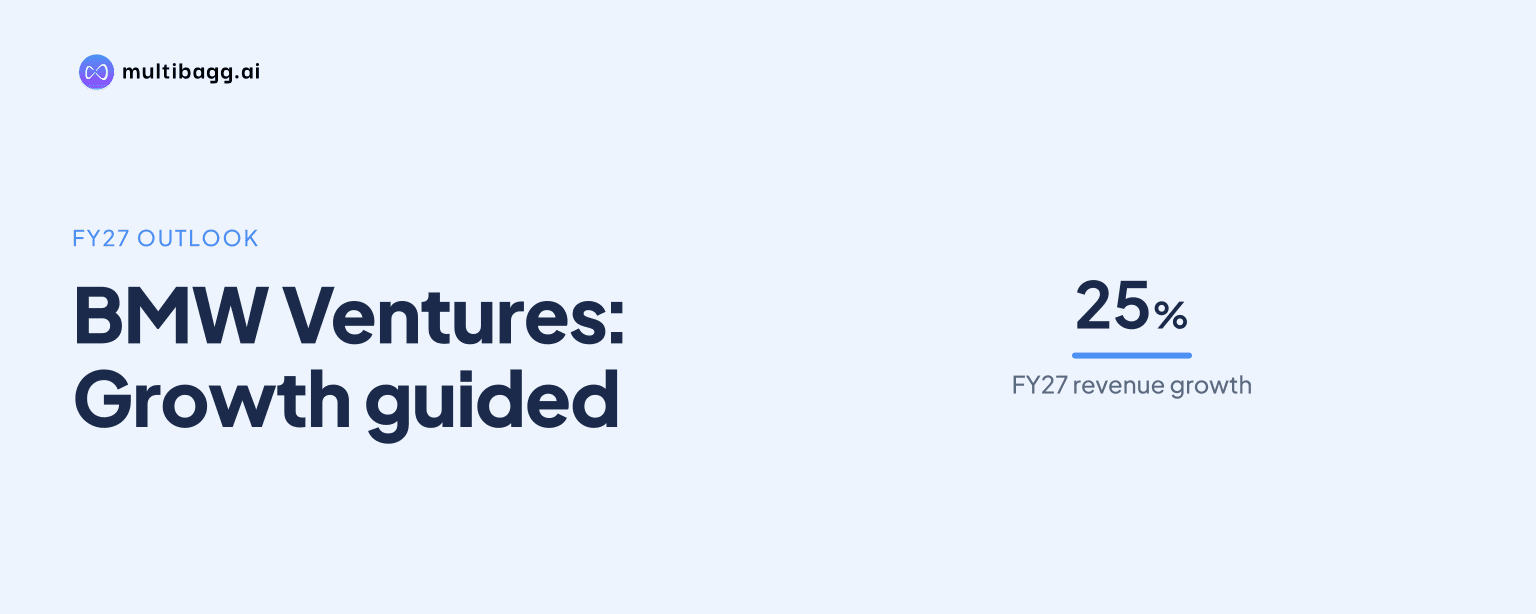
On November 4, 2026, BMW Ventures Limited said it expects FY27 revenue to grow 25% and profit to increase 20% from the prior year, but management gave no earnings before interest, tax, depreciation and amortisation, or EBITDA, growth target. The outlook is tied to distribution, fabrication and value-added processing.
Know BMW Ventures inside out
Results, valuation, peers and who's buying, in one view.
What is BMW Ventures' FY27 growth guidance?
BMW Ventures guided for average FY27 revenue growth of 25% and said profit should increase 20% from the prior year. Bijay K Kishorepuria gave the outlook while answering a question on revenue, EBITDA and profit after tax, after stating that the company had recorded 38% growth in the last year. The call did not define the metric represented by that 38% figure.
Management also gave a second description of its profit outlook in the same response. After citing a 20% profit increase, Kishorepuria said BMW Ventures expected average growth of 25% in revenue, profit before tax, or PBT, and profit after tax, or PAT. The transcript does not reconcile the 20% profit statement with the later 25% reference to PBT and PAT.
The 25% revenue outlook is below the 38% growth figure cited for the last year, although the two measures are not directly comparable because management did not define the earlier figure. BMW Ventures gave no rupee revenue, PBT or PAT targets, leaving the FY27 outlook expressed as percentage growth rather than absolute projections.
Why did BMW Ventures omit an EBITDA growth target?
BMW Ventures said it could not yet state how much EBITDA growth it would achieve in FY27. Management linked an EBITDA impact to machinery deployed for fabrication in Uttarakhand, saying the machines remained idle for 6 months and closed for 3 months before being sold at a loss of Rs 2 crore.
Kishorepuria said depreciation associated with those machines affected EBITDA, while margins before tax and after tax increased by 25 to 30 basis points. A basis point is one-hundredth of a percentage point. Management said EBITDA would be fine when machines are fully utilised, but it provided neither an EBITDA margin target nor a date for that outcome.
The call also showed why the business mix can affect earnings before interest, tax, depreciation and amortisation. Management said fabrication earns Rs 10 to Rs 12 per kilogram, steel-material margins are lower, and job-work margins are 20% to 25%. It also said flat products generally have better margins than long products, while long products provide higher volume turnover.
Got a follow-up? Ask IRIS
Which businesses are expected to support BMW Ventures' growth?
BMW Ventures said distribution remains its key business, while it plans to begin welding-rod production of 200 to 300 tonnes per month and develop fabrication. Management said it was discussing the manufacture of brackets for Tata Steel and was pursuing fabrication involving hot-rolled sheets, railway-related work and Bharat Heavy Electricals Limited, or BHEL.
Management cited a fabrication order book of Rs 76 crore, comprising Rs 50 crore of pre-engineered building, or PEB, work and Rs 25 crore of railway work. It also said it was undertaking 300 tonnes per month for BHEL. These disclosed figures position fabrication as an additional contributor to the growth plan alongside the distribution business.
BMW Ventures described its railway role as subcontract fabrication rather than direct bridge contracting. Management said railway staff conduct 3 inspections before delivery, while BMW Ventures fabricates steel to an approved design for the contractor. The company also identified customer-sized coil cutting, sheet profiling and colour-sheet profiles as value-added activities that generate processing income.
Can BMW Ventures meet higher demand without immediate expansion?
BMW Ventures said it expects to use its existing capacity more fully over the next 3 years before requiring major additional capacity. Management said it would begin planning extra capital expenditure at about 60% utilisation, with the aim of having additional capacity ready before current capacity is exhausted. No capital-expenditure amount or implementation timetable was disclosed.
The company said it has 43 acres of land in Purnea, 17 acres at another location and 15 acres of registered land in Kolkata. Management said it plans housing development on the 17-acre site, had not finalised a use for the 43-acre Purnea parcel, and could consider a fabrication unit in Kolkata if utilisation at the present site is completed.
Working capital is another disclosed operating consideration as volumes rise. Management said BMW Ventures has a working-capital limit of Rs 350 crore, average inventory of 45 days and average booking of 45 days over 3 months. Its railway subcontract model limits its role to fabrication rather than the larger bridge contract, which management said is held by contractors.
Conclusion
BMW Ventures has set a directional FY27 plan of 25% average revenue growth and a stated 20% profit increase, while withholding an EBITDA target. The plan combines distribution with a Rs 76 crore fabrication order book, welding-rod production of 200 to 300 tonnes per month, and processing services such as coil cutting and sheet profiling.
The next operating marker is capacity utilisation, because management said it would start planning additional capital expenditure at about 60% utilisation and expects fuller use of current capacity over 3 years. Investors will also need clarification on whether the FY27 PBT and PAT expectation is 20% or 25%, and whether management later quantifies EBITDA growth.