








Bombay Coated targets automotive for up to 50% of FY31 mix
MAX Plan at ₹4,999/yr

Find your next multibaggerBe a Pro Investor
Research stocks and track your picks on the go. Download the app.
Key highlights
- Bombay Coated said automotive could contribute 40%-50% of FY31 revenue, versus 87% currently from white goods and home appliances.
- Management said automotive EBITDA per tonne would be below white-goods processing, but output could be about 50% higher for an appliance-equivalent tonnage.
- Bombay Coated processed 1.5 lakh tonnes in FY26 and targets 5-6 lakh tonnes by FY2030-31.
- Bombay Coated targets debt to equity below 1 time by March 2027, from 2.48 times at September 30.
powered by IRIS
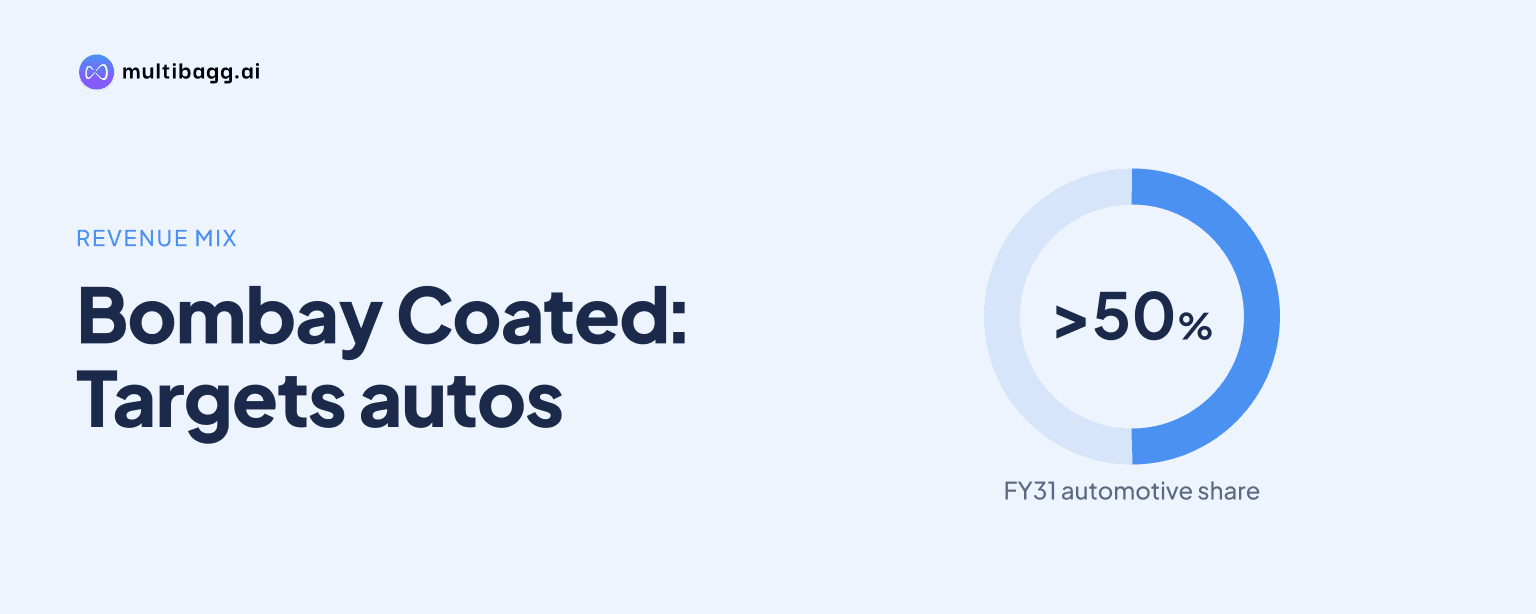
Bombay Coated & Special Steels Limited expects automotive steel processing to account for 40%-50% of its FY31 revenue mix, compared with 87% of its current top line from white goods and home appliances. Management said automotive could increase processed volumes but generate EBITDA per tonne below the white-goods processing business.
Know Bombay Coated and Special Steels inside out
Results, valuation, peers and who's buying, in one view.
How large could Bombay Coated's automotive business become by FY31?
Bombay Coated expects automotive to account for 40%-50% of revenue by FY31, leaving appliances at about 50%-60%, according to management's medium-term mix view. Management described the potential outcome as either a 50:50 split or a 60:40 split in favour of appliances, reflecting Bombay Coated's current appliance-centric position.
The proposed change would be substantial because white goods and home appliances now provide 87% of Bombay Coated's top line. Automotive was not reported as a separate revenue contributor on the call and was described as a new processing vertical to be added once implemented. The FY31 mix is therefore management's stated vision rather than current segment reporting or a formal financial forecast.
Bombay Coated's route to automotive could use a different mill arrangement from its appliance business. Management said the company is tied to JSW as its principal mill for appliance-grade steel and cannot add a second steel manufacturer for the same white-goods industry. For a separate vertical such as automotive, management said another mill could be explored.
Why is Bombay Coated entering automotive steel processing?
Bombay Coated is pursuing automotive to add a growth vertical beyond appliances and increase processing output. Management said automotive uses thicker steel, and processing an appliance-equivalent tonnage could result in “X plus 50%” additional automotive production, making the proposed business more volume-centric.
Appliances remain Bombay Coated's nearer-term growth base. Management said the white-goods industries it serves are growing at roughly 18%-22% compound annual growth rate, or CAGR, depending on the category. It put Indian air-conditioner penetration at about 8%, versus 70%-75% in developed countries, and said the current Indian AC market of 3 crore units could double or triple in the next two to three years.
Bombay Coated serves air conditioners, home and commercial refrigerators, washing machines and water heaters in appliances. Management said ACs and refrigerators represent about 95%-96% of appliance sales and contribute in almost equal proportions. Automotive is consequently positioned as diversification beyond two major appliance product groups rather than as a replacement for appliance demand.
Management also linked automotive to a larger volume ambition. Bombay Coated processed 1.5 lakh tonnes in FY26 and said its vision for FY2030-31 is 5-6 lakh tonnes. It has historically delivered volume growth of roughly 15%-20% and said it expects similar growth in the current year before automotive adds further scale.
Got a follow-up? Ask IRIS
Will automotive reduce Bombay Coated's EBITDA per tonne?
Yes, management said automotive EBITDA per tonne would be a notch below white-goods processing, although higher volumes could make its absolute EBITDA contribution substantial. The stated trade-off is greater throughput from automotive without the same per-tonne profitability as appliance steel processing.
Management said it remained confident of maintaining existing or historical EBITDA levels while appliances are the major revenue contributor. It did not provide a combined EBITDA-per-tonne target for an automotive-plus-appliances business, saying the consolidated margin mix would become clearer after entry into automotive processing. An analyst referred to quarterly EBITDA per tonne of about Rs 6,400, but management did not independently confirm a sustainable forward figure.
A 40%-50% automotive revenue share by FY31 could reduce the consolidated EBITDA-per-tonne measure even if total EBITDA rises with volumes. Management agreed that a larger automotive share could lower consolidated EBITDA per tonne, while saying it was focused on robust volume growth and higher absolute numbers.
Bombay Coated's near-term volume outlook remains appliance-led. Management said first-half FY27 volume was about 69,000 tonnes and projected nearly 1 lakh tonnes in H2 FY27, consistent with a seasonal pattern in which the second half is larger. It also said it was on track for volumes in the 1.7 lakh-tonne range in FY27, compared with 1.5 lakh tonnes in FY26.
What must happen before Bombay Coated can deliver its FY31 mix?
Bombay Coated must implement an automotive processing line and secure relevant mill arrangements before it can pursue the 40%-50% FY31 automotive mix. Management did not disclose an automotive start date, capital-expenditure budget, plant location or approved capacity, leaving the timing and capital requirement unresolved.
Current facilities show both available utilisation and approval dependencies. Annualised capacity utilisation has historically been around 62%, while peak-season utilisation reaches 95%-100%. Management said construction at the proposed Supa facility had not started because it awaited approvals from the steel mill; if approved and built, Supa could become a Rs 500 crore annual top-line plant.
Bombay Coated had incurred Rs 22 crore of capital expenditure in FY27 from March to the November 25, 2026 call, but management did not provide a two-year capex plan. It said annual plans depend on approvals for new facilities and invited requests for detailed yearly figures through investor relations. Manufacturing lines have expected lifecycles of 15-20 years, with preventive maintenance carried out regularly.
Funding may also affect the scope for expansion. Bombay Coated said it had fully repaid Rs 140 crore using IPO proceeds and targeted debt to equity below 1 time by the March 2027 closing, from 2.48 times at September 30. Management estimated interest savings of Rs 3.5 crore to Rs 4 crore over the next four months after repayment of long-term and short-term borrowings.
Conclusion
Bombay Coated is planning to shift from a business where white goods and home appliances contribute 87% of top line toward one where automotive could provide 40%-50% of FY31 revenue. Management's rationale is higher processing volume, including potentially 50% more automotive output for an appliance-equivalent tonnage, while accepting lower EBITDA per tonne in automotive.
The next disclosures to watch are an automotive-line implementation plan, mill tie-up and dedicated capital-expenditure details, none of which management quantified on the call. Nearer-term milestones include nearly 1 lakh tonnes of H2 FY27 sales volume, volumes in the 1.7 lakh-tonne range for FY27 and debt to equity below 1 time by March 2027.

