








Bombay Coated H1 revenue rises 38% as per-tonne EBITDA improves
MAX Plan at ₹4,999/yr

Find your next multibaggerBe a Pro Investor
Research stocks and track your picks on the go. Download the app.
Key highlights
- Bombay Coated reported H1 FY27 revenue of Rs 677.32 crore, up 37.8% from Rs 491.51 crore.
- H1 FY27 sales volume rose 15.8% to 68,952 tonnes, while EBITDA per tonne increased to Rs 7,319.
- Q2 FY27 gross margin was 11.61%, down from 14.96% in Q2 FY26, and EBITDA per tonne was Rs 6,403.
- Bombay Coated reported an 82-day cash-conversion cycle and debt-to-equity of 2.48 times as of September 30, 2026.
powered by IRIS
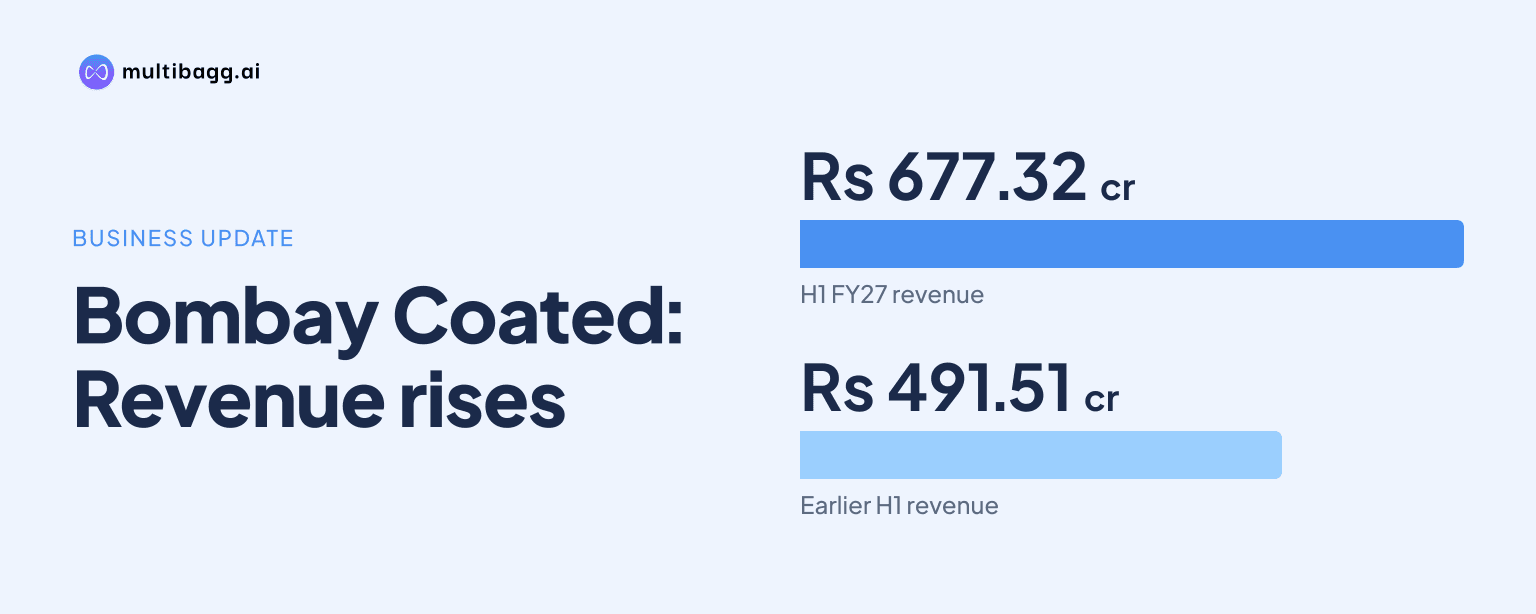
Bombay Coated & Special Steels Limited reported H1 FY27 revenue of Rs 677.32 crore, up 37.8% from H1 FY26, as sales volume rose to 68,952 tonnes and EBITDA per tonne increased 9.2% to Rs 7,319. The half-year improvement came despite Q2 FY27 gross margin falling to 11.61% from 14.96% a year earlier.
Know Bombay Coated and Special Steels inside out
Results, valuation, peers and who's buying, in one view.
How fast did Bombay Coated's H1 FY27 revenue and volume grow?
Bombay Coated's H1 FY27 revenue rose 37.8% to Rs 677.32 crore from Rs 491.51 crore in H1 FY26, while sales volume increased 15.8% to 68,952 tonnes from 59,545 tonnes. Revenue therefore grew faster than volume during the half year, as the company processed and supplied steel for customers in appliances, automotive, heating, ventilation and air-conditioning, electrical equipment and general engineering.
Q2 FY27 revenue was Rs 280.24 crore, compared with Rs 186.64 crore in Q2 FY26, while sales volume rose to 27,835 tonnes from 22,854 tonnes. This represented revenue growth of 50.1% and volume growth of 21.8% in the quarter, although Q2 accounted for less than half of the Rs 677.32 crore reported for H1 FY27.
Bombay Coated served 215 customers in H1 FY27, with its five largest customers contributing 52.27% of revenue. The company provides slitting, cut-to-length, embossing and shearing services, supplying steel in customer-specific dimensions that management said can go directly into component formation and assembly-line production.
What happened to Bombay Coated's Q2 margins and per-tonne earnings?
Bombay Coated's Q2 FY27 gross margin declined to 11.61% from 14.96% in Q2 FY26, while Q2 EBITDA margin was 6.36%. EBITDA means earnings before interest, tax, depreciation and amortisation. Management attributed the quarter-on-quarter movement in percentage metrics partly to seasonality and said steel prices had risen over the preceding three quarters.
Q2 FY27 EBITDA per tonne was Rs 6,403, down 11.6% from Rs 7,247 in Q2 FY26. In contrast, H1 FY27 EBITDA per tonne rose 9.2% to Rs 7,319 from Rs 6,703 in H1 FY26. The half-year result therefore combined lower Q2 per-tonne earnings with a higher per-tonne outcome across the six-month period.
Bombay Coated reported H1 FY27 EBITDA of Rs 50.46 crore and profit after tax of Rs 19.91 crore. In Q2 FY27, EBITDA was Rs 17.82 crore and profit after tax was Rs 4.84 crore. H1 FY27 EBITDA margin was 7.45%, compared with the 6.36% margin reported for Q2 FY27.
Why does Bombay Coated focus on EBITDA per tonne?
Bombay Coated says EBITDA per tonne captures earnings generated from processed and sold volumes and is its key operating profitability measure. Management said it seeks to improve the metric through product mix, processing efficiency, cost control and capacity utilisation, rather than specifying a percentage EBITDA-margin target for H2 FY27.
Management cited FY26 annualised EBITDA per tonne of about Rs 5,900 and said Q2 FY27 EBITDA per tonne of Rs 6,403 remained above that annualised benchmark. That comparison differs from the year-on-year quarterly comparison, under which Q2 FY27 was below Q2 FY26's Rs 7,247 per tonne.
H2 FY27 is typically Bombay Coated's higher-volume period, according to management. The company said its second-half priorities include volume growth, EBITDA per tonne, working-capital efficiency, prudent capital allocation and balance-sheet strengthening, while describing its historic revenue-growth range as about 30% compound annual growth rate.
Got a follow-up? Ask IRIS
What do Bombay Coated's working-capital and debt figures show?
Bombay Coated reported an 82-day cash-conversion cycle as of September 30, 2026, comprising 51 inventory days, 41 receivable days and 10 payable days. Management said its focus is on inventory planning, timely collections and supplier-payment management while maintaining customer service levels.
For H1 FY27, Bombay Coated reported return on equity of 30.28% and annualised return on capital employed of 17.74%. The company listed on the BSE and NSE on November 5, 2026, and management said the public issue raised Rs 183.05 crore.
Management said it had repaid Rs 140 crore from initial public offering proceeds, including Rs 125 crore of long-term and short-term borrowings and Rs 14 crore to Rs 15 crore related to Siemens. Debt-to-equity stood at 2.48 times on September 30, 2026, and management is targeting a ratio below one time by the end of FY27.
What has Bombay Coated disclosed about capacity and expansion?
Bombay Coated said annualised capacity utilisation has historically been about 62%, rising to 95% to 100% during seasonal peaks. Its four facilities are located at Bhiwandi and Wada in Maharashtra, Ghiloth in the National Capital Region, and Sri City in Andhra Pradesh.
The company bought land at Supa in Maharashtra's Parner district on November 19, 2026, for a proposed automotive steel facility. Construction has not started because approvals from a steel mill are pending. If approvals are obtained, management envisages annual revenue of Rs 500 crore from the plant.
Bombay Coated incurred Rs 22 crore of capital expenditure from March through Q2 FY27, according to management. It did not provide a quantified forward capital-expenditure plan, saying the amount depends on approvals for the proposed facility. Management described its manufacturing lines as having a typical life cycle of 15 to 20 years, with maintenance centred on preventive work.
Conclusion
Bombay Coated's H1 FY27 results showed that revenue growth of 37.8%, a 15.8% increase in sales volume and a 9.2% rise in EBITDA per tonne outweighed the weaker Q2 percentage-margin comparison at the half-year level. The figures also show the difference between management's preferred per-tonne profitability measure and Q2 FY27 gross margin, which fell by 3.35 percentage points from Q2 FY26.
The next disclosed milestones are H2 FY27 seasonal volumes, management's efforts to maintain EBITDA per tonne and its target to reduce debt-to-equity below one time by FY27 end. Investors can also watch for steel-mill approvals for the Supa project, which management said could support a Rs 500 crore annual-revenue plant, and progress toward its FY2030-31 aspiration of 0.5 million to 0.6 million tonnes of sales volume and roughly Rs 5,000 crore of revenue.

