








Bombay Coated targets about 170,000 tonnes in FY27 sales
MAX Plan at ₹4,999/yr

Find your next multibaggerBe a Pro Investor
Research stocks and track your picks on the go. Download the app.
Key highlights
- Bombay Coated targets about 170,000 tonnes of FY27 sales volume, versus 150,000 tonnes in FY26.
- Management expects nearly 100,000 tonnes of sales volume in H2 FY27 after roughly 69,000 tonnes in H1.
- White goods and home appliances account for roughly 87% of Bombay Coated revenue.
- Management estimated Rs 3.5 crore to Rs 4 crore of interest-cost savings over the next four months after debt repayment.
powered by IRIS
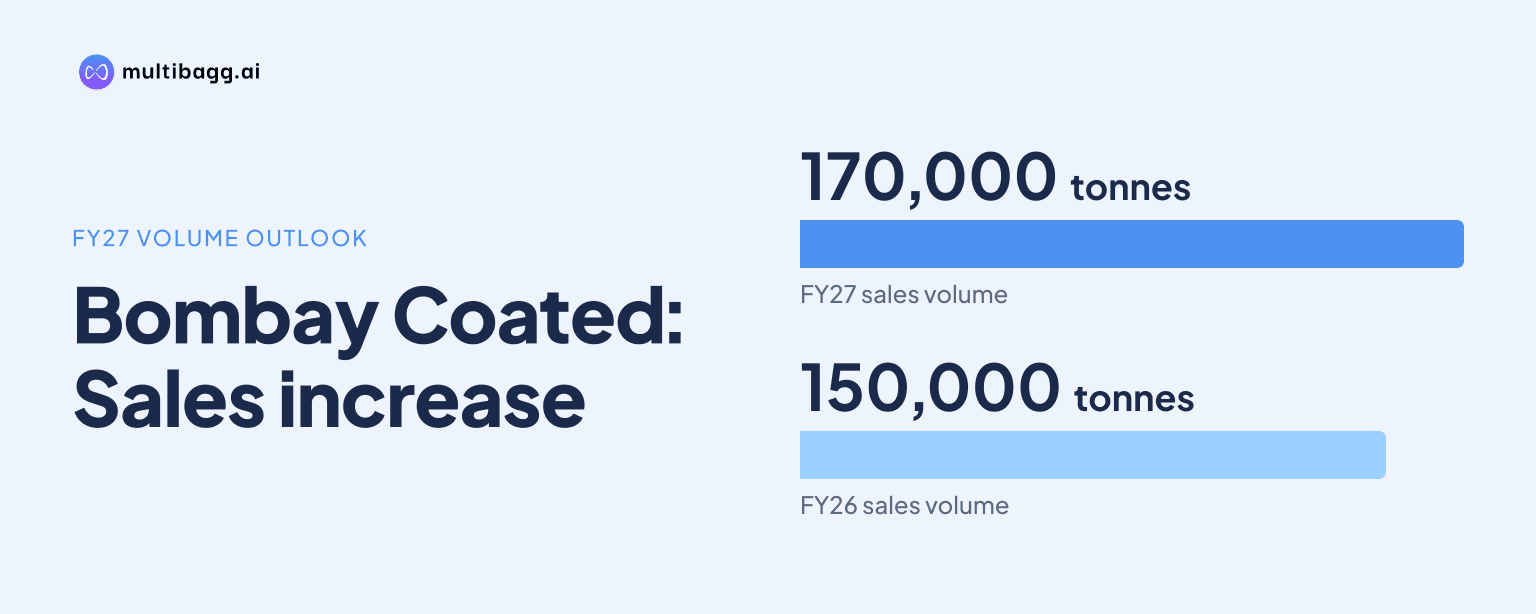
Bombay Coated & Special Steels Limited said on November 25, 2026 that it was on track for about 170,000 tonnes of FY27 sales volume, supported by a target of nearly 100,000 tonnes in H2 FY27 after roughly 69,000 tonnes in H1. The plan implies annual volume about 13% above FY26 sales of 150,000 tonnes.
Know Bombay Coated and Special Steels inside out
Results, valuation, peers and who's buying, in one view.
What is Bombay Coated’s FY27 volume target?
Bombay Coated is targeting sales volume of about 170,000 tonnes in FY27. Management said it was on track for the “lakh 70 range” after reporting FY26 volume of 150,000 tonnes, implying an increase of around 20,000 tonnes. Management also said its historical volume growth had been roughly 15% to 20%.
The more specific management outlook is nearly 100,000 tonnes in H2 FY27. Alongside roughly 69,000 tonnes discussed for H1 FY27, this gives an implied full-year total of about 169,000 tonnes, broadly matching the stated annual target. The H2 figure is management guidance, rather than a reported sales result.
Why does Bombay Coated expect higher H2 FY27 volume?
Bombay Coated expects H2 FY27 volume to exceed H1 because its appliance business follows a seasonal selling cycle. Management said the cycle generally starts in September or October and continues until May or June, depending on weather conditions, and described the normal first-half to second-half mix as 40:60.
Management said H2 quantities typically reach about 1.3 to 1.5 times H1 quantities. Applied to the roughly 69,000 tonnes discussed for H1 FY27, that relationship gives an indicative H2 range of 89,700 to 103,500 tonnes, encompassing the nearly 100,000-tonne outlook. Management also said that, in the prior year, H2 sales volume was about double H1 volume.
Which markets support Bombay Coated’s FY27 volume plan?
Bombay Coated’s FY27 plan is principally tied to white goods and home appliances, which contribute roughly 87% of revenue. Management identified air conditioners, home and commercial refrigerators, washing machines and water heaters as the four appliance applications it serves.
Air conditioners and refrigerators account for about 95% to 96% of Bombay Coated’s appliance business and contribute in almost equal measure, according to management. The company said the white-goods and home-appliance industries it serves are expanding at roughly 18% to 22% compound annual growth rates, depending on the particular industry.
Management also cited India’s air-conditioner penetration of 8%, compared with 70% to 75% in developed countries, as part of its demand rationale. It estimated that India’s air-conditioner market, currently about 3 crore units, could double or triple over the next two to three years. That market view was management’s assessment and not company sales guidance.
Got a follow-up? Ask IRIS
How could debt repayment affect Bombay Coated’s PBT?
Bombay Coated expects debt repayment from initial public offering proceeds to lower interest costs and support profit before tax, or PBT. Management said the proceeds had already been used to repay long-term and short-term borrowings, and estimated interest-cost savings of Rs 3.5 crore to Rs 4 crore over the next four months.
Management said PBT should increase in a similar proportion because of the lower interest outgo. It also expects the debt-equity ratio at the March 2027 close to be below 1 time. These are management expectations; the call did not include a rupee PBT target or a revenue target for H2 FY27.
An analyst referred to quarterly earnings before interest, tax, depreciation and amortisation, or EBITDA, of around Rs 6,400 per tonne and a higher H1 FY27 level. Management did not restate a sustainable per-tonne EBITDA figure, but said it was confident of maintaining historical EBITDA levels while appliances remain the principal revenue contributor.
What does automotive processing mean for Bombay Coated’s plans?
Bombay Coated plans to add automotive steel processing as a separate vertical alongside appliances. Management said automotive steel’s greater thickness could deliver about 50% more production than an equivalent appliance-processing tonnage comparison, making the new operation more volume-oriented.
Management said automotive EBITDA per tonne would be below current white-goods levels, although absolute EBITDA could become substantial through higher production volume. It said the combined EBITDA profile would be clearer after the automotive processing line begins, and did not disclose a start date or commissioning schedule on the November 25, 2026 call.
For FY2030-31, Bombay Coated’s stated volume ambition is 500,000 to 600,000 tonnes, compared with 150,000 tonnes in FY26 and about 170,000 tonnes targeted for FY27. Management envisages an appliance-to-automotive mix of roughly 50:50 to 60:40 by FY2031, a shift from the current business mix in which white goods provide about 87% of revenue.
Conclusion
Bombay Coated’s FY27 plan combines nearly 100,000 tonnes of H2 sales with roughly 69,000 tonnes discussed for H1, taking expected full-year volume to about 170,000 tonnes from 150,000 tonnes in FY26. The seasonal appliance cycle is central to that outlook, while air conditioners and refrigerators remain the main applications within the 87% white-goods revenue base.
The next measures to watch are H2 FY27 sales against the nearly 100,000-tonne target, the expected March 2027 debt-equity ratio below 1 time, and whether the projected Rs 3.5 crore to Rs 4 crore of four-month interest savings supports PBT. Management’s automotive-processing plan and its FY2030-31 target of 500,000 to 600,000 tonnes remain longer-term milestones without a disclosed implementation timetable.

