








Bombay Coated and Special Steels Releases Q2 FY27 Transcript
MAX Plan at ₹4,999/yr

Find your next multibaggerBe a Pro Investor
Research stocks and track your picks on the go. Download the app.
Key highlights
- Bombay Coated released the transcript of its Q2 and H1 FY27 earnings call held on November 25, 2026.
- Bombay Coated reported H1 FY27 revenue of ₹677.32 crore, up 37.80% year on year.
- Q2 FY27 revenue was ₹280.24 crore, while profit after tax was ₹4.84 crore.
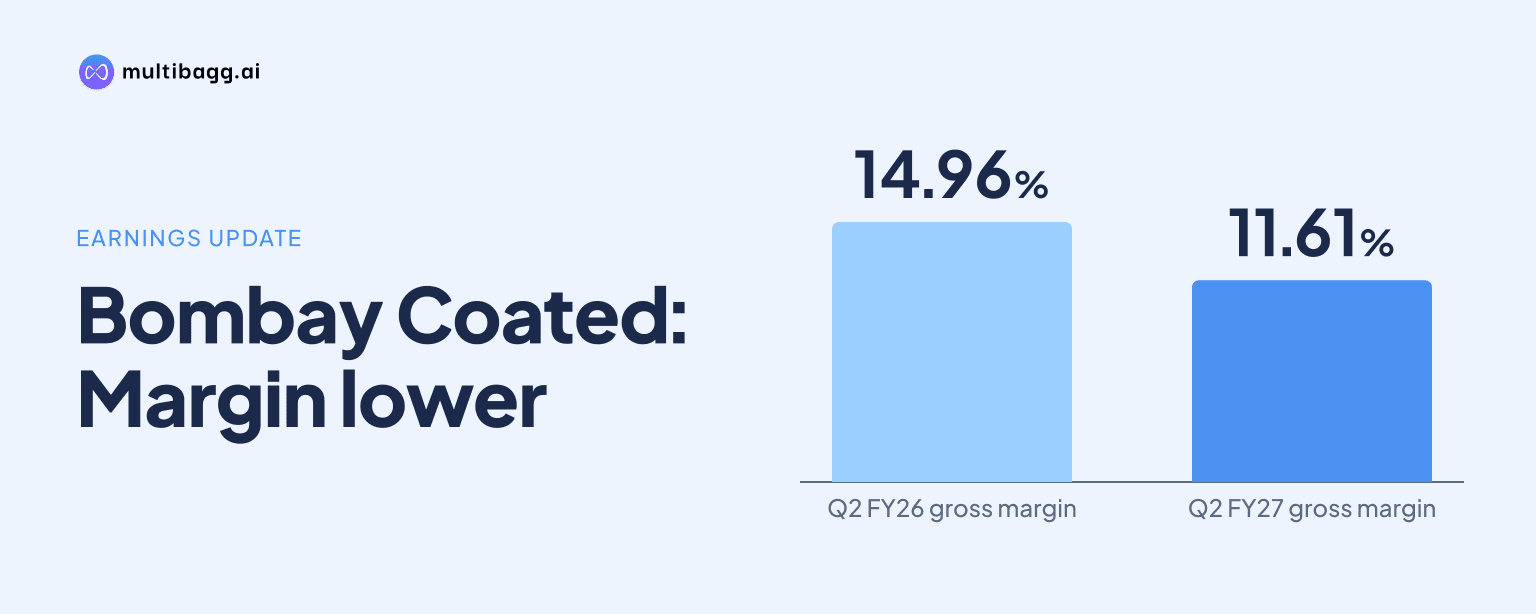
- Q2 FY27 gross margin was 11.61%, compared with 14.96% in Q2 FY26.
powered by IRIS
Bombay Coated and Special Steels released the transcript of its Q2 FY27 earnings call, held on November 25, 2026, following H1 FY27 revenue of ₹677.32 crore. The filing gives investors a formal record of management’s discussion after the company reported quarterly revenue of ₹280.24 crore for the September quarter.
Know Bombay Coated and Special Steels inside out
Results, valuation, peers and who's buying, in one view.
What did Bombay Coated release in its latest filing?
Bombay Coated released the transcript of its Q2 and H1 FY27 earnings call conducted on November 25, 2026. The filing is a disclosure of the discussion held with investors and analysts after the company’s financial results for the quarter ended September 30, 2026.
An earnings-call transcript is distinct from the financial results themselves. It records management’s commentary and responses during the call, allowing investors who did not attend to review the discussion alongside the company’s reported numbers and investor presentation.
The filing does not announce a new operating transaction, capital-raising decision or revised financial result. Its immediate significance is the availability of the call record, which can help market participants assess management’s explanations of revenue growth, profitability, debt reduction and business priorities disclosed around the quarterly results.
What were Bombay Coated’s reported Q2 and H1 FY27 financial figures?
Bombay Coated reported Q2 FY27 revenue of ₹280.24 crore and H1 FY27 revenue of ₹677.32 crore. Available earnings-call summaries state that Q2 revenue rose 50.15% year on year, while H1 revenue increased 37.80% year on year.
For the July-September quarter, reported profit after tax was ₹4.84 crore, up 39.97% year on year according to the available earnings materials. Q2 EBITDA was stated at ₹17.82 crore, an increase of 7.62% from the corresponding earlier period.
The revenue growth was accompanied by lower per-tonne profitability in the quarter. Available call summaries put Q2 EBITDA per tonne at ₹6,403, compared with ₹7,247 a year earlier. Gross margin was reported at 11.61%, against 14.96% in Q2 FY26.
What issues were discussed during the Q2 FY27 earnings call?
The earnings call covered quarterly profitability, volume and realisation trends, debt reduction and growth priorities, based on available summaries of the discussion. Revenue growth in Q2 was described as being supported by both higher volume and higher realisations, with reported volume growth of 21.8% year on year.
Management’s stated market focus included water heaters, washing machines, automotive applications, electrical products and heating, ventilation and air-conditioning, or HVAC, applications. Geographic expansion across India and overseas markets was also identified as an area of focus.
Margin performance was relevant because EBITDA growth was lower than revenue growth and gross margin declined year on year. The transcript gives investors the underlying management commentary on such topics, rather than requiring them to rely only on headline results or third-party call summaries.
Got a follow-up? Ask IRIS
Why does the earnings-call transcript matter to investors?
The transcript matters because it provides the record of management communication following a period of strong reported revenue growth but weaker Q2 margin indicators. Investors can use it to compare management’s explanations with the reported movement in revenue, EBITDA, profit and unit-level profitability.
For shareholders, the key issue is not only the 50.15% Q2 revenue increase but also whether earnings conversion and balance-sheet improvement are supported by disclosures made on the call. The company has indicated a target of debt-to-equity below 1 times in FY27, while available call commentary cited debt-to-equity of 2.48 times.
The release also improves access to information for retail investors. A transcript can be reviewed at an investor’s own pace and used with the result announcement and presentation to identify stated targets, operational priorities and matters that management did not quantify during the discussion.
What should investors monitor after Bombay Coated’s transcript release?
Investors should monitor whether revenue growth continues alongside stabilisation in EBITDA per tonne and gross margin. Q2 revenue growth and profit growth were positive, but the reported decline in gross margin from 14.96% to 11.61% makes future margin disclosures relevant.
Balance-sheet progress is another measurable item. Bombay Coated has set a debt-to-equity objective of below 1 times in FY27, and available earnings material linked deleveraging plans to IPO proceeds. Investors can track subsequent filings for updated debt figures, use of proceeds and the company’s progress against that target.
Operationally, future disclosures may provide evidence of progress in targeted end markets, including appliances, automotive, electrical and HVAC. The transcript filing itself does not establish the financial outcome of these plans, but it places management’s stated priorities on the public record.
Conclusion
Bombay Coated’s November 27 filing releases the transcript of its Q2 and H1 FY27 earnings call held on November 25. The document follows reported H1 revenue of ₹677.32 crore and gives investors a formal source for management’s discussion of growth, profitability, leverage and operating priorities.
The next disclosures to watch are updates on the FY27 debt-to-equity target of below 1 times, the company’s margin and EBITDA-per-tonne performance, and progress towards its FY31 sales-volume target of 0.5 million to 0.6 million tonnes.

