










Borosil Renewables keeps February-March start after cost rise
Key highlights
- Borosil Renewables increased its 600-tonne-per-day expansion cost by Rs 150 crore to Rs 1,100 crore.
- The Rs 1,100 crore project is funded through Rs 800 crore internally and Rs 300 crore of previously tied-up debt.
- Management said one new furnace will be fired in February and the second in March.
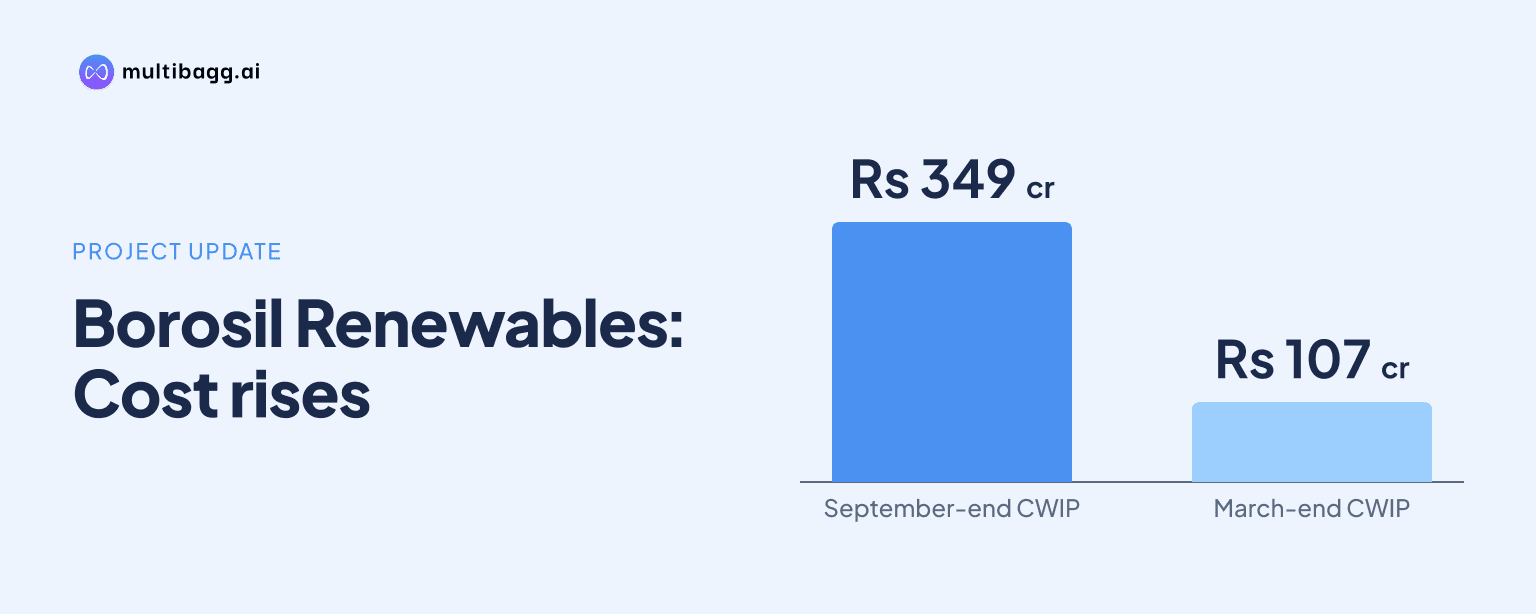
- Capital work in progress rose to Rs 349 crore at September-end from Rs 107 crore at March-end.
powered by IRIS
Borosil Renewables Limited raised the cost of its 600-tonne-per-day solar-glass expansion by Rs 150 crore to Rs 1,100 crore, yet management said the two new furnaces remain scheduled for firing in February and March. Management said the added cost is fully funded without increasing bank loan amounts.
Know Borosil Renewables inside out
Results, valuation, peers and who's buying, in one view.
Why did Borosil Renewables raise its expansion budget?
Borosil Renewables raised the project cost after its September board meeting widened the scope to include fuel-saving equipment, additional power-supply protection and foreign-exchange effects. Management said about 20% of the Rs 150 crore increase, or about Rs 30 crore, reflected rupee depreciation against the US dollar. The larger portion was for equipment intended to reduce fuel costs, which management said would have its own payback.
The second identified addition is redundancy against electricity failures, for which management indicated spending of about Rs 25 crore. Management said a constant and robust power supply is important for glass furnaces because fluctuations can cause serious disturbances. The revised Rs 1,100 crore budget therefore includes measures intended to protect furnace operations as well as equipment intended to reduce fuel use, rather than being solely a currency-related cost increase.
How will Borosil Renewables fund the Rs 1,100 crore project?
Borosil Renewables said the full Rs 1,100 crore requirement is already funded through Rs 800 crore of internal funding and Rs 300 crore of debt arranged earlier. Management said the debt had not yet been drawn at the time of the call and that it did not expect to increase bank loan amounts after the Rs 150 crore revision. It also said funds from preferential warrants and a preferential equity issue were already available.
Capital work in progress was Rs 349 crore at the end of September, compared with Rs 107 crore at the end of March, and management said the entire September balance related to the expansion project. It also reported letters of credit of more than Rs 150 crore for materials in transit and advances paid for the project. The building was more or less complete, while machine deliveries were expected and installation was planned to begin toward the end of the quarter.
Is Borosil Renewables still on schedule to start the new furnaces?
Borosil Renewables said it remains on track to fire one new furnace in February and the second in March. Management described the project as being on course for those dates despite the Rs 150 crore increase in its budget. The new furnaces form part of a planned 60% capacity addition, which management linked to an expected broadly similar increase in turnover once the facility operates.
The timetable overlaps with a decision on older furnaces SG1 and SG2, which have operated for seven years and may require rebuilding depending on their condition. Management expects them to continue producing until at least March 2027 and plans to decide in February or March whether to take them down in the first half of the next financial year. Each repair could take 75 days, but management said it would carry out work one furnace at a time after the new capacity starts, with the aim of maintaining customer supply.
Got a follow-up? Ask IRIS
What does the expansion mean for Borosil Renewables' output and sales plans?
Borosil Renewables expects the 60% capacity increase to support a similar percentage increase in turnover. Management said the larger facility could also provide 2% to 3% operating leverage because overheads would be spread across higher production. These are management expectations, not a formal earnings forecast, and management said it was discussing supply with current customers and potential customers it had not previously served because of limited capacity.
Management based its sales confidence on estimated domestic solar-module production demand of about 62 gigawatts, compared with domestic solar-glass supply capacity of about 18 gigawatts. It said demand should remain higher than domestic supply when the new furnaces begin production around the end of March. Borosil Renewables also cited its existing customer relationships and said it was onboarding customers before the furnaces start.
How are current operations affecting Borosil Renewables' ramp-up plans?
Borosil Renewables said maintenance reduced production by close to 4.5% during the quarter and caused revenue loss of about Rs 15 crore. Following repairs and parameter adjustments, management said output had risen about 8% to 10% above earlier levels, although it cautioned that it was too early to commit to that rate as sustainable. Management said no production loss was planned or expected in the current year.
Quarterly realisation was Rs 155.9 per square metre, down from Rs 160.3 per square metre in the previous quarter, after a temporary reduction in the fuel surcharge. Management said it returned to customers in October to restore the earlier surcharge and expected to achieve the earlier realisation level by the end of the quarter. It also said higher output, increased domestic sourcing of dolomite and productivity measures were intended to offset higher soda ash, imported mineral and freight costs.
Conclusion
The Rs 1,100 crore project revision adds fuel-saving equipment and power-supply redundancy while retaining the previously arranged Rs 300 crore debt component and avoiding any increase in bank loan amounts. The February and March firing schedule positions the 60% capacity addition for a market where management estimates domestic module demand at 62 gigawatts against domestic solar-glass supply of 18 gigawatts.
The next disclosed milestones are machinery installation toward the end of the quarter, the two furnace firings in February and March, and a February or March decision on potential SG1 and SG2 shutdowns in the first half of the next financial year. Management will also need to establish whether the reported 8% to 10% output improvement after repairs can be sustained while the new facility ramps up.