










Borosil Renewables says October output exceeded prior peak
Key highlights
- Borosil Renewables said Q2 FY27 maintenance reduced production by about 4.5%.
- Management estimated the Q2 FY27 disruption caused about Rs 15 crore of revenue loss.
- Solar-glass EBITDA was Rs 116.34 crore in Q2 FY27, with a 30.4% margin.
- Borosil Renewables plans to fire new 600-tonnes-per-day furnaces in February and March 2027.
powered by IRIS
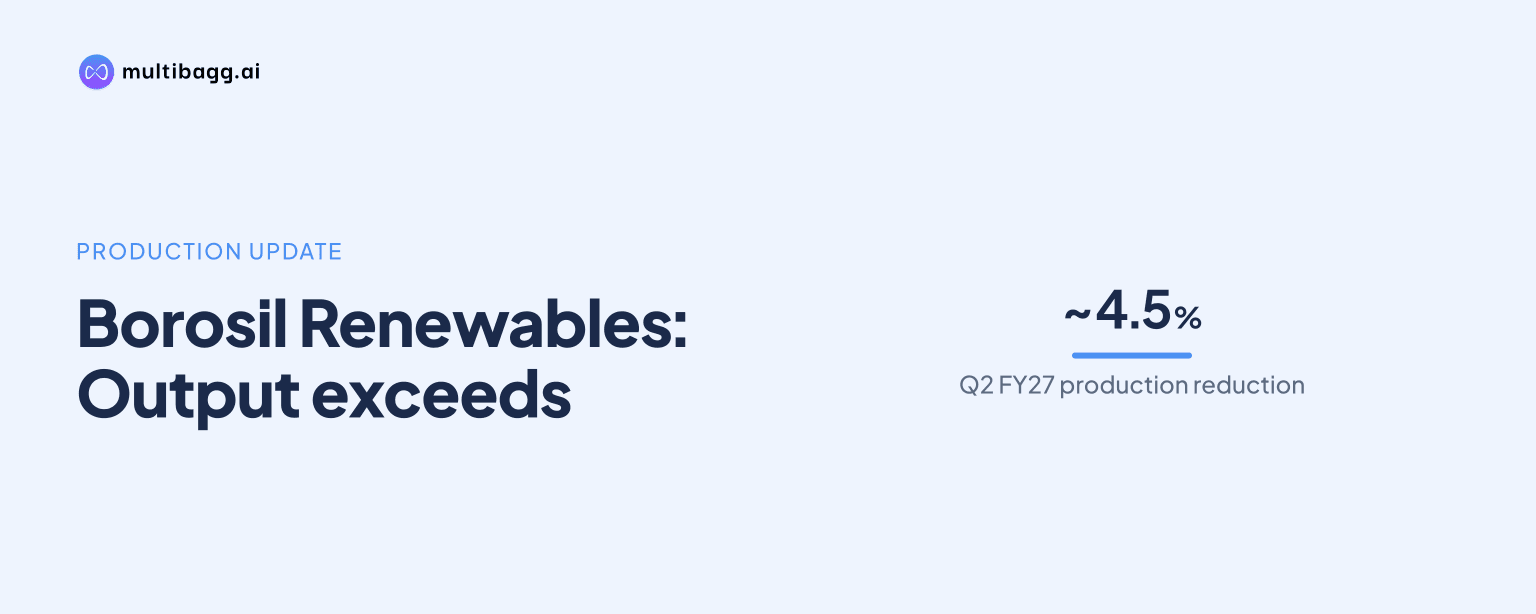
Borosil Renewables Limited said October production exceeded its previous historical peak after Q2 FY27 furnace maintenance and fine-tuning cut output by about 4.5% and caused about Rs 15 crore of revenue loss. Management expects the higher output rate and a restored fuel surcharge to help recover the FY27 shortfall.
Know Borosil Renewables inside out
Results, valuation, peers and who's buying, in one view.
Why did Borosil Renewables’ Q2 FY27 output fall?
Borosil Renewables’ Q2 FY27 output declined by about 4.5% because of furnace maintenance and adjustments to operating parameters. Management said the work corrected small anomalies and fine-tuned production, but it reduced solar-glass volumes during the quarter and contributed to lower profitability.
Management estimated the revenue impact of the disruption at about Rs 15 crore, below an analyst’s Rs 20 crore estimate. Solar-glass sales fell sequentially to Rs 382.1 crore in Q2 FY27 from Rs 405.7 crore in Q1 FY27, although they remained above Rs 378.4 crore in Q2 FY26.
Borosil Renewables reported total sales of Rs 396.2 crore in Q2 FY27, including Rs 14.1 crore from solar kits, for which management said EBITDA was negligible. Solar-glass EBITDA was Rs 116.34 crore, down from Rs 125.5 crore in Q2 FY26 and Rs 142.0 crore in Q1 FY27, while the margin declined to 30.4%.
Has Borosil Renewables restored production after maintenance?
Borosil Renewables said production began increasing from the middle of September and exceeded all earlier company levels during October. Management described October production as exceptionally good, but did not disclose a tonnes-per-day figure for either the Q2 FY27 disruption or the October run rate.
Management said the maintenance and parameter changes lifted output above the earlier production level, rather than merely restoring it. It expects the better run rate to continue through the current quarter and said it could make good the Q2 FY27 shortfall during the rest of FY27, which remains a management expectation.
Borosil Renewables said it does not expect a further production loss during FY27 from planned furnace work. Furnace 1 and Furnace 2 have each operated for seven years, and management expects to decide in February or March whether their rebuilds should occur in the first half of FY28.
How did pricing and fuel costs affect Q2 FY27 margins?
Borosil Renewables’ average ex-factory selling price was Rs 155.9 per millimeter in Q2 FY27, compared with Rs 160.3 per millimeter in Q1 FY27 and Rs 147.5 per millimeter in Q2 FY26. The sequential decline of Rs 4.4 per millimeter followed a partial reduction of the fuel surcharge in July.
Management said it reduced the surcharge when gas prices appeared to be falling after an improvement in the West Asia conflict situation. It said this period lasted about two weeks before oil and gas prices rose again, leaving Borosil Renewables with elevated fuel costs during Q2 FY27.
Borosil Renewables approached customers in October to restore the original fuel surcharge. Management said it was gradually moving towards Rs 160.3 per millimeter by the end of the current quarter and expects margins to return to higher levels if production and selling prices normalise.
Got a follow-up? Ask IRIS
What capacity expansion is Borosil Renewables building?
Borosil Renewables is adding 600 tonnes per day of production capacity at its existing location, a 60% expansion. Management said it plans to fire one new furnace in February 2027 and the other in March 2027, with commissioning expected towards the end of Q4 FY27.
The project cost has increased by Rs 150 crore to about Rs 1,100 crore. Management said about 20% of the increase arose from rupee-dollar exchange movement, while the principal additions were fuel-saving equipment and higher power redundancy, including about Rs 25 crore for the latter.
Borosil Renewables said the Rs 1,100 crore project is fully funded by Rs 800 crore of internal funding and Rs 300 crore of debt arranged earlier, which had not yet been drawn. Capital work in progress was Rs 349 crore at September, compared with Rs 107 crore in March, and management said building work was largely complete.
Can Borosil Renewables maintain supply during FY28 rebuilds?
Borosil Renewables said Furnace 1 and Furnace 2 may each require a 75-day shutdown for rebuilding in the first half of FY28. Management plans to rebuild them one at a time, depending on furnace health, rather than take both units out of service simultaneously.
Management expects new capacity to be coming on stream while the older furnaces are rebuilt, with the aim of maintaining supplies to customers. However, the Executive Chairman said recovery of any volume lost during the future shutdowns could not be guaranteed and remained speculative.
Borosil Renewables cited domestic module manufacturing capacity of 233 gigawatts against annual solar installations of about 62 gigawatts on a direct-current basis. Management said domestic solar-glass suppliers serve about 18 gigawatts, with the remainder imported, and cited this supply gap and customer relationships in its assessment that extra capacity can be sold.
Conclusion
Borosil Renewables’ Q2 FY27 disruption reduced output by about 4.5%, caused about Rs 15 crore of revenue loss and coincided with solar-glass EBITDA of Rs 116.34 crore and a 30.4% margin. Production above the prior peak in October indicates that the maintenance and furnace adjustments delivered the operational recovery management had sought.
The next disclosed milestones are the February and March 2027 firing of the two new furnaces, the expected end-Q4 FY27 commissioning, and the February or March decision on older-furnace rebuilds. Investors will also watch whether the higher production rate persists and whether the restored fuel surcharge supports management’s stated 31% to 32% EBITDA-margin expectation.