










Borosil Renewables plans offsets after 10% soda ash rise
Key highlights
- Borosil Renewables said soda-ash prices increased about 10% from June to the September quarter.
- Soda ash represents about 30% to 32% of Borosil Renewables' raw-material basket.
- Borosil Renewables currently sources about 30% to 40% of dolomite domestically and plans to reverse that mix.
- Management said output was about 8% to 10% above earlier levels after a roughly 5% production dip.
powered by IRIS
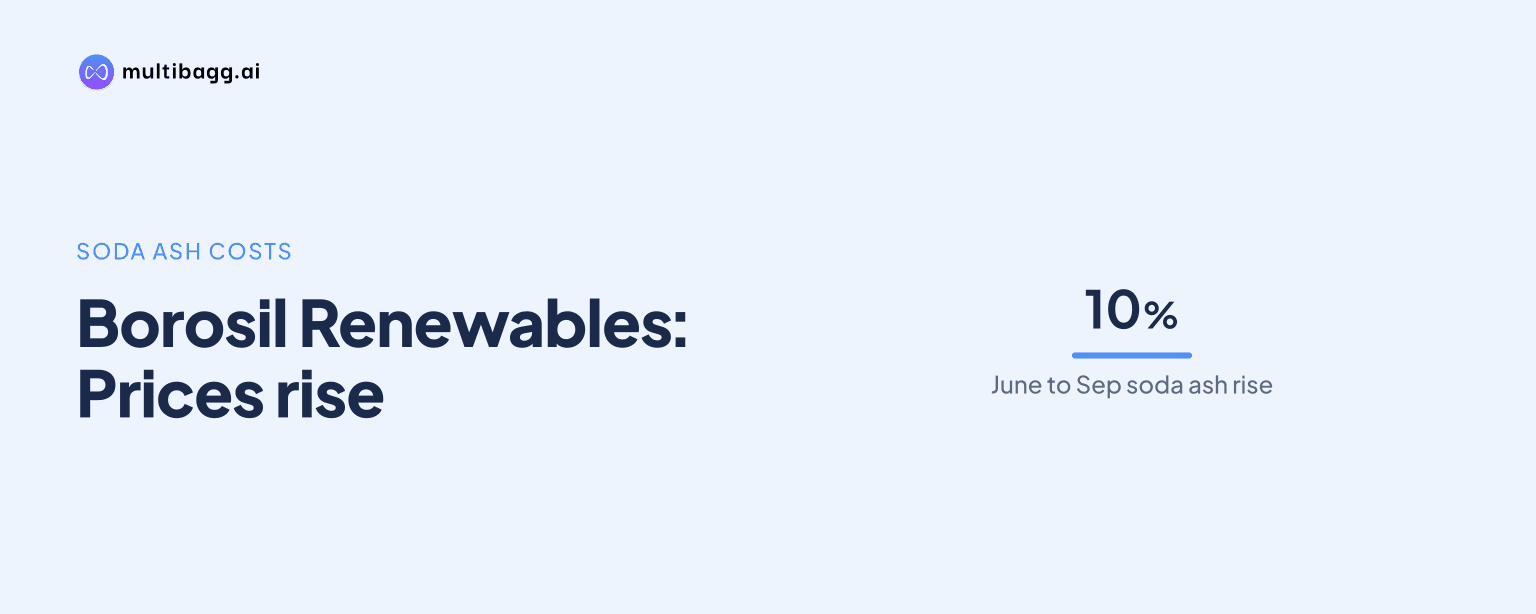
In the June to September quarter, Borosil Renewables Limited accepted a 10% soda-ash price increase and said it would offset input pressure through domestic mineral sourcing, productivity and higher output rather than a standard pass-through clause. Borosil Renewables also cited substantially higher freight from China for an imported mineral input.
Know Borosil Renewables inside out
Results, valuation, peers and who's buying, in one view.
Why did Borosil Renewables' raw-material costs rise?
Borosil Renewables said raw-material costs increased because domestic soda-ash vendors raised prices and imported dolomite and limestone became more costly. Management said it accepted a price increase after negotiations with soda-ash manufacturers, although the agreed rate remained above the previous quarter's level. The company said it does not expect soda-ash prices to decline soon.
Imported minerals added a separate cost pressure in the June to September quarter. Borosil Renewables said it requires imported dolomite and limestone grades to maintain solar-glass quality, while mixing those materials partly with domestic supply. Freight rates from China had risen over the preceding couple of months, management said, substantially increasing the freight cost for one imported item from China.
How exposed is Borosil Renewables to soda ash and imported minerals?
Borosil Renewables said soda ash accounts for about 30% to 32% of its raw-material basket, making the 10% increase relevant to its manufacturing cost base. Management did not quantify the rupee effect of the increase or identify soda ash as the sole cause of the quarterly gross-margin movement. It instead identified soda ash, imported mineral pricing and higher freight as separate drivers.
An analyst on the call described a roughly 400-basis-point decline in gross margin quarter on quarter and a roughly 400- to 500-basis-point decline in earnings before interest, tax, depreciation and amortisation, or EBITDA, margin. Borosil Renewables did not confirm those calculations or assign a specific margin effect to each input. Management said the second-quarter production shortfall also reduced output during the period.
The mineral issue is linked to product requirements rather than freight alone. Borosil Renewables said the quality and grade of imported dolomite and limestone are required for the glass it produces, although local material is blended with imported supply. This means a lower-cost domestic mix must still meet the quality specification used in solar-glass manufacturing.
Can Borosil Renewables pass higher input costs to customers?
Borosil Renewables said it has no standard cost-plus, pass-on or pass-through arrangement for soda ash, mineral freight or other normal cost items. Management said the company sells at market prices aligned with the landed cost of imports, rather than under a formula that automatically increases customer prices when a particular input becomes more expensive.
Management distinguished the past fuel surcharge from a routine contractual mechanism. It said the surcharge was requested during a one-off force-majeure situation when war-related disruption created a cost burden that the company could not bear. Management said customers agreed then, while rupee depreciation had also raised the cost of imported glass for those customers.
Borosil Renewables said it had returned to earlier fuel-surcharge levels, which management expects to provide protection on that cost line. However, it separately said ordinary raw-material inflation requires efficiency and productivity improvements. The company therefore cannot rely on the exceptional fuel arrangement to recover the 10% soda-ash increase or elevated mineral freight.
Got a follow-up? Ask IRIS
How does Borosil Renewables plan to offset the cost increase?
Borosil Renewables plans to reverse its dolomite sourcing mix in favour of domestic material over the next couple of months. The company currently obtains about 30% to 40% of dolomite domestically, meaning imported material remains the larger share. Management presented the proposed reversal as a way to reduce exposure to higher imported-input and China-linked freight costs.
Higher output is the second part of the plan. Management said production had fallen by about 5% during the recent shutdown, then rose by about 15% from that lower level after modifications. It estimated that output was consequently about 8% to 10% above earlier levels, but cautioned that it was too early to commit to maintaining that increase on a sustained basis.
Borosil Renewables said greater production should generate more output and sales, helping to offset cost increases through better utilisation and productivity. Management also expects the planned 60% capacity expansion to increase turnover by a similar percentage. It estimated that the new facility could provide an additional 2% to 3% of operating leverage by spreading overheads across a larger production base.
What could affect Borosil Renewables' margin recovery plan?
Borosil Renewables' domestic-sourcing plan remains subject to material quality and execution. The company said imported dolomite and limestone are used because of the grade needed for its glass, while domestic material is already mixed into the batch. Management did not say that imports would be eliminated, only that the current 30% to 40% domestic share for dolomite should be reversed over the next couple of months.
Sustaining the post-modification production rate is another unresolved factor. Management described the current output level as about 8% to 10% above earlier levels, but said it was too early to make a sustained commitment. It nevertheless told investors that the production deficit was behind it and that higher production, fuel-surcharge levels and local sourcing could help it reach earlier margins.
The expansion benefit is also forward-looking rather than reported. Borosil Renewables expects the larger facility to add 2% to 3% of operating leverage, but that depends on installation, ramp-up, production quality and volume. Management said its immediate focus was bringing two new furnaces into production and stabilising them, before deciding on further growth opportunities by the end of the financial year.
Conclusion
Borosil Renewables faces input-cost pressure from a 10% soda-ash rise and higher freight on imported minerals without a standard customer pass-through mechanism. Its response combines a larger domestic dolomite mix, productivity work and higher output following the recent shutdown. The comparison is central to the plan: domestic dolomite sourcing is currently 30% to 40%, and management intends to make local supply the larger share.
The next indicators are whether Borosil Renewables completes the sourcing shift over the next couple of months and sustains production that management placed 8% to 10% above earlier levels. Management also expects the 60% capacity expansion to create 2% to 3% of operating leverage, while its stated priority is to commission and stabilise the two new furnaces before outlining further growth plans by the end of the financial year.