










Borosil Scientific plans up to Rs 130 crore manufacturing expansion
Key highlights
- Borosil Scientific plans up to Rs 130 crore of manufacturing investment across glassware expansion and a borosilicate 3.3 glass-tubing furnace.
- The Rs 60 crore glassware project would increase annual capacity from about 15 lakh units to about 108 lakh units, with production targeted for March 2027.
- The planned tubing furnace would have capacity of about 20 metric tonnes per day and is expected to begin production by 31 March 2028.
- Consolidated H1FY27 net sales rose 9.3% to Rs 221.7 crore, while EBITDA increased 37.8% to Rs 19.8 crore and profit after tax reached Rs 9.7 crore.
powered by IRIS
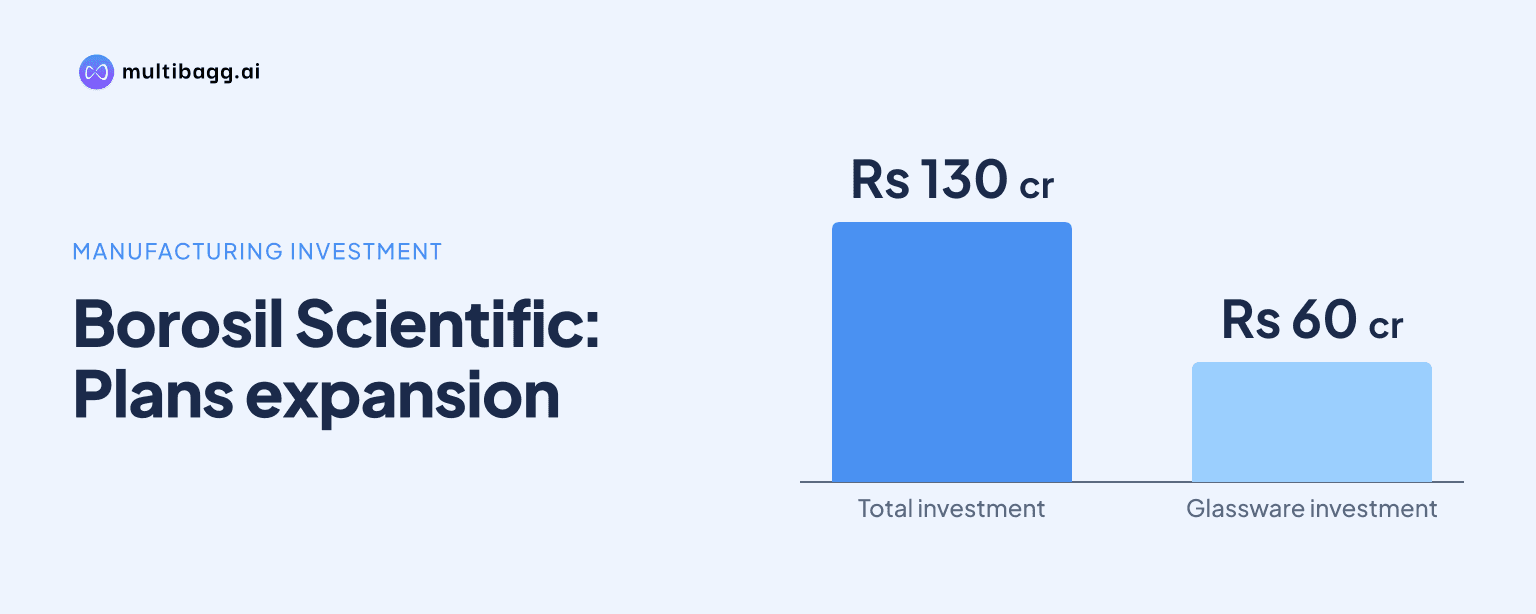
Borosil Scientific plans up to Rs 130 crore of manufacturing investment through a Rs 60 crore glassware expansion and a borosilicate 3.3 glass-tubing furnace costing up to Rs 70 crore. The glassware project would raise annual capacity from about 15 lakh units to about 108 lakh units, while the furnace is planned at about 20 metric tonnes a day.
Know Borosil Scientific inside out
Results, valuation, peers and who's buying, in one view.
What does BSL's Rs 60 crore glassware project involve?
BSL proposes to spend Rs 60 crore to lift glassware manufacturing capacity from about 15 lakh units per annum to about 108 lakh units per annum. This would add about 93 lakh units of annual capacity and take output to 7.2 times the current level, with commercial production expected in March 2027.
BSL says the additional capacity is intended to serve increasing demand from Borosil Limited and expected expansion in laboratory glassware. The company also says the project will build on existing manufacturing infrastructure that contributes to revenue and plant utilisation, while creating infrastructure for future Scientific Products portfolio expansion.
BSL expects the investment to enhance its overall return on capital employed, or ROCE, but does not provide a target ROCE or expected return from the Rs 60 crore project. It proposes to fund the expansion through internal accruals and borrowings and may apply for subsidy support under the Viksit Gujarat Industrial Policy 2026, subject to availability and eligibility.
Why is BSL building a borosilicate 3.3 glass-tubing furnace?
BSL plans a greenfield borosilicate 3.3 glass-tubing furnace with proposed installed capacity of about 20 metric tonnes per day. The project is intended primarily to provide tubing for captive use in BSL's glassware manufacturing, reducing the company's dependence on imported tubing.
The furnace has planned capital expenditure of up to Rs 70 crore and is expected to begin commercial production by 31 March 2028. Its planned start follows the March 2027 target for the glassware expansion, creating a later domestic source of tubing for the enlarged glassware operation.
BSL identifies supply-chain reliability, material availability and quality control as the reasons for the backward-integration project. It also says the furnace has the potential to optimise manufacturing costs, although the presentation does not quantify expected savings, imported volumes replaced or the share of tubing needs that captive output would meet.
Surplus tubing may be sold in the external market after captive requirements are served. Funding is planned through internal accruals and/or borrowings, and BSL intends to apply for eligible subsidy benefits under the Viksit Gujarat Industrial Policy 2026, subject to applicable eligibility.
How will BSL fund its manufacturing investments?
BSL's two announced projects have combined planned spending of up to Rs 130 crore, comprising Rs 60 crore for glassware capacity and up to Rs 70 crore for the tubing furnace. The glassware project specifies internal accruals and borrowings, while the furnace permits internal accruals and/or borrowings.
BSL reported standalone net debt of Rs 133.9 crore at the end of Q2FY27, compared with Rs 143.3 crore at the end of Q1FY27 and Rs 113.8 crore at the end of Q2FY26. Consolidated net debt was Rs 129.5 crore at the Q2FY27 period end, against Rs 136.8 crore in Q1FY27 and Rs 107.6 crore a year earlier.
The projects have different operating purposes despite their shared funding sources. The Rs 60 crore project increases finished-glassware output for Borosil Limited demand and laboratory-glassware expansion, whereas the furnace aims to supply a key material input, borosilicate 3.3 tubing, primarily within BSL's manufacturing chain.
Potential Gujarat policy support is not described as committed funding for either project. BSL says only that it proposes or intends to apply for benefits on eligible investment, leaving the amount, availability and approval of any subsidy unresolved.
Got a follow-up? Ask IRIS
What sales trends support BSL's capacity plans?
BSL reported consolidated Scientific Segment sales of Rs 147.4 crore in H1FY27, up 7.8% from Rs 136.7 crore in H1FY26. Within the segment, Process System sales increased 36.1% to Rs 21 crore, Lab Equipments rose 14.2% to Rs 23.6 crore, and Lab Consumables increased 2.2% to Rs 102.9 crore.
For Q2FY27, Scientific Segment sales rose 8.3% year on year to Rs 79.1 crore from Rs 73 crore. Process System recorded the fastest quarterly increase, rising 64.6% to Rs 12.4 crore, while Lab Consumables reached Rs 55.3 crore and Lab Equipments were unchanged year on year at Rs 11.3 crore.
Primary Pharma Packaging sales increased 26.6% to Rs 44 crore in H1FY27 from Rs 34.8 crore in H1FY26. Consumer Glassware moved differently, declining 3.5% to Rs 30.3 crore from Rs 31.4 crore, and BSL changed its internal reporting structure during the quarter ended 30 September 2026 to review Consumer Glassware separately.
BSL says Lab Consumables revenue was affected by Ind AS 115, the Indian Accounting Standard governing revenue from contracts with customers. Excluding that effect, management says H1FY27 Lab Consumables growth was 6.3%, compared with reported growth of 2.2%, while growth across all product categories was 10.7%, against reported growth of 9.3%.
What financial performance frames BSL's investment programme?
BSL's consolidated net sales increased 9.3% year on year to Rs 221.7 crore in H1FY27, while earnings before interest, tax, depreciation and amortisation, or EBITDA, rose 37.8% to Rs 19.8 crore. Consolidated EBITDA margin rose to 8.9% from 7.1%, and profit after tax was Rs 9.7 crore compared with a Rs 1.4 crore loss in H1FY26.
Standalone sales rose 8.3% to Rs 204.1 crore in H1FY27, but standalone EBITDA increased 1.3% to Rs 23.2 crore and EBITDA margin declined to 11.4% from 12.2%. BSL attributes the pressure on standalone profitability in Q2FY27 and H1FY27 to higher input costs arising from geopolitical tensions in the Middle East.
Management's medium-term target is revenue compound annual growth of 12% to 14%. Its stated margin-improvement actions include greater emphasis on Process Sciences and laboratory equipment, annual pricing, expense control, renewable energy and margin improvement from backward integration through the borosilicate 3.3 glass furnace.
Conclusion
BSL's proposed manufacturing programme pairs a major increase in finished-glassware capacity with a domestic source of borosilicate 3.3 tubing. The glassware project would expand capacity from about 15 lakh to about 108 lakh units annually, while the furnace is intended to reduce imported-tubing reliance and improve supply reliability, availability and quality control.
The next disclosed milestones are commercial production of the glassware expansion in March 2027 and of the tubing furnace by 31 March 2028. Investors can also watch the use of internal accruals and borrowings, eligibility for any Gujarat policy subsidy, and management's stated aim for backward integration to contribute to margin improvement.