










Borosil Scientific targets 12-14% CAGR through expansion
Key highlights
- Borosil Scientific is targeting medium-term revenue growth of 12% to 14% CAGR through LabQuest, Process Sciences, exports and customer expansion.
- Process equipment has a serviceable addressable market of Rs 1,242 crore and estimated growth of 12% to 14%.
- The proposed borosilicate 3.3 glass-tubing furnace will have capacity of about 20 metric tonnes a day, with capital expenditure of up to Rs 70 crore and commercial production expected by 31 March 2028.
- Key pharmaceutical customers account for 17.8% of the Scientific segment mix, while other pharmaceutical customers account for 16.4%.
powered by IRIS
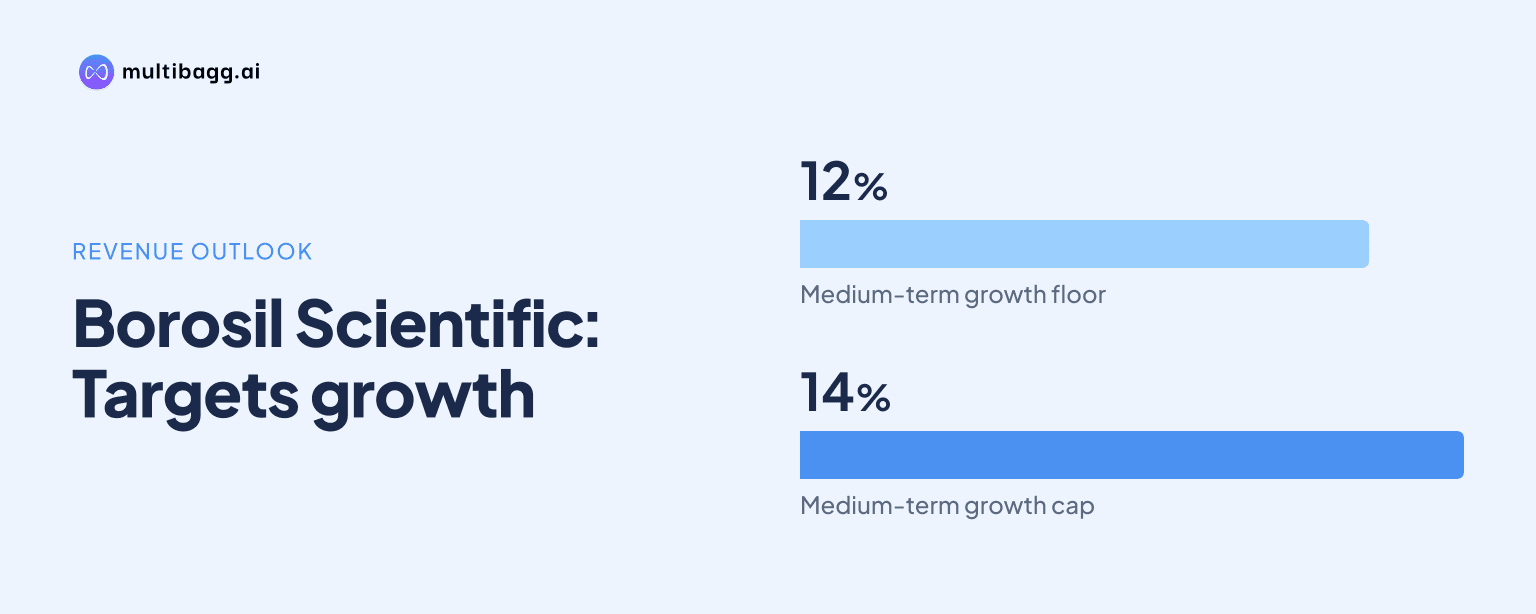
Borosil Scientific targets medium-term revenue compound annual growth rate (CAGR) of 12-14%, supported by planned expansion in LabQuest, Process Sciences, exports and customer coverage. Management also plans to improve earnings before interest, tax, depreciation and amortisation (EBITDA) margins through higher-profit-margin equipment and process systems, annual pricing, renewable energy and a proposed capital expenditure of up to Rs 70 crore for a tubing furnace.
Know Borosil Scientific inside out
Results, valuation, peers and who's buying, in one view.
How does Borosil Scientific plan to achieve 12-14% growth?
Borosil Scientific plans to pursue its 12-14% medium-term revenue CAGR target by sustaining its leading market presence in pharmaceutical laboratory glassware, expanding exports across product categories, broadening LabQuest and Process Sciences, and acquiring new customers. Management says LabQuest and Process Sciences will widen the range sold to existing clients, while new customers and product diversification are intended to broaden the revenue base.
The plan spans several customer segments rather than relying on one end market. Key pharmaceutical customers represent 17.8% of the Scientific segment mix and other pharmaceutical customers account for 16.4%, while research, chemical and allied industries, food and feed, and cement and steel each account for 14.0%. Dairy and beverage, government, and health and education each represent 3.3%, supporting management’s stated focus on wider customer coverage.
Which Indian markets does Borosil Scientific address?
Borosil Scientific identifies laboratory equipment as the largest total addressable market, or TAM, it discloses at Rs 4,800 crore, while pharmaceutical primary packaging has the largest stated serviceable addressable market, or SAM, at Rs 1,377 crore. TAM refers to the full relevant market cited in the presentation, while SAM is the portion Borosil Scientific identifies as serviceable.
The market-growth estimates differ across the portfolio. Laboratory glassware and consumables and laboratory equipment are estimated to grow by 6% to 8%, pharmaceutical primary packaging by 9% to 10%, and process equipment by 12% to 14%. The lower end of the process-equipment range is 6 percentage points above the lower end of the laboratory categories, aligning with management’s emphasis on Process Sciences.
Why are Process Sciences and LabQuest central to the plan?
Process Sciences and LabQuest are central because Borosil Scientific intends to use them to broaden its offering to existing clients, while management identifies process systems and laboratory equipment as higher-profit-margin areas. Process equipment has a stated SAM of Rs 1,242 crore against a TAM of Rs 1,362 crore, and its estimated growth range of 12% to 14% exceeds the 6% to 8% estimate for laboratory equipment.
LabQuest is linked to a different market profile from Process Sciences. Laboratory equipment has the larger TAM of Rs 4,800 crore but a SAM of Rs 755 crore, compared with process equipment’s TAM of Rs 1,362 crore and SAM of Rs 1,242 crore. Management’s plan therefore combines a laboratory-equipment opportunity with process equipment, which has the presentation’s highest stated market-growth range.
Got a follow-up? Ask IRIS
How does Borosil Scientific plan to improve EBITDA margins?
Borosil Scientific plans to improve EBITDA margins by placing greater emphasis on Process Sciences and laboratory equipment, which management describes as high-profit-margin categories. Its other stated levers are improving margins in laboratory glassware and consumables, maintaining an annual pricing strategy, controlling expenses vigilantly, focusing on renewable energy and gaining from backward integration through a borosilicate 3.3 glass furnace.
The presentation gives no numerical EBITDA margin target, base margin or deadline for margin improvement, unlike its explicit 12% to 14% revenue CAGR goal. Annual pricing, expense control and renewable energy are presented as operating measures, while the furnace is intended to provide a manufacturing and supply-chain mechanism. The project specifically concerns tubing used in glassware manufacturing.
What will the borosilicate tubing furnace contribute?
The proposed greenfield borosilicate 3.3 glass-tubing furnace is intended to reduce dependence on imported tubing, improve supply-chain reliability and availability, strengthen quality control and potentially optimise manufacturing costs. Borosil Scientific proposes installed capacity of about 20 metric tonnes a day, primarily for captive use in glassware manufacturing, although surplus output may be sold in the external market.
The project has planned capital expenditure of up to Rs 70 crore and expected commercial production by 31 March 2028. Borosil Scientific expects to fund it through internal accruals and/or borrowings and intends to apply for eligible subsidy benefits under the Viksit Gujarat Industrial Policy 2026. Management states that any subsidy remains subject to applicable eligibility.
Conclusion
Borosil Scientific’s strategy combines wider sales coverage through LabQuest, Process Sciences, exports and new customers with a margin plan based on product mix, pricing, cost control, renewable energy and backward integration. Process equipment stands out in the disclosed opportunity set with estimated market growth of 12% to 14%, above the 6% to 8% range for laboratory glassware, consumables and laboratory equipment.
The next item to watch is execution of the borosilicate 3.3 glass-tubing furnace, which is expected to commence commercial production by 31 March 2028 after capital expenditure of up to Rs 70 crore. Its contribution to supply availability, manufacturing costs and margins will depend on commissioning, captive consumption, possible external sales and eligibility for the proposed policy support.