










Bosch Limited expects a more modest second half after record Q2
Key highlights
- Bosch standalone revenue rose 28.6% year on year to Rs 6,164.1 crore in July-September 2026.
- Bosch management expects flat to modest Q3 FY27 growth against a high prior-year base.
- RBIC revenue rose 27.9% to Rs 1,506.2 crore in Q2, while EBITDA grew 4.7% to Rs 234.4 crore.
- Bosch spent Rs 350 crore on capital expenditure in the first half of FY27.
powered by IRIS
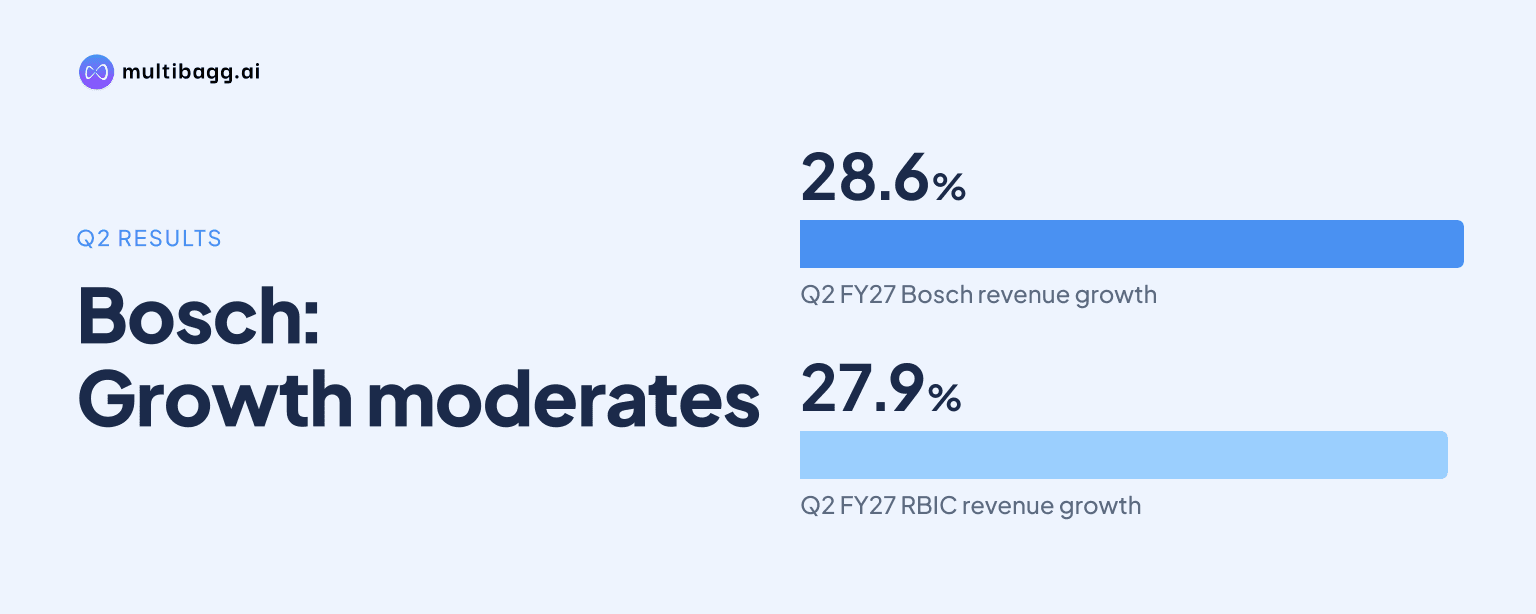
Bosch Limited expects FY27’s second half to be more modest after July-September 2026 standalone revenue rose 28.6% year on year to Rs 6,164.1 crore. Management cited inflation, weak and uneven monsoon conditions, tighter interest rates and a high comparison base, saying the moderation is likely to extend beyond tractors to other vehicle segments.
Know Bosch inside out
Results, valuation, peers and who's buying, in one view.
Why does Bosch expect demand to moderate in the second half?
Bosch expects a more modest second half because inflation, weak monsoons and higher interest rates are weighing on demand after several strong quarters. Managing Director Guruprasad Mudlapur said the October 2026 repo-rate increase of 25 basis points to 5.50%, elevated energy prices and uneven rainfall have created multiple pressures, particularly on farm sentiment and tractor demand.
The caution is not confined to tractors. Bosch said tractors had already moved to modest growth, while passenger vehicles, commercial vehicles and two-wheelers were also likely to follow a similar direction because of the high base in the corresponding prior-year quarter and normal demand cyclicality after a record Q2. Management’s formal outlook for Q3 FY27 was flat to modest growth relative to that high prior-year base.
How strong was Bosch’s July-September quarter?
Bosch delivered standalone revenue of Rs 6,164.1 crore in July-September 2026, up 28.6% from July-September 2025, led by product sales. The mobility business rose 30.3%, with Powertrain Solutions the principal contributor, followed by two-wheeler and aftermarket operations; consumer goods also gained from standard-line products, accessories, campaigns and e-commerce.
Standalone earnings before interest, tax, depreciation and amortisation, or EBITDA, rose 30.1% to Rs 802.8 crore in the quarter. Revenue growth supported the increase, although management said higher raw-material prices, particularly aluminium, partly offset the benefit. Profit after tax increased 21.7% and included a Rs 124 crore exceptional credit from reversing the provision for long-service awards after Bosch decided to discontinue that benefit globally from January 1, 2027.
Which businesses drove Bosch’s first-half growth?
Bosch’s mobility business grew 28% in April-September 2026 from the same six months of FY26, led by Powertrain Solutions and passenger-car demand. Vehicle Motion also benefited from the passenger-car market, while two-wheeler growth reflected higher production and increased sales of exhaust-gas sensors, fuel injectors and anti-lock braking systems, or ABS.
Consumer goods rose 19% in the first half as sales campaigns increased demand for standard-line products and accessories. In the July-September quarter, Power Tools grew across global tools, measuring tools, accessories, hand tools and outdoor-garden products. Bosch’s Chennai plant crossed cumulative production of 20 million power tools, while the business introduced personal protective equipment safety helmets and the PRO360 digital platform for users and sub-dealers.
Powertrain Solutions also sees regulatory activity supporting future product work. The CAFE Phase 3 rules take effect in April 2027, and Bosch said original equipment manufacturers, or OEMs, are aligning platform plans around ethanol blends, compressed natural gas, or CNG, and hybrid incentives. Management did not quantify the potential content-per-vehicle increase, but said Bosch was prepared to support the rules and had begun consultations on draft BS-VII requirements scheduled for 2029 for passenger cars and 2031 for commercial vehicles.
Got a follow-up? Ask IRIS
What does RBIC add, and what is pressuring margins?
Bosch consolidated Bosch Chassis Systems India Private Limited, referred to as RBIC, from July 1, 2026, bringing active safety, occupant safety and vehicle-motion products into its reported results. RBIC operates plants at Chakan, Sanand and Manesar and supplies ABS, electronic stability programmes, integrated braking systems, airbag control units, sensors and vehicle-motion software for internal-combustion, hybrid and electric vehicles.
RBIC reported July-September revenue of Rs 1,506.2 crore, up 27.9% year on year, driven by Vehicle Motion and Two-Wheeler & Powersports sales. Its EBITDA increased only 4.7% to Rs 234.4 crore, however, as aluminium and electronic-control-unit costs rose and the rupee depreciated against the euro. First-half EBITDA declined 5.1% to Rs 392 crore, against Rs 413.1 crore a year earlier, partly because of new ESP10 production-start costs and an additional ABS10M capacity line for two-wheelers.
Management said volume and the absorption of fixed costs are the primary margin drivers at RBIC, but commodity and foreign-exchange costs are recovered only with a timing lag where contracts allow. Chief Financial Officer Oslen Tillmann said Bosch is seeking to recover the whole cost increase but could not predict a 100% recovery because customers also face higher material costs. Management expects some short-term effects to persist for perhaps one more quarter and said recoveries should improve subsequent margins.
What are Bosch’s capital-spending and integration priorities?
Bosch had spent Rs 350 crore of capital expenditure in the first half of FY27, compared with roughly Rs 300 crore annually over each of the preceding three years, according to an analyst’s question. Tillmann said capital spending is seasonal, with a high share typically occurring in the third quarter, and that most FY27 investment is directed to plant and machinery upgrades that lift output from existing production lines.
The company is not presenting large immediate acquisition synergies from RBIC as a central earnings lever. Management said Bosch and RBIC already operated in similar ways within the Bosch mobility business, while capacity and customer deliveries had been the priority. It is now examining further optimisation, including localisation: RBIC will continue to obtain electronic control units from Bosch Automotive Electronics, while the subsidiary seeks to increase local content in other areas.
Conclusion
Bosch’s 28.6% standalone revenue increase to Rs 6,164.1 crore in July-September confirms broad Q2 momentum across powertrain, vehicle motion, two-wheelers, aftermarket and consumer goods. But management’s demand view is more restrained than the quarterly growth rate suggests: inflation, the 5.50% repo rate, weak rainfall and a high base are expected to temper FY27 second-half growth across tractors and other automotive categories.
The next indicators are Q3 volume trends, the pace of commodity and currency cost recovery at RBIC, and capital spending that management said is weighted towards the third quarter. Investors will also watch for Bosch’s future disclosure on CAFE Phase 3 content per vehicle before the regulation takes effect in April 2027, and for the record date if shareholders approve the proposed three-for-one bonus issue and Rs 10-to-Rs 2 share split.