










Bosch revenue rises 28.2% as mobility sales gain 29.8%
Key highlights
- Bosch reported Jul-Sep 2026 consolidated revenue of Rs 7,655.1 crore, up 28.2% year on year.
- Bosch mobility solution sales increased 29.8% to Rs 6,813 crore in Jul-Sep 2026.
- Bosch consumer goods sales rose 17.1% to Rs 511.3 crore in the September quarter.
- Bosch consolidated PAT increased 18.5% to Rs 840.5 crore in Jul-Sep 2026.
powered by IRIS
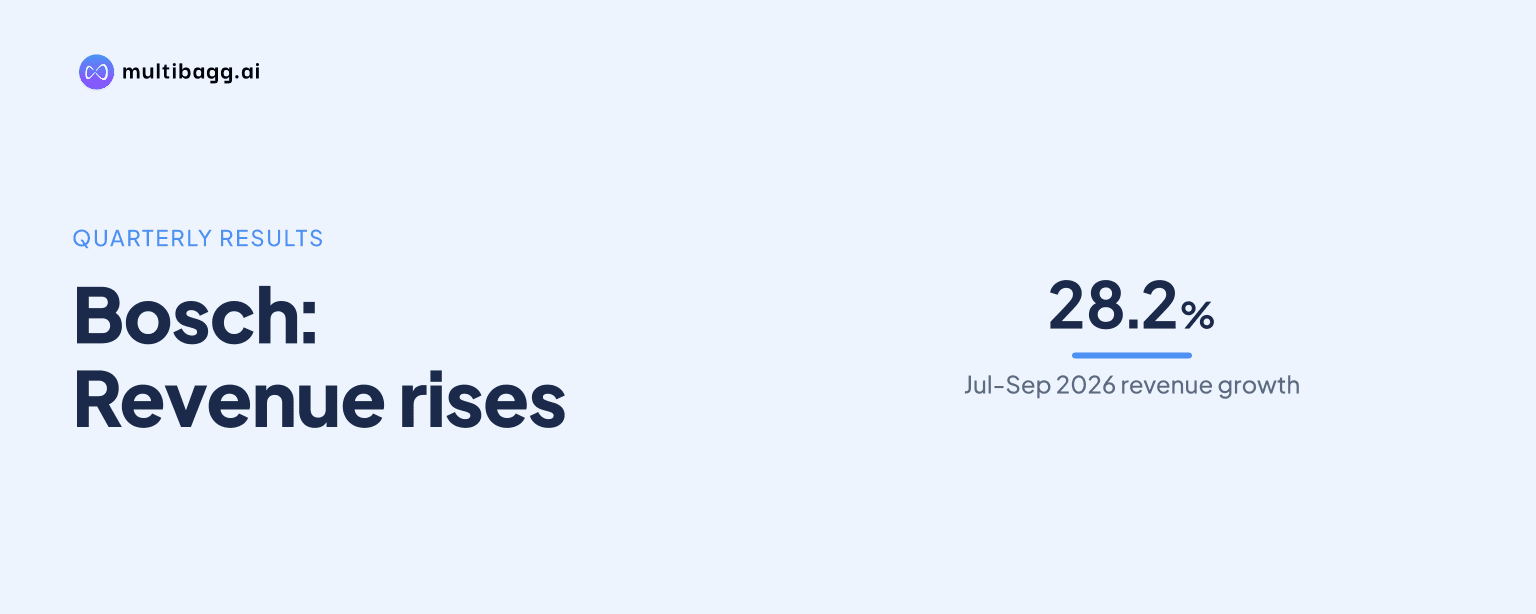
Bosch Limited reported consolidated revenue from operations of Rs 7,655.1 crore for Jul-Sep 2026, up 28.2% from Rs 5,969.4 crore a year earlier, with mobility solution sales rising 29.8% to Rs 6,813 crore. Consumer goods sales also increased 17.1% to Rs 511.3 crore in the quarter.
Know Bosch inside out
Results, valuation, peers and who's buying, in one view.
How did Bosch’s consolidated revenue change in the September quarter?
Bosch’s consolidated revenue from operations rose by Rs 1,685.7 crore between Jul-Sep 2025 and Jul-Sep 2026. Revenue reached Rs 7,655.1 crore in the latest quarter, compared with Rs 5,969.4 crore in the corresponding prior-year period. The presentation labels the comparison as Q-on-Q, although the reported periods are one year apart.
The six-month comparison also showed higher revenue, although growth was lower than in the quarter. Apr-Sep 2026 consolidated revenue was Rs 14,821.8 crore, up 25.0% from Rs 11,856.2 crore in Apr-Sep 2025. The quarterly rate of 28.2% was therefore 3.2 percentage points above the six-month rate.
Which Bosch businesses drove September-quarter sales growth?
Bosch’s mobility solution sales were the largest disclosed contributor to the increase, rising 29.8% to Rs 6,813 crore in Jul-Sep 2026 from Rs 5,248.1 crore a year earlier. The business grew across Power Solutions, Vehicle Motion, Mobility Aftermarket and the two-wheeler segment, rather than through a single disclosed activity.
Power Solutions recorded the fastest named increase at 36.4%, followed by Vehicle Motion at 34.9%. Mobility Aftermarket grew 13.2%, while the two-wheeler segment increased 17.7%. Bosch attributed Power Solutions growth to demand in passenger-car and commercial-vehicle segments, and linked Vehicle Motion growth to buoyant four-wheeler demand.
Consumer goods sales increased by Rs 74.6 crore to Rs 511.3 crore, a 17.1% gain from Rs 436.7 crore. Bosch cited e-commerce and accessory sales as the drivers. Mobility sales growth exceeded consumer goods growth by 12.7 percentage points, while both disclosed sector groups expanded in the quarter.
What happened to Bosch’s profit and operating earnings?
Bosch reported consolidated earnings before interest, taxes, depreciation and amortisation, or EBITDA, of Rs 1,037.1 crore for Jul-Sep 2026, compared with Rs 841.7 crore a year earlier. EBITDA increased 23.2%, which was below the 28.2% rise in quarterly revenue. Bosch said absolute EBITDA growth was mainly driven by revenue growth and was partly offset by higher raw-material costs.
Consolidated profit after tax, or PAT, rose 18.5% to Rs 840.5 crore from Rs 708.4 crore. Bosch attributed the quarterly PAT increase to improved EBITDA. The presentation does not disclose an EBITDA margin or a quarterly breakdown of other income, finance costs or taxes, so it does not quantify the factors behind the difference between revenue, EBITDA and PAT growth rates.
For Apr-Sep 2026, EBITDA rose 20.6% to Rs 2,015.9 crore from Rs 1,671.4 crore. However, six-month PAT fell 13.1% to Rs 1,654.1 crore from Rs 1,901.6 crore. Bosch said the prior-year period included an exceptional profit on the sale of the BT business, which affected the year-on-year PAT comparison.
Got a follow-up? Ask IRIS
What production trends supported Bosch’s automotive businesses?
Bosch cited Society of Indian Automobile Manufacturers, or SIAM, data showing automotive production excluding two-wheelers of 2.829 million units in Q2 FY27. That was 24% above Q2 FY26 and 15% above Q1 FY27. The company said positive domestic demand and a low-base effect supported the Indian automotive sector during the quarter.
Heavy commercial vehicle production had the fastest year-on-year growth among the listed non-two-wheeler categories, increasing 37% to 133,000 units. Light commercial vehicles rose 32% to 227,000 units, three-wheelers increased 25% to 440,000 units, and tractors grew 8% to 349,000 units. Total Q2 FY27 production across these categories was 2.829 million units.
Two-wheeler production was 8.126 million units in Q2 FY27, up 16% year on year and 11% from Q1 FY27. Bosch linked its two-wheeler sales growth to favourable product mix and pre-festive original equipment manufacturer demand. For Apr-Sep FY27, two-wheeler production reached 15.417 million units, up 19% from the corresponding previous period.
What product and regulatory developments did Bosch disclose?
Bosch disclosed more than 10 million cumulative deliveries of Electronic Product Modules, or EPM4, in its two-wheeler and PowerSports business. It also supported the launch of a 160 cubic-centimetre motorcycle with integrated engine-management systems and anti-lock braking systems after a nine-month development cycle, alongside systems deployed on a new 585 cubic-centimetre multi-cylinder motorcycle platform.
In Mobility Aftermarket, Bosch said its workshop network exceeded 5,000 and that it launched passenger-car clutch and suspension components. Its Power Tools business surpassed 20 million power tools produced at the Chennai plant. Bosch also listed launches including a measuring wheel, moisture meter, GLM50 compact device, magnetic drill and safety helmets.
Bosch said Corporate Average Fuel Efficiency, or CAFE, Phase 3 has been finalised and notified for rollout in April 2027. It also cited draft Bharat Stage 7, or BS7, implementation dates of 2029 for passenger cars and 2031 for commercial vehicles. These are regulatory timelines rather than Bosch revenue or earnings forecasts.
Conclusion
Bosch’s September-quarter results showed growth in both disclosed sector groups, led by a 29.8% increase in mobility solution sales and a 17.1% rise in consumer goods sales. Consolidated revenue grew 28.2%, while EBITDA and PAT increased 23.2% and 18.5%, respectively, with higher raw-material costs partly offsetting the operating benefit of higher revenue.
The next reported period will show whether passenger-car, commercial-vehicle and two-wheeler production trends remain supportive after pre-festive demand. Management’s disclosed April 2027 CAFE Phase 3 rollout, the draft BS7 timetable and the commercial progression of validated compressed natural gas direct injection technology are longer-term developments to watch.