










Bosch Limited Q2 FY27 Revenue Rises 28.2% to ₹7,655 Crore
Key highlights
- Bosch reported Q2 FY27 consolidated revenue of ₹7,655.10 crore, up 28.2% year-on-year.
- Consolidated Q2 FY27 profit after tax rose 18.5% to ₹840.50 crore, including a ₹130.40 crore provision reversal.
- Bosch's mobility business grew 29.8% in Q2 FY27, supported by passenger vehicle and commercial vehicle demand.
- RBIC's first-half FY27 EBITDA declined 5.1% amid raw-material and production start-up costs.
powered by IRIS
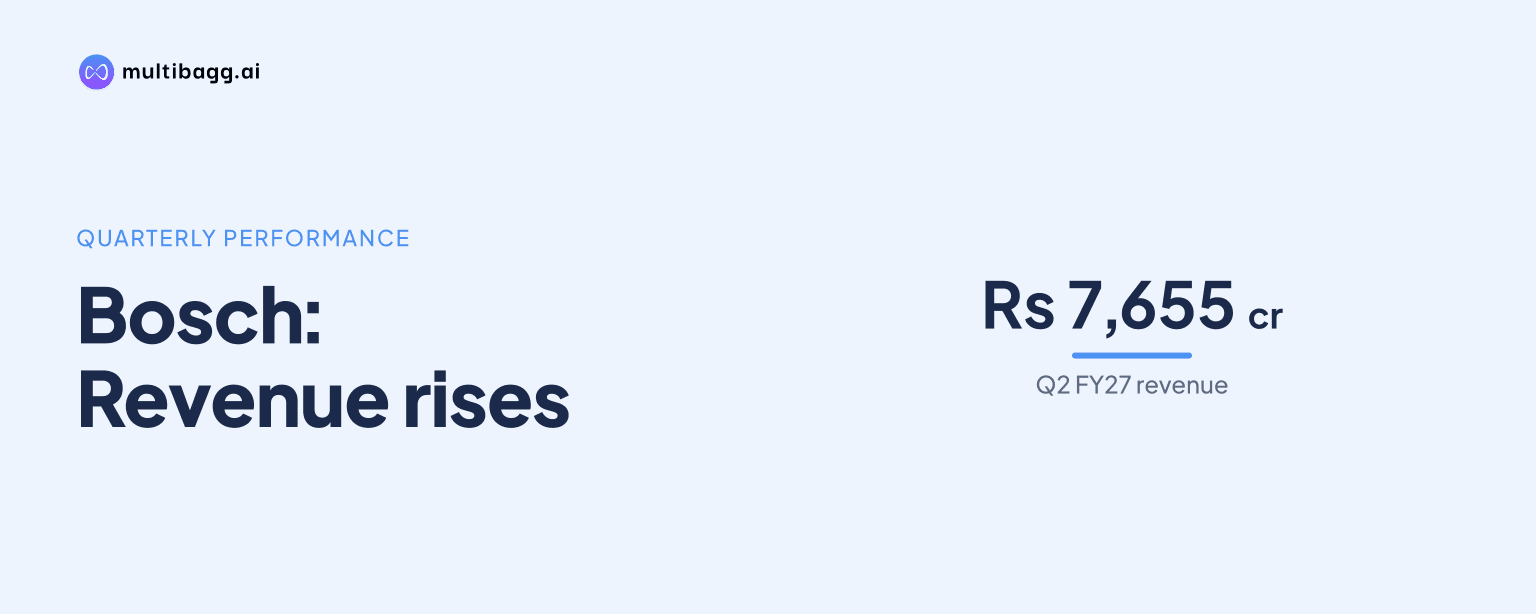
Bosch Limited reported consolidated revenue of ₹7,655.10 crore in Q2 FY27, a 28.2% year-on-year increase, supported by demand in power solutions and vehicle motion and the first-time inclusion of RBIC from July 1, 2026. Consolidated profit after tax rose 18.5% to ₹840.50 crore.
Know Bosch inside out
Results, valuation, peers and who's buying, in one view.
How did Bosch perform in Q2 FY27?
Bosch delivered broad-based growth during the September 2026 quarter, with consolidated revenue rising from ₹5,969.40 crore in Q2 FY26 to ₹7,655.10 crore. Revenue was also 6.81% higher sequentially than ₹7,166.70 crore reported in the preceding quarter. The mobility business grew 29.8% year-on-year, helped by demand across passenger vehicles and commercial vehicles during the festive period.
Consolidated EBITDA increased 23.2% year-on-year to ₹1,037.10 crore. Profit after tax rose to ₹840.50 crore from ₹708.40 crore a year earlier. The quarterly profit included a provision reversal of ₹130.40 crore, according to the earnings summary. On a standalone basis, Bosch reported revenue of ₹6,164.10 crore, up 28.6%, and profit after tax of ₹674.60 crore, up 21.7%.
What drove Bosch's revenue growth during the quarter?
Bosch's revenue growth was led by its power solutions and vehicle motion businesses, while the mobility business benefited from market demand and festive-season momentum. The passenger car and commercial vehicle segments were specifically identified as contributors to the 29.8% growth in mobility operations.
The consolidation of Bosch Chassis Systems India, referred to as RBIC, also added to reported revenue. Bosch acquired RBIC effective July 1, 2026, making Q2 FY27 the first quarter in which its financial performance was included in the consolidated results. RBIC's own operations recorded 27.9% growth for the quarter, according to the company summary.
Management said the RBIC integration had been completed successfully. However, it did not identify substantial incremental synergy opportunities because RBIC was already a Bosch Group company and operated in a manner similar to Bosch before the acquisition.
Why did RBIC margins face pressure?
RBIC's EBITDA for the first half of FY27 declined 5.1% year-on-year, reflecting higher raw-material costs and one-time start-up costs associated with new production lines. Management also cited foreign-exchange effects, capacity-expansion investments and a change in the depreciation method as factors affecting margins.
Managing Director Guruprasad Mudalapur said the margin effects were short-term and could continue for another quarter before returning to earlier levels. He added that several costs are passed through or recoverable, meaning the current quarter should not be viewed as representative of the business's normal profitability.
Higher aluminium prices were among the raw-material pressures mentioned during the call. This is relevant for automotive component suppliers because the timing of cost recovery from customers can affect reported margins even where commercial arrangements allow eventual pass-throughs.
Got a follow-up? Ask IRIS
What is Bosch's outlook for the second half of FY27?
Bosch expects flat to modest growth in the second half of FY27, as a high comparison base, uneven monsoon conditions, inflation and tighter interest rates may constrain demand. Management indicated that the first half's growth rate should not be treated as a guide to the remainder of the financial year.
The company specifically highlighted weak monsoon conditions as a pressure point for tractor demand. Management noted that tractors were already recording modest growth and said other segments could follow a similar direction, particularly after several quarters of stronger performance.
Bosch said it is positioned to support the CAFE 3 norms, which are scheduled to take effect from April 2027. The regulatory transition is important for automotive suppliers because it requires vehicle manufacturers to meet tighter fuel-efficiency and emission-related requirements. Bosch's technology platform is intended to support customers through that change.
What should investors track after Bosch's Q2 results?
Investors will be watching whether revenue momentum in mobility continues as demand conditions become more moderate. The stated outlook links the second half to vehicle-market conditions, tractor demand and the high base from the same period of the preceding year, rather than providing a numerical revenue forecast.
Margin recovery at RBIC is another material operating point. Management expects temporary effects from foreign exchange, aluminium costs, capacity investment and depreciation changes to persist for about one more quarter. The timing and extent of recovery will influence the consolidated profitability contribution from the acquired business.
The board also approved a 3:1 bonus share issue and a stock split, subject to applicable processes and disclosures. Separately, Bosch said capital expenditure is typically seasonal, with higher spending in the third quarter. The Bosch TACO joint venture in Nasik is being established and is expected to begin production in the middle of the next year after receiving global merger-control clearances.
Conclusion
Bosch's Q2 FY27 results showed strong revenue and profit growth, driven by automotive demand and the inclusion of RBIC in consolidated accounts. Revenue rose 28.2% to ₹7,655.10 crore and profit after tax increased 18.5% to ₹840.50 crore, although the profit figure included a ₹130.40 crore provision reversal and RBIC faced temporary margin pressure.
The next key disclosures will be Bosch's third-quarter performance, progress in RBIC margin normalisation and capital expenditure trends. Investors will also track demand in tractors and other vehicle segments, the planned mid-next-year start of production at the Bosch TACO joint venture, and preparations for CAFE 3 norms from April 2027.