










Bosch Q3 forecast signals a 19% production drop from Q2
Key highlights
- Bosch forecast Q3 FY27 production excluding two-wheelers at 2.299 million units, 530,000 below Q2 FY27.
- Production excluding two-wheelers reached 2.829 million units in Q2 FY27, up 24% year on year.
- Heavy commercial vehicle production rose 37% year on year to 133,000 units in Q2 FY27.
- Two-wheeler production reached 8.126 million units in Q2 FY27, up 16% year on year.
powered by IRIS
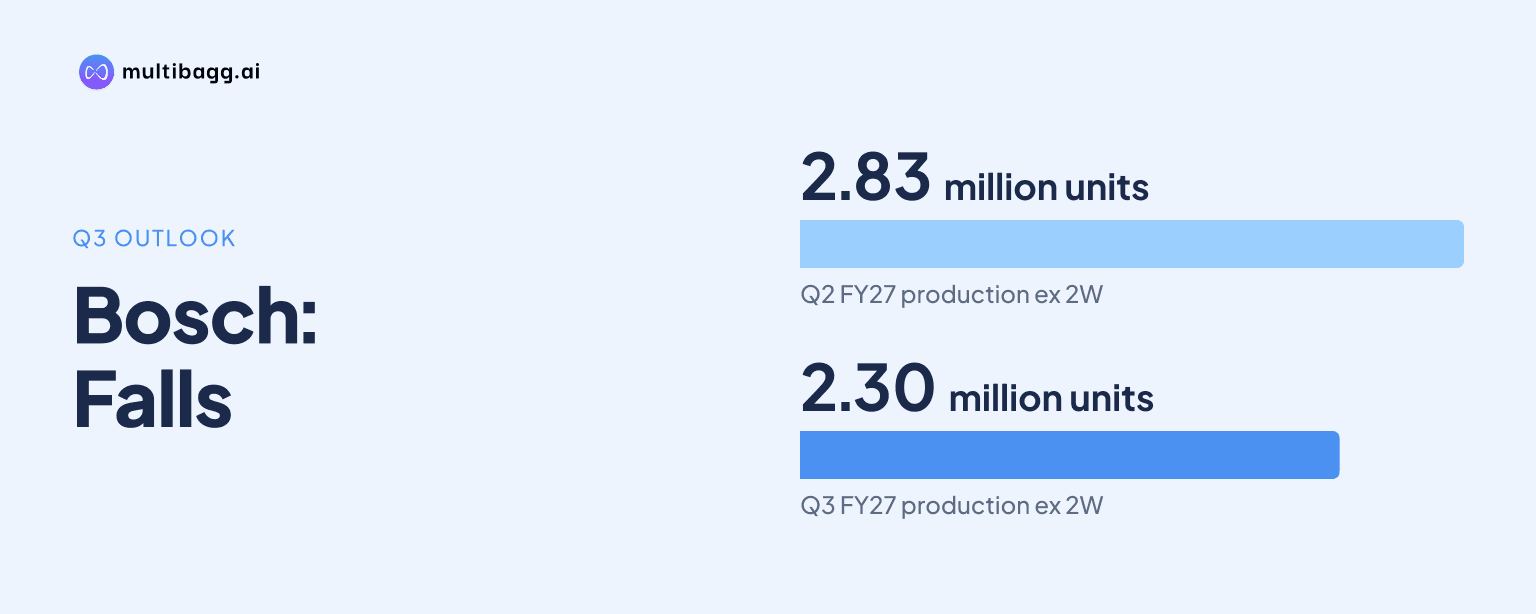
Bosch Limited’s Q3 FY27 industry production forecast is 2.299 million units, 19% below the 2.829 million units reported for Q2 FY27, which was 24% above Q2 FY26. The production series excludes two-wheelers, and Bosch’s presentation identifies positive domestic demand and a low base effect as factors behind the completed Q2 result.
Know Bosch inside out
Results, valuation, peers and who's buying, in one view.
Why is Bosch forecasting lower production in Q3 FY27?
Bosch forecasts 2.299 million units for Q3 FY27, a sequential reduction of 530,000 units from Q2 FY27’s 2.829 million units. The forecast follows two consecutive increases in the quarterly series, from 2.463 million units in Q1 FY27 to 2.829 million in Q2 FY27, or 15% growth between those two quarters.
The forecast is also below the 2.337 million units recorded in Q3 FY26 and marginally below the 2.300 million units in Q2 FY26. It therefore does not carry Q2 FY27’s higher production level into the following quarter; instead, it points to a volume level broadly in line with comparable FY26 quarters. Bosch does not disclose a category-specific or market-specific reason for the Q3 FY27 forecast.
Bosch says the Indian automotive sector ended Q2 FY27 positively because of domestic demand and a low base effect. That comment applies to the completed quarter, when total production was 24% higher year on year, rather than explaining the subsequent Q3 forecast. The presentation also states that the production series had a 7% compound annual growth rate from FY23 to FY26, excluding two-wheelers.
Which vehicle segments drove Q2 FY27 production growth?
Heavy commercial vehicles, or HCVs, posted the largest year-on-year increase among the listed categories, rising 37% to 133,000 units in Q2 FY27. Light commercial vehicles, or LCVs, rose 32% to 227,000 units, three-wheelers increased 25% to 440,000 units, and tractors grew 8% to 349,000 units.
The listed segments also recorded higher Q2 FY27 output than in the preceding quarter: three-wheelers were up 24%, while HCVs and LCVs each rose 19% and tractors increased 3%. Their combined Q2 volume was 1.149 million units, compared with the total production-series figure of 2.829 million units, which also includes passenger cars, or PCs, that are not separately quantified in the summary table.
For the first half of FY27, three-wheelers recorded the highest growth among the listed categories, rising 31% to 794,000 units. LCV production increased 27% to 418,000 units, HCV output rose 21% to 244,000 units, and tractor production increased 11% to 687,000 units. Total production excluding two-wheelers reached 5.292 million units, 21% above the first half of FY26.
Got a follow-up? Ask IRIS
How do two-wheelers compare with Bosch’s production series?
Two-wheeler production was substantially larger than the production series excluding two-wheelers, reaching 8.126 million units in Q2 FY27. That was 16% above Q2 FY26 and 11% above the prior quarter, while the separate total excluding two-wheelers was 2.829 million units and grew 24% year on year.
For the FY27 year-to-date period, two-wheeler production was 15.417 million units, up 19% from the comparable FY26 period. The production chart carrying Bosch’s 2.299 million-unit Q3 FY27 forecast is explicitly marked as excluding two-wheelers. As a result, that forecast should not be interpreted as an outlook for the two-wheeler category.
Bosch’s presentation uses PC, LCV, HCV, tractor and three-wheeler as the legend for the production series, while reporting two-wheelers in a separate row. The distinction matters because Q2 FY27’s 16% two-wheeler growth was lower than the 24% increase in the total excluding two-wheelers, and no Q3 FY27 two-wheeler forecast is disclosed on this page.
Does the production backdrop match Bosch’s sales performance?
Bosch’s consolidated revenue from operations rose 28.2% to Rs 7,655.1 crore in Jul-Sep 2026, alongside the Q2 FY27 production backdrop. Consolidated mobility-solutions sales rose 29.8% to Rs 6,813 crore from Rs 5,248.1 crore in Jul-Sep 2025, while consumer-goods sales increased 17.1% to Rs 511.3 crore from Rs 436.7 crore.
Management attributed mobility-solutions growth to Power Solutions, up 36.4%; Vehicle Motion, up 34.9%; Mobility Aftermarket, up 13.2%; and the two-wheeler segment, up 17.7%. It also cited demand in passenger cars and commercial vehicles, four-wheeler growth, favourable product mix and pre-festive original equipment manufacturer demand as drivers of quarterly revenue. The presentation does not quantify how much of the sales increase was directly linked to the production volumes.
In Apr-Sep 2026, consolidated revenue from operations increased 25.0% to Rs 14,821.8 crore from Rs 11,856.2 crore a year earlier. Mobility-solutions sales grew 28.0% to Rs 13,183.2 crore and consumer-goods sales grew 19.0% to Rs 1,032.1 crore. This first-half sales increase coincided with 21% growth in production excluding two-wheelers, although the Q3 forecast indicates a lower sequential volume level.
Conclusion
The production data show broad Q2 FY27 growth across three-wheelers, tractors and commercial vehicles, with HCVs and LCVs rising 37% and 32%, respectively. Yet the forecast of 2.299 million units for Q3 FY27 is 530,000 units below Q2’s 2.829 million, shifting the near-term industry volume signal from expansion to a sequential decline.
The next measure to watch is actual Q3 FY27 production against Bosch’s 2.299 million-unit forecast, particularly because the presentation does not identify the cause of the expected reduction. Management’s cited Q2 factors, including domestic demand, the low base effect and pre-festive original equipment manufacturer demand, provide the disclosed context for assessing whether the forecast is met.