










Bosch seeks ₹5,200 crore shareholder approval for RBAI deals
Key highlights
- Bosch seeks to raise its RBAI transaction ceiling by ₹1,200 crore, from ₹4,000 crore to ₹5,200 crore.
- The proposed limit includes up to ₹1,550 crore of secured RBAI loans at 9.2% annual interest.
- Bosch estimates ₹120 crore of interest income from the proposed RBAI loans.
- Bosch and RBIC reported ₹3,179.30 crore of RBAI transactions in FY 2025-26.
powered by IRIS
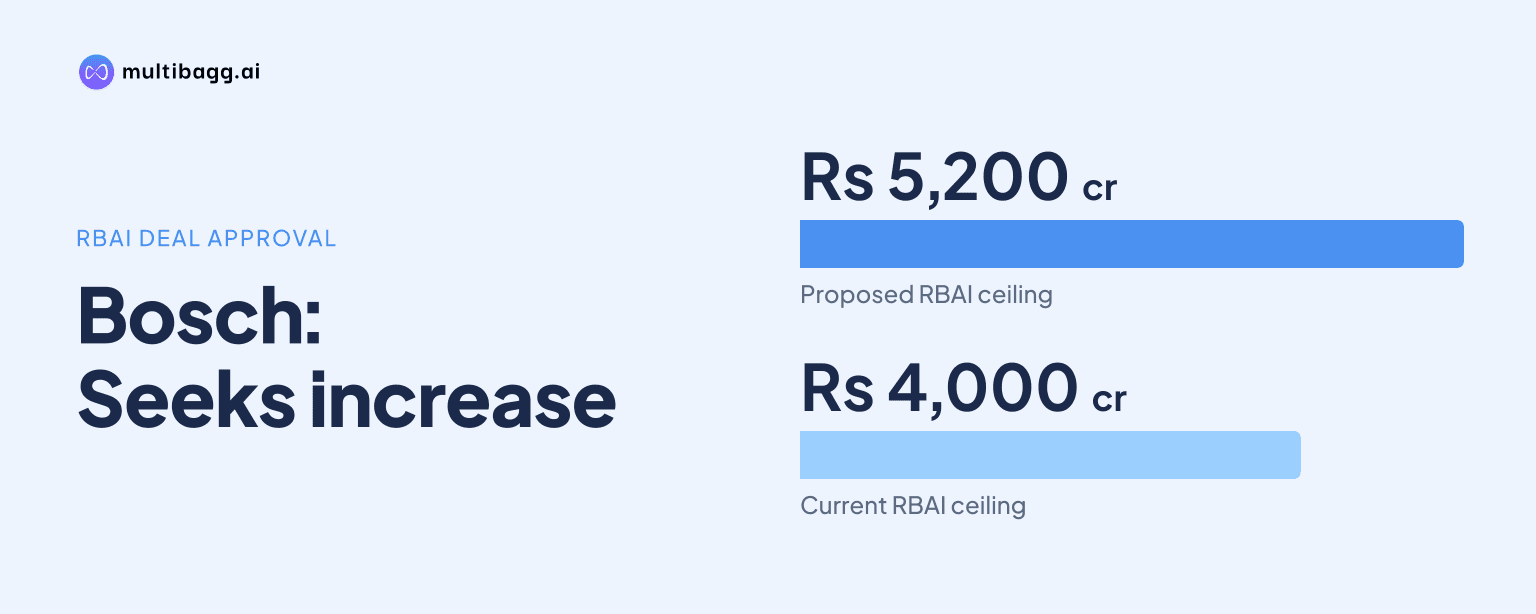
Bosch Limited is seeking shareholder approval for related-party transactions of up to ₹5,200 crore with Bosch Automotive Electronics India Private Limited from the 2026 Annual General Meeting, or AGM, to the 2027 AGM, including up to ₹1,550 crore of secured loans priced at 9.2% a year. The request would replace the ₹4,000 crore limit approved in August 2026.
Know Bosch inside out
Results, valuation, peers and who's buying, in one view.
Why is Bosch raising its RBAI transaction limit?
Bosch is seeking to raise the approved ceiling by ₹1,200 crore, from ₹4,000 crore to ₹5,200 crore. The company attributes the revision to growth in the automobile industry, increased customer demand and the aggregation of transactions by Bosch Chassis Systems India Private Limited, or RBIC, with Bosch Automotive Electronics India Private Limited, or RBAI, from July 1, 2026.
The proposed authority runs from the 2026 AGM to the 2027 AGM and covers transactions by Bosch and RBIC with RBAI. Bosch's share of the ceiling is ₹4,120 crore and RBIC's is ₹1,080 crore. Bosch says the category allocations are indicative and can vary between transaction types, but the aggregate cap cannot exceed ₹5,200 crore if shareholders approve the resolution.
Transactions excluding loans represent 18% of Bosch's consolidated turnover for FY 2025-26, according to the filing. They also represent 22% of RBIC's standalone turnover and 81% of RBAI's turnover for that year. Bosch identifies RBAI as a fellow subsidiary engaged in automotive electronic components and systems, including electronic control units, sensors and engineering support services.
What transactions are included in Bosch's ₹5,200 crore proposal?
Bosch's ₹5,200 crore proposal includes ₹3,650 crore for goods, services, rental and interest income, plus ₹1,550 crore for loans. Purchases of goods and other items form the largest commercial category at ₹3,155 crore, comprising ₹2,170 crore for Bosch and ₹985 crore for RBIC. Bosch says these goods are specialised automotive products involving proprietary know-how and intended for customer requirements in the automotive segment.
Sales of goods are capped at ₹225 crore, including ₹140 crore for Bosch and ₹85 crore for RBIC. Bosch's sale of goods includes assembly lines and automotive components, while its ₹85 crore service-sale allocation covers application and engineering services and sales support. The company says these activities can increase capacity utilisation and provide additional revenue.
Bosch also proposes up to ₹40 crore of purchases of services, comprising ₹30 crore for Bosch and ₹10 crore for RBIC. The disclosure identifies rental and other charges for a Chennai power-tools manufacturing plant for Bosch, and engineering services related to electronic control units for RBIC. Estimated rental income from land and factory buildings leased to RBAI is ₹25 crore, while estimated loan interest income is ₹120 crore.
All listed goods and services arrangements have a 12-month tenure and are proposed under omnibus approval. Bosch says intercompany goods and service prices are governed by transfer-pricing rules and generally use cost plus an appropriate margin supported by independent benchmarking. It says reimbursements are recovered at cost, while rental charges are benchmarked to prevailing market rates with year-on-year escalation.
What are the terms of Bosch's proposed RBAI loans?
Bosch proposes to give or renew loans to RBAI of up to ₹1,550 crore at an interest rate of 9.2% per annum. The company estimates the loans could generate ₹120 crore of interest income. The loans would be funded from reserves and surplus, and the filing says Bosch does not plan to incur financial indebtedness to provide them.
Each loan disbursement or renewal would mature 12 months from its date. Repayment is due one year after disbursement or earlier, while renewals would be based on mutually acceptable terms. Bosch states that the ultimate use of the funds would be RBAI's working-capital requirements and capacity expansion.
The proposed loans would be secured by a corporate guarantee from Robert Bosch GmbH, with a stated security coverage ratio of 100%. Bosch says it has not obtained a separate credit rating for RBAI because the full loan amount is guaranteed by the parent company. The filing records nil defaults by RBAI in the last financial year and nil defaults on borrowings during the prior three financial years.
The filing also reports nil for RBAI's subsisting non-performing asset classification, willful-defaulter status, insolvency or liquidation process, and applicable disqualifications under Section 29A of the Insolvency and Bankruptcy Code, 2016. The ₹1,550 crore loan limit is ₹750 crore above the ₹800 crore of loans given or renewed in FY 2025-26.
Got a follow-up? Ask IRIS
How do current RBAI dealings compare with the proposed limit?
Bosch and RBIC reported ₹3,179.30 crore of transactions with RBAI in FY 2025-26, compared with a proposed annual aggregate ceiling of ₹5,200 crore. Purchases of goods and other items were the largest FY 2025-26 category at ₹2,195.80 crore, followed by ₹800 crore of loans given or renewed. The proposal therefore provides a ceiling ₹2,020.70 crore above the prior year's reported total transactions.
For Apr-Sep 2026, Bosch and RBIC together reported ₹1,679.70 crore of transactions with RBAI. Bosch accounted for ₹1,138 crore and RBIC accounted for ₹541.70 crore. RBIC became a Bosch subsidiary on July 1, 2026, but the filing presents its full Apr-Sep 2026 figures, as well as its full FY 2025-26 figures, to provide comparative information.
RBAI reported FY 2025-26 turnover of ₹4,513.30 crore, a loss after tax of ₹3.90 crore and net worth of ₹415.10 crore. Bosch and RBAI each disclosed nil direct or indirect shareholding in the other. The filing also says no default was reported by RBAI concerning obligations under arrangements with Bosch or RBIC during the last financial year.
What shareholder approvals and safeguards apply to Bosch's plan?
Bosch's Audit Committee approved the proposed material related-party transactions on November 5, 2026, and the Board approved them on November 6, 2026. The Audit Committee reviewed the management information on proposed terms and pricing, as well as the certificate issued by the managing director and chief financial officer under related-party transaction industry standards.
Bosch says the Audit Committee concluded that the transactions would be in the ordinary course of business and at arm's length. No external valuation report was relied upon for the proposal. The company further disclosed that no director, key managerial personnel or their relatives had a direct or indirect financial interest in the resolution.
The transactions require prior member approval because they are material related-party transactions under Regulation 23 of the Securities and Exchange Board of India Listing Regulations. Related parties, whether or not they are parties to these transactions, cannot vote on Item No. 6. The Board has recommended that shareholders pass an ordinary resolution.
Conclusion
Bosch is seeking authority to raise its RBAI transaction ceiling by ₹1,200 crore to ₹5,200 crore, combining purchases, sales, services, rental, interest income and lending by Bosch and RBIC. Purchases of goods and other items account for ₹3,155 crore of the proposal, while the ₹1,550 crore lending component would carry 9.2% interest and a 100% corporate guarantee from Robert Bosch GmbH.
The next disclosed event is the shareholder vote at the 2026 AGM, which will determine whether the revised authority becomes effective through the 2027 AGM. If approved, investors can watch the use of the 12-month loan facilities for working capital and capacity expansion, as well as the extent to which transaction categories move within the fixed ₹5,200 crore aggregate limit.