










BRG toll backlog targets half of revenue as capital use falls
Key highlights
- BRG had nearly Rs 962 crore of toll-collection contracts in its Rs 1,755 crore order book at 30 September 2026.
- Management expects toll collection to contribute about 40% to 50% of FY27 revenue.
- BRG reported H1 FY27 revenue of about Rs 550 crore, up from Rs 342 crore in H1 FY26.
- Management said toll contracts require about 5% working capital, versus 15% to 20% for EPC work.
powered by IRIS
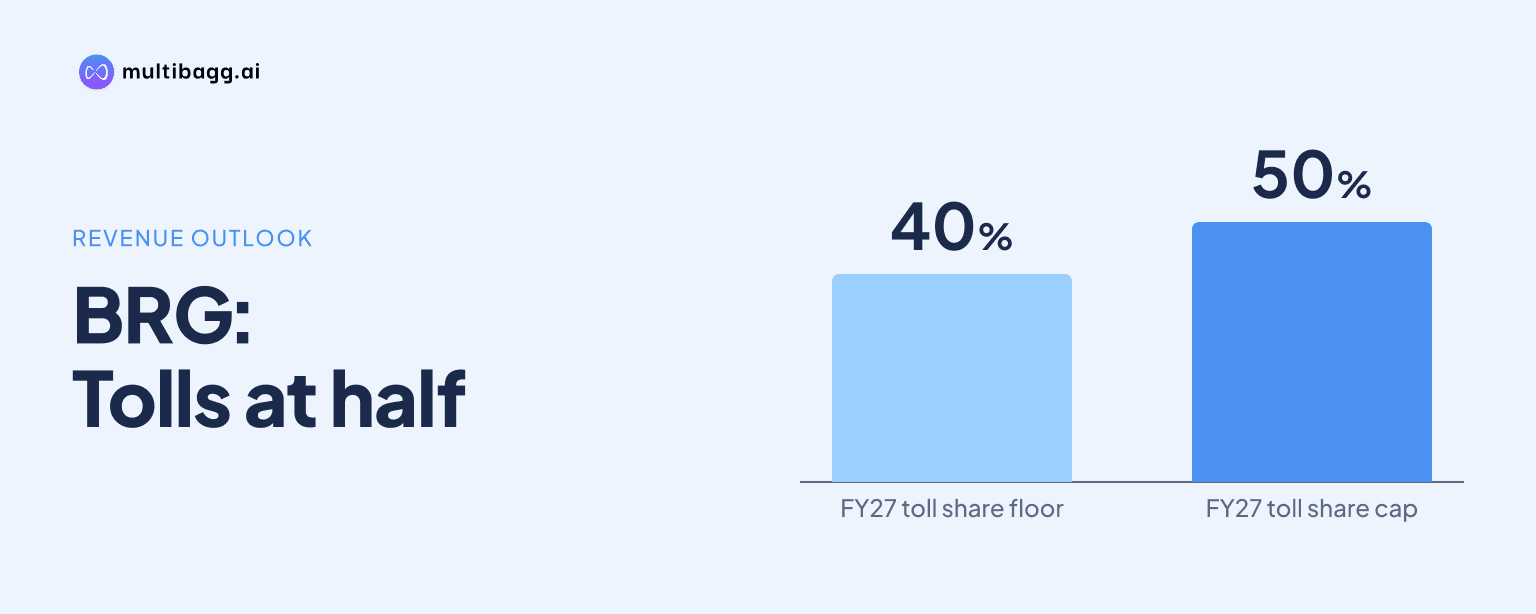
For H1 FY27, B.R.Goyal Infrastructure Limited said its Rs 962 crore toll-collection backlog was expected to provide about half of revenue, as management said these contracts need about 5% working capital, versus 15% to 20% for engineering, procurement and construction work.
Know B.R.Goyal Infrastructure inside out
Results, valuation, peers and who's buying, in one view.
How much of BRG's order book is toll collection?
BRG had nearly Rs 962 crore of toll-collection contracts within its Rs 1,755 crore order book at 30 September 2026, making toll collection its largest disclosed order-book segment. Road projects accounted for Rs 589 crore, wastewater work for Rs 132 crore and building projects for Rs 72 crore. Toll contracts represented about 55% of the stated order book by value.
The toll backlog expanded through fresh awards in H1 FY27, when BRG secured gross new work orders of about Rs 1,087 crore across its businesses. The largest disclosed toll award was a Rs 377.54 crore user-fee collection and operations-and-maintenance contract for the Bundelkhand Expressway from the Uttar Pradesh Expressways Industrial Development Authority, with a two-year period.
BRG also won six fresh toll-plaza contracts from the National Highways Authority of India. Their disclosed values were Rs 118 crore for Katpur in Gujarat, Rs 39 crore for Husnapur in Maharashtra, Rs 151 crore for Jajau in Madhya Pradesh, Rs 119 crore for Surapattu in Tamil Nadu, Rs 108 crore for Chillakallu in Telangana and Rs 52 crore for Khambara in Maharashtra.
Management said toll contracts received in FY27 could contribute about 40% to 50% of revenue in the current financial year. It separately said it expected revenue to be nearly evenly split, at about 50% each from toll collection and engineering, procurement and construction, or EPC. BRG did not disclose toll revenue for H1 FY27, so this revenue mix remains management's expectation rather than a reported segment result.
Why does BRG use return on capital employed for toll contracts?
BRG uses return on capital employed, or ROCE, to compare toll collection with EPC because management said their capital requirements differ. Chief Financial Officer Dasharath Tomar said EPC contracts generally require working capital of about 15% to 20%, as well as investment in plant, machinery and equipment. Toll collection needs about 5% working capital and has effectively zero plant-and-machinery cost, according to management.
The operating model also differs. BRG said toll plazas are pre-established, it pays a fixed amount to the National Highways Authority of India and its main cost is employee expense. Tomar said depreciation in toll collection is zero, which is why management does not view earnings before interest, tax, depreciation and amortisation, or EBITDA, margins as directly comparable with equipment-intensive EPC contracts.
Management put EPC ROCE at 15% to 25%, compared with 30% to 50% for toll-collection contracts. Tomar added that toll ROCE could reach 60% to 70% as the scale of those contracts rises. That range is management's stated potential outcome, not a reported company-wide return ratio.
The contract durations cited by BRG help explain the capital-turnover argument. Management described toll work as typically one-year fixed contracts, compared with EPC contracts lasting two to three years, and said the shorter toll cycle turns capital faster. It also said the fixed collection-and-payment model avoids the material-procurement price movements that can affect construction execution.
Got a follow-up? Ask IRIS
What did BRG report in H1 FY27 and expect for execution?
BRG reported revenue from operations of about Rs 550 crore in H1 FY27, up about 61% from Rs 342 crore in H1 FY26, as EPC execution and toll contracts both contributed. Earnings before interest, tax and amortisation, excluding other income, were about Rs 35 crore, compared with Rs 27 crore in the prior-year half. Profit after tax rose about 38% to Rs 22 crore from Rs 16 crore.
Revenue grew faster than the reported increase in earnings before interest, tax and amortisation and profit after tax during the six months to 30 September 2026. Management reported a profit-after-tax margin of 4.02% in H1 FY27, while it cited an EBITDA margin of 6.38% in H1 FY26. The call did not provide a comparable H1 FY27 EBITDA-margin figure.
Management expects the H2 FY27 revenue stream to be similar to H1 FY27. BRG said its 30 September 2026 order book would be executed over periods ranging from six months to a maximum of 24 months. The time frame spans shorter toll contracts and construction work such as the Rs 81.75 crore Cyber City civil and structural project, which has a 24-month construction period plus a three-month grace period.
Will BRG need additional limits to support toll expansion?
BRG said it does not expect to need new bank-guarantee or cash-credit limits over the next one to one-and-a-half years under its current growth outlook. Management cited about Rs 50 crore of cash-credit limits and Rs 315 crore of bank guarantees, or about Rs 365 crore in total. It said a substantial order-book increase of about Rs 5,000 crore could change that assessment.
The company said bank guarantees are released as older contracts conclude, allowing them to support new bids. Management also cited surety bonds, which it said are accepted by central government agencies and in some cases by state agencies, as a mechanism that can reduce reliance on bank guarantees. The expected absence of new limits is therefore conditional on contract turnover, the scale of order inflows and continuing acceptance of surety bonds.
BRG's working-capital limit increased to Rs 50 crore from Rs 35 crore after documentation for a Rs 15 crore enhancement was completed in March 2026. Management also referred to an equipment-loan enhancement of about Rs 10 crore. These facilities sit alongside the lower working-capital requirement that management attributes to toll collection, rather than establishing that future expansion will require no funding.
Conclusion
BRG's Rs 962 crore toll backlog has moved toll collection to the centre of its stated revenue mix, accounting for about 55% of the Rs 1,755 crore order book at 30 September 2026. Management's case for the shift rests on toll work requiring about 5% working capital against 15% to 20% for EPC, alongside its stated 30% to 50% toll ROCE range. H1 FY27 revenue rose to about Rs 550 crore from Rs 342 crore a year earlier.
The next measure to watch is conversion of this backlog into H2 FY27 revenue, which management expects to be similar to H1 FY27. BRG also said it expects the existing order book to be executed within six to 24 months and indicated a target of adding Rs 1,000 crore to Rs 1,500 crore of orders during FY27, making order inflows and guarantee capacity relevant to the planned mix shift.