










BRG Toll Mix and Cost Inflation Limited EBITDA Growth to 28%
Key highlights
- BRG reported 61% H1 FY27 revenue growth, while EBITDA increased 28%.
- H1 FY27 revenue included about Rs 303 crore from EPC and Rs 236 crore from Toll Collection Contracts.
- Other expenses rose from Rs 305 crore to Rs 392 crore alongside higher EPC execution, subcontracting and project overheads.
- BRG management expects 25% to 30% revenue growth in the current year after FY26 turnover of Rs 824 crore.
powered by IRIS
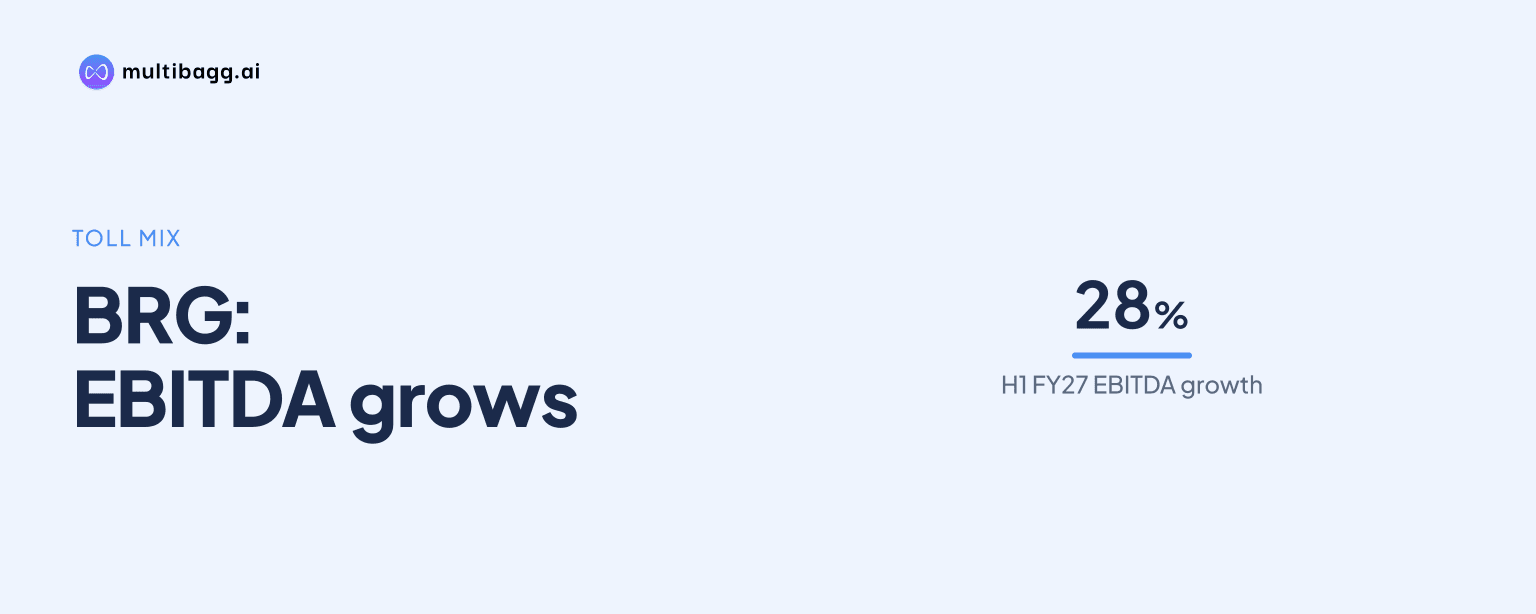
BRG reported 61% revenue growth in H1 FY27, but EBITDA rose 28%, as its Rs 236 crore Toll Collection Contracts business had a different blended margin profile from engineering, procurement and construction work and costs for bitumen, diesel and cement increased.
Know B.R.Goyal Infrastructure inside out
Results, valuation, peers and who's buying, in one view.
Why did BRG's EBITDA grow more slowly than revenue?
BRG's EBITDA grew more slowly than revenue because the expanding Toll Collection Contracts, or TCC, business did not produce an EBITDA margin comparable with traditional engineering, procurement and construction, or EPC, contracts on a blended basis. Management said TCC was positive for turnover and return on capital employed, or ROCE, but its mix affected operating-profit growth in H1 FY27.
The second factor was EPC cost inflation. Management cited global war conditions that had increased petroleum-product prices, including bitumen and diesel, as well as cement, which it identified as a primary raw material. Those costs applied across EPC contracts while BRG increased execution volumes and lifted H1 FY27 turnover by 61%.
The 61% revenue increase and 28% EBITDA increase therefore reflected both the changing revenue mix and higher costs of EPC delivery. Management did not disclose an H1 FY27 EBITDA margin, an absolute EBITDA amount, or a quantified split between the effects of TCC mix and raw-material inflation.
How was BRG's H1 FY27 revenue divided between EPC and toll collection?
BRG reported approximately Rs 550 crore of H1 FY27 revenue, including about Rs 303 crore from EPC, around Rs 236 crore from TCC and roughly Rs 10 lakh to Rs 11 crore from other trading activities. EPC was the largest reported stream, but TCC formed a substantial share of revenue during the six months.
The difference between the reported Rs 303 crore EPC contribution and Rs 236 crore TCC contribution was about Rs 67 crore. Management explicitly said TCC and EPC do not carry comparable blended EBITDA margins, explaining why a larger TCC contribution can make revenue growth and EBITDA growth diverge.
Other expenses increased from Rs 305 crore to Rs 392 crore, according to an analyst's question during the call. Management said this movement aligned with higher EPC contract revenue, subcontracting costs and project overheads associated with increased turnover, although the exchange did not identify the periods for the two expense figures.
What growth and profitability outlook has BRG given?
BRG management said it targets consistent annual growth of 20% to 25% and expects revenue growth of 25% to 30% in the current year. It referred to FY26 turnover of Rs 824 crore and said large-scale orders had supported that year's performance.
Management said large infrastructure companies achieve profit after tax, or PAT, margins of 8% to 10%, and BRG aspires to move towards those levels over time. It also said such a margin outcome was not expected immediately in the current year, making this a longer-term aspiration rather than current-year PAT margin guidance.
For H2, management said BRG could deliver good and decent performance because execution, commitment and adherence to timelines were progressing according to plan. That statement did not include a numerical H2 revenue, EBITDA or margin forecast, and it remains management's outlook rather than a reported result.
Got a follow-up? Ask IRIS
How does BRG plan to fund order-book expansion?
BRG said its working-capital cycle is about 45 to 60 days and that it does not foresee additional working-capital limits as its order book expands towards Rs 2,500 crore to Rs 3,000 crore. Management said EPC projects generate mobilisation advances directly from departments, reducing reliance on additional fund-based facilities.
The company increased its fund-based working-capital limit by Rs 15 crore in April 2026, taking the limit from Rs 35 crore to Rs 50 crore. Management said finance costs rose over the six-month period because of the initial processing-fee debit and higher utilisation following the enhancement.
For non-fund-based capacity, BRG said acceptance of surety bonds by central government agencies and some state agencies had reduced bank-guarantee needs. Management said it did not expect a new bank-guarantee or cash-credit limit requirement for one to one-and-a-half years unless the order book increased by about Rs 5,000 crore.
Can BRG add more toll collection contracts?
BRG operated about 24 toll plazas across Gujarat, Maharashtra, Madhya Pradesh, Tamil Nadu, Telangana, Chhattisgarh and Uttar Pradesh. Management reported a TCC bid strike ratio above 75%, compared with an EPC strike ratio of 10% to 15%, and said advance project identification, data collection and surveys support its toll bids.
Management said BRG was satisfied with its current plaza count and may bid for two or three additional toll plazas in the current financial year, or possibly five identified opportunities. It has not set a specific capital-exposure limit for TCC, although management said it assesses TCC and EPC investments on a consolidated basis.
BRG is also exploring toll-operate-transfer, or TOT, contracts, under which it would pay upfront for concessions lasting 20 years. Management said internal cash accruals and banking support could help finance such opportunities, but it reported no TOT award and disclosed no committed investment amount.
Conclusion
BRG's H1 FY27 revenue rose faster than EBITDA because the Rs 236 crore TCC contribution changed the blended margin profile while bitumen, diesel and cement costs increased in EPC execution. The rise in other expenses from Rs 305 crore to Rs 392 crore also coincided with higher EPC activity, subcontracting and project overheads.
Next, investors can watch whether BRG delivers management's expected 25% to 30% current-year revenue growth and its stated H2 execution plan. Other disclosed milestones are order-book expansion towards Rs 2,500 crore to Rs 3,000 crore without new working-capital limits and bidding for two to five additional toll plazas.