










Namo eWaste plans Rs 70 crore-plus hydrometallurgy plant
Key highlights
- Namo eWaste plans a 5-tonne-per-day hydrometallurgy plant costing more than Rs 70 crore, excluding working capital.
- The proposed refinery is designed to process about 2,000 tonnes of black mass annually after a Rs 6 crore Nashik pilot.
- Battery recycling generated about Rs 35 crore of Namo eWaste’s approximately Rs 124 crore H1 FY27 operating income.
- Management expects battery-recycling utilisation to rise from more than 30% in H1 FY27 to about 60% to 65% for FY27.
powered by IRIS
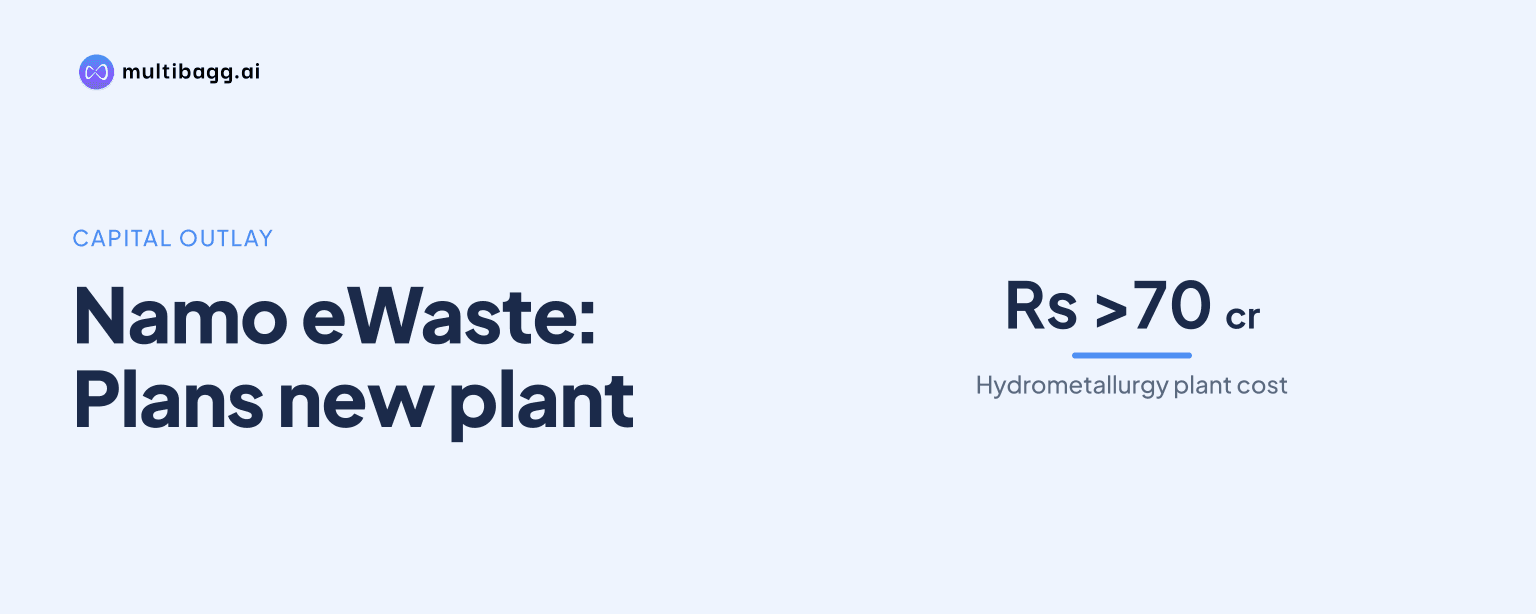
Namo eWaste Management Limited plans a Rs 70 crore-plus, 5-tonne-per-day hydrometallurgy plant in Haryana after a Rs 6 crore Nashik pilot due before March 2027, aiming to process about 2,000 tonnes of black mass annually as management develops in-house refining amid restrictions on black-mass exports.
Know Namo eWaste Management inside out
Results, valuation, peers and who's buying, in one view.
What hydrometallurgy capacity is Namo eWaste building?
Namo eWaste is building a 1-metric-tonne-per-day hydrometallurgy pilot unit at Nashik, with commercial production expected before the end of FY27 in March 2027. Management said the civil work was complete as of the November 18, 2026 earnings call, and put pilot capital expenditure at about Rs 6 crore.
Namo eWaste’s planned next stage is a 5-metric-tonne-per-day commercial plant in Haryana, which management said would require more than Rs 70 crore of capital expenditure excluding working capital. The company expects the larger unit to take about 18 months to build and to process approximately 2,000 tonnes of black mass each year.
Management said it has completed a technology tie-up and assembled equipment and process specialists for the Nashik pilot, without naming the partner. It selected Haryana for the larger plant because the National Capital Region is seen as a better market for processing external material as well as black mass generated by Namo eWaste’s own battery-recycling operation.
How do black-mass restrictions affect Namo eWaste?
Namo eWaste is retaining an export outlet for black mass while it builds domestic refining capacity. Management said the company recently obtained a special export licence even though black mass is in a restricted category, allowing it to pursue exports as long as that route remains available.
The company began battery recycling in August 2025 and had already been selling black mass to Indian refiners before beginning the refining project. Management said export buyers offer metal payables of about 80%, compared with about 72% from domestic buyers, and illustrated the difference as Rs 85 against Rs 100.
Management described the government’s position on black-mass exports as having become clearer and said that domestic extraction capability will be needed if export opportunities close. It did not provide a government deadline for any further restriction, a realised black-mass selling price, or a forecast refining margin from the planned unit.
Black-mass pricing remains linked to commodity and metal prices, according to management. Namo eWaste cited an approximate market range of Rs 400 to Rs 1,000 per kilogram, while clarifying that it currently sells rather than procures black mass and would procure it after its hydrometallurgy plant starts.
Can Namo eWaste internally supply the planned refinery?
Namo eWaste expects its planned 5-tonne-per-day refinery to be sufficient for near-term internal volumes. Management said 60% battery-recycling capacity utilisation would generate about 1,500 tonnes of black mass in FY27, against the larger refining plant’s annual processing capability of roughly 2,000 tonnes.
The company said that capacity should be sufficient for two to 2.5 years at expected production levels, and that up to 100% of internally generated black mass could be used in hydrometallurgy. Namo eWaste clarified that its battery facility has 12,000 metric tonnes of annual capacity, while its 32,000-metric-tonne plant at Palwal handles e-waste.
Battery-facility utilisation exceeded 30% in H1 FY27 and management expects it to reach about 60% to 65% for the full year in a single shift. That rise depends on feedstock sourcing, which management described as the principal constraint, rather than adding processing capacity.
The battery mix also affects revenue and throughput. Management said lithium iron phosphate, or LFP, batteries require more capacity for lower revenue, while nickel manganese cobalt, or NMC, batteries can generate higher revenue at lower utilisation; Namo eWaste said H1 FY27 processing included more LFP material.
Got a follow-up? Ask IRIS
How will Namo eWaste fund the larger project?
Namo eWaste’s first funding preference for the Rs 70 crore-plus commercial plant is debt, management said. The stated capital cost excludes working capital, and management said it was not considering equity dilution unless another funding route became more favourable.
In a separate discussion of supporting approximately Rs 750 crore of revenue, management indicated that debt could be around Rs 100 crore across long-term and short-term requirements. It described that amount as approximate, rather than as a committed borrowing plan or a disclosed financing facility.
Management cited two potential subsidy mechanisms for its Nashik and larger hydrometallurgy projects. It said it had filed papers for a state capital subsidy in Nashik and expected eligibility for 50% of relevant battery-plant capital expenditure.
Namo eWaste also said the Ministry of Mines had allocated Rs 60 crore to its larger hydrometallurgy project from a Rs 1,500 crore subsidy scheme for critical-mineral extraction. Management said the Rs 60 crore would not be paid entirely upfront because it is divided across capital expenditure, operating expenditure and production-linked conditions, including metal purity and quantities extracted.
What does hydrometallurgy mean for Namo eWaste’s growth plan?
Namo eWaste sees hydrometallurgy as part of a plan to move beyond e-waste and battery recycling into critical-mineral recovery. Management said it aims to recover more than 12 metals from different waste streams within two to three years, using refining capability that could process more than one type of feedstock.
The company reported total income from operations of approximately Rs 124 crore in H1 FY27, up 41% year on year. Earnings before interest, tax, depreciation and amortisation, or EBITDA, rose 41% to Rs 16 crore, while profit after tax increased 29% to Rs 9 crore.
Battery recycling contributed about Rs 35 crore of H1 FY27 operating income, with e-waste, information-technology refurbishment and extended producer responsibility, or EPR, activities making up the balance. Management said it held Rs 12 crore to Rs 15 crore of battery inventory received late in the first half and was targeting about Rs 125 crore of battery revenue for FY27.
Management estimated that the 5-tonne-per-day hydrometallurgy plant could support Rs 350 crore to Rs 400 crore of annual revenue, including EPR. That is a management estimate based on a proposed plant, not an operating result, and it will depend on feedstock availability, battery chemistry and successful refining performance.
Conclusion
Namo eWaste’s proposed refining investment would move the company from selling black mass to processing it into recovered metals, subject to a Nashik pilot scheduled before March 2027 and a later Haryana plant requiring more than Rs 70 crore. The planned 2,000-tonne annual capacity exceeds management’s estimate of 1,500 tonnes of black mass at 60% battery utilisation, leaving room for external material.
The next items to watch are the pilot’s commercial start before March 2027, the timing and conditions attached to the claimed state and Ministry of Mines subsidies, and battery-feedstock sourcing. Management said the larger plant would take about 18 months, while future capacity decisions would be made after the pilot, initial refining operations and sourcing pipeline are streamlined.