










Namo eWaste targets Rs 700-750 crore FY28 revenue after H1
Key highlights
- Namo eWaste reported approximately Rs 124 crore of income from operations in H1 FY27, up 41% year on year.
- Namo eWaste is targeting approximately Rs 350 crore in FY27 and Rs 700-750 crore in FY28.
- Namo eWaste places its Rs 1,000 crore revenue ambition at the end of FY29.
- Namo eWaste expects Nashik battery-recycling utilisation of about 60-65% in FY27 after more than 30% in H1.
powered by IRIS
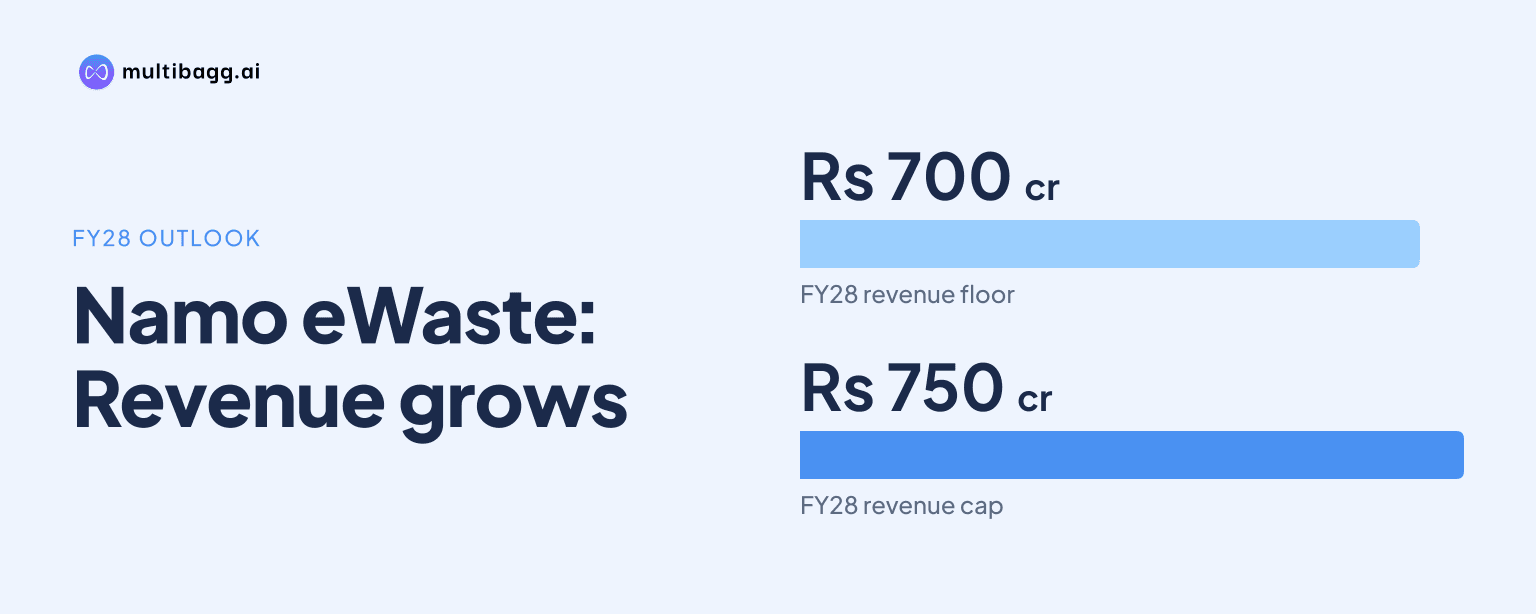
Namo eWaste Management Limited is targeting Rs 700-750 crore of revenue in FY28 after reporting approximately Rs 124 crore of income from operations in H1 FY27, while management placed its Rs 1,000 crore revenue ambition at the end of FY29. The plan depends on compliance-led H2 demand, battery recycling utilisation and hydrometallurgy expansion.
Know Namo eWaste Management inside out
Results, valuation, peers and who's buying, in one view.
What is Namo eWaste’s revenue roadmap through FY29?
Namo eWaste is targeting about Rs 350 crore in FY27, Rs 700-750 crore in FY28 and Rs 1,000 crore by the end of FY29. On the November 18, 2026 earnings call, management described Rs 350 crore as the first FY27 benchmark, while saying Rs 400 crore would be an ambitious outcome.
The FY28 target follows approximately Rs 124 crore of H1 FY27 income from operations and Rs 107 crore cited on the call for the year ended March 2026. Management initially linked the Rs 1,000 crore potential to FY28 or FY29 as hydrometallurgy and other activities were added, then agreed with an analyst’s summary that Rs 700-750 crore was the FY28 target and FY29 was the period for reaching Rs 1,000 crore.
Namo eWaste said the target path is not limited to current e-waste operations. Management expects growth from battery recycling, hydrometallurgy and new business domains, although it did not specify those additional domains or their financial contribution during the call.
Why does Namo eWaste expect a stronger H2 FY27?
Namo eWaste expects H2 FY27 to be materially larger than H1 because disposal activity and Extended Producer Responsibility, or EPR, compliance are concentrated in the last part of the financial year. Management identified January to March as the period with the highest revenue potential because a larger share of compliance-related disposal occurs then.
At approximately Rs 124 crore in H1 FY27, the Rs 350 crore FY27 benchmark implies roughly Rs 226 crore of revenue in H2. Management said it viewed Rs 300 crore as achievable when considering the position toward March 31, while maintaining that the Rs 350-400 crore range remained within reach.
Namo eWaste reported that H1 FY27 income from operations increased 41% year on year to approximately Rs 124 crore. Earnings before interest, tax, depreciation and amortisation, or EBITDA, also rose 41% to Rs 16 crore, with a margin of almost 13%, while profit after tax, or PAT, rose 29% to Rs 9 crore.
Management did not identify gold or silver prices as a significant factor in H1 FY27 performance. Asked about those commodities, it said their overall contribution was limited, instead attributing the expected H2 increase to EPR timing and disposal activity.
Got a follow-up? Ask IRIS
Which facilities support Namo eWaste’s FY27 and FY28 plan?
Namo eWaste said battery recycling contributed approximately Rs 35 crore of its Rs 124 crore H1 FY27 income from operations. The Nashik battery facility operated at more than 30% utilisation in H1, and management expects utilisation of about 60-65% for FY27 in a single shift.
Management said battery scrap purchase prices range from Rs 100 to Rs 400 per kilogram, depending on battery type. It estimated battery-recycling gross margin at approximately 22-25%, or roughly Rs 20-50 per kilogram, and clarified that an earlier cited 17-20% figure was related to gross margin rather than EBITDA margin.
Namo eWaste expects utilisation of about 40% in FY27 at its 32,000-metric-tonne Haryana e-waste facility. It expects Nashik e-waste utilisation of 60-70%, compared with 65% in the prior year, while processing more information-technology goods and mobile phones than the white goods that formed a larger part of Nashik’s mix last year.
The 25,000-metric-tonne Hyderabad e-waste facility began partial commercial operations in late Q2 FY27. Management expects only single-digit utilisation there in FY27 while awaiting the final recycling licence from the Pollution Control Board, but said partial operations were allowing revenue capture; in the first full year, it expects around 30% utilisation. Total installed e-waste and battery-recycling capacity stands at 82,000 metric tonnes per year.
How could hydrometallurgy affect Namo eWaste’s targets?
Namo eWaste plans to start commercial production at a Nashik pilot hydrometallurgy unit before the end of March FY27. The pilot requires approximately Rs 6 crore of capital expenditure, while management estimated capital expenditure above Rs 70 crore, excluding working capital, for a larger five-metric-tonnes-per-day facility.
The company currently sells black mass to Indian refiners and said it had acquired a special export licence despite black mass being in a restricted export category. Management estimated that 60% utilisation of battery recycling capacity would generate about 1,500 metric tonnes of black mass, while a five-metric-tonnes-per-day refining plant could process approximately 2,000 tonnes annually.
Management said the larger plant would be sufficient for two to 2.5 years based on expected black-mass volumes and is targeted within 12-18 months after pilot testing. It estimated that the five-metric-tonnes-per-day unit could generate Rs 350-400 crore of annual revenue, including EPR, which is a management estimate rather than reported revenue.
Namo eWaste said debt was its first funding option for the larger project. Management also said it had filed for a 50% state capital subsidy at the Nashik battery facility, and that the Ministry of Mines had allocated Rs 60 crore to the larger project, subject to capital expenditure, operating expenditure, production and metal-purity conditions.
Conclusion
Namo eWaste’s revenue plan now centres on approximately Rs 350 crore in FY27, Rs 700-750 crore in FY28 and Rs 1,000 crore by the end of FY29. The near-term outcome depends on an H2 FY27 acceleration from approximately Rs 124 crore of H1 income, supported by the seasonal concentration of EPR compliance and a move toward 60-65% Nashik battery utilisation.
The next disclosed milestones are the Nashik pilot’s targeted commercial start before the end of March FY27, final recycling approval for Hyderabad and progress on the larger hydrometallurgy plant over 12-18 months. Management’s Rs 350-400 crore annual-revenue estimate for that five-metric-tonnes-per-day facility and the FY29 Rs 1,000 crore ambition depend on execution of those plans and future announcements on additional domains.