










Virtual Galaxy Infotech Limited targets Rs 25-30 crore BOT revenue
Key highlights
- Virtual Galaxy said about Rs 60 crore of BOT investment can generate Rs 25 crore to Rs 30 crore of annual revenue for five years.
- H1 FY2027 operating cash flow was Rs 38.7 crore, while investing outflows were Rs 56.9 crore.
- Tangible assets under development increased to Rs 57.9 crore on September 30, 2026 from Rs 9.8 crore at FY2026-end.
- Virtual Galaxy's H1 FY2027 unexecuted order book rose 46% to Rs 148.9 crore.
powered by IRIS
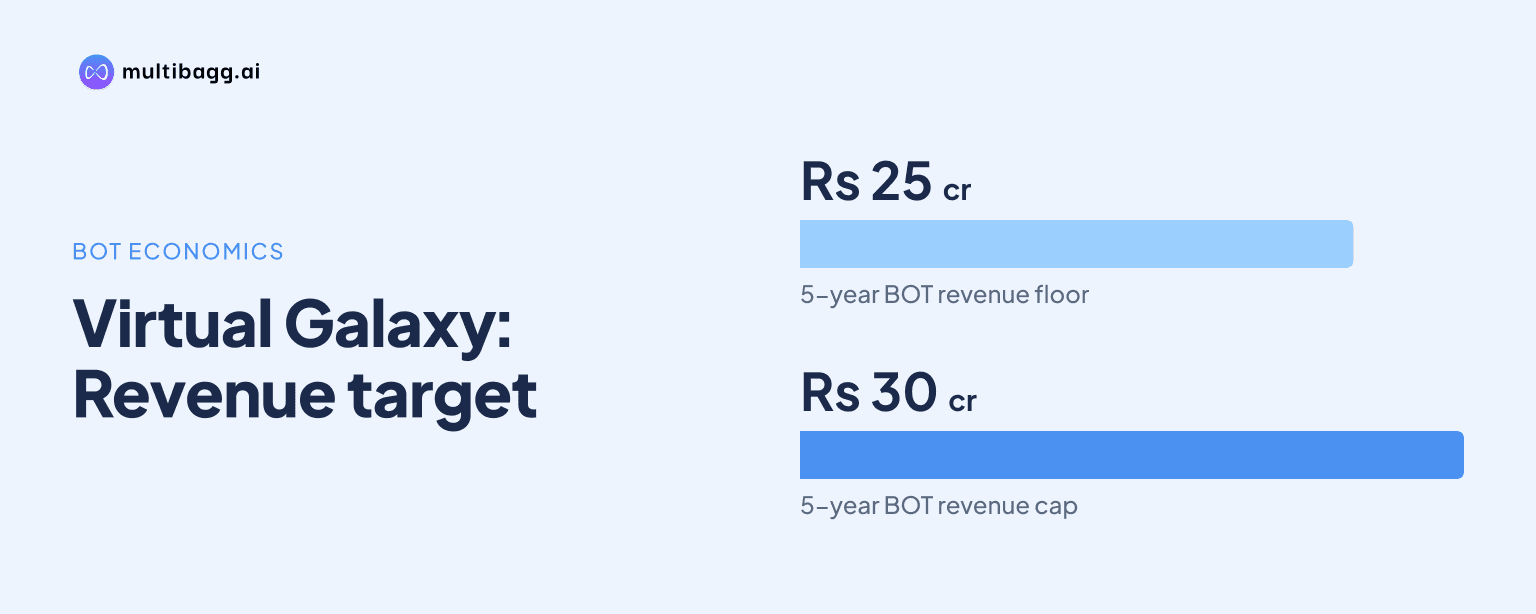
Virtual Galaxy said on November 16, 2026 that about Rs 60 crore invested in build-operate-transfer projects can generate Rs 25 crore to Rs 30 crore of annual revenue for five years after commissioning. The stated revenue profile explains why H1 FY2027 investing outflows of Rs 56.9 crore exceeded operating cash generation of Rs 38.7 crore.
Know Virtual Galaxy Infotech inside out
Results, valuation, peers and who's buying, in one view.
What revenue does Virtual Galaxy expect from BOT projects?
Virtual Galaxy expects about Rs 57 crore to Rs 60 crore of build-operate-transfer, or BOT, investment to generate Rs 25 crore to Rs 30 crore of annual revenue for five years. Management confirmed the range in response to an analyst asking about the expected return from the infrastructure projects being built for banking customers.
At the range midpoint, annual revenue would be Rs 27.5 crore and five-year revenue would be about Rs 137.5 crore, although management agreed only with the analyst's broader estimate of about Rs 120 crore from a Rs 60 crore investment. Virtual Galaxy did not disclose project-level contract values, capital costs, renewal assumptions or a formal return-on-capital calculation.
The BOT model requires Virtual Galaxy to fund servers, storage, data-centre infrastructure and related hardware before a banking project begins operating. Once commissioned, the company receives monthly rental revenue, which management said is classified under software as a service, or SaaS, rather than one-time product sales.
Management said BOT contracts can run for five or seven years, while most projects are typically for five years. At the end of a contract, the infrastructure is transferred to the customer; a renewal can require refreshed equipment, though management said some customers continue using the existing infrastructure and Virtual Galaxy then earns SaaS revenue without fresh hardware investment.
Why has Virtual Galaxy's free cash flow been negative?
Virtual Galaxy's free cash flow has remained negative because it has funded BOT infrastructure before the resulting monthly rental revenue begins. In H1 FY2027, cash from operating activities was Rs 38.7 crore, while net cash used in investing activities was Rs 56.9 crore, producing an investment outflow that exceeded operating cash generation by Rs 18.2 crore.
Cash and cash equivalents fell to Rs 11.4 crore on September 30, 2026, from Rs 31.2 crore on March 31, 2026, primarily because of investment outflows. Total borrowings were broadly unchanged at Rs 47.9 crore on September 30, 2026, compared with Rs 48.4 crore at the end of FY2026.
An analyst said free cash flow had been negative in FY2024, FY2025, FY2026 and H1 FY2027. Management attributed this to the approximately Rs 57 crore invested in BOT projects and said the assets should have a positive future cash-flow impact, but it did not give a date for free cash flow to turn positive.
How will Virtual Galaxy convert BOT spending into revenue?
Virtual Galaxy plans to convert BOT spending into revenue by progressively commissioning projects from March 2027 onwards. Tangible assets under development rose to Rs 57.9 crore on September 30, 2026 from Rs 9.8 crore at the end of FY2026, mainly reflecting turnkey BOT infrastructure and renewals of banking arrangements.
The company holds the expenditure as capital work in progress until a project is completed and operational. Management said the infrastructure is then transferred to fixed assets, depreciation begins, and the deployment generates monthly rental revenue over the contracted tenure.
Virtual Galaxy said it applies a 25% depreciation rate because most BOT projects have an approximately five-year life. This accounting sequence separates BOT hardware from cost of materials until commissioning, whereas servers, storage and data-centre hardware used in other one-time projects can be recognised in material consumption.
Intangible assets under development also increased, reaching Rs 22.4 crore on September 30, 2026 from Rs 12.4 crore at FY2026-end. Management said this research and development spending on proprietary software platforms is expected to support incremental SaaS revenue from H2 FY2027, subject to approvals, certifications and implementation requirements.
Got a follow-up? Ask IRIS
What margin has Virtual Galaxy indicated for BOT revenue?
Virtual Galaxy said it targets at least a 25% margin on BOT revenue after depreciation. Management confirmed that the target was on a net basis after an analyst asked whether the Rs 25 crore to Rs 30 crore annual BOT revenue estimate would still meet that threshold after depreciation.
The company did not disclose a separately reported BOT margin, project-level depreciation schedule or finance-cost allocation. Management also said product sales and SaaS operate at approximately 25% margin, but it did not provide a segment-wise reconciliation showing the profitability of BOT contracts relative to the other two revenue streams.
H1 FY2027 results show why depreciation matters to profit conversion. Revenue from operations rose 21% year on year to Rs 104.6 crore, while earnings before interest, tax, depreciation and amortisation, or EBITDA, increased 41% to Rs 54 crore and EBITDA margin expanded to 51.7% from 44.6%.
Profit after tax increased 12% to Rs 24.6 crore, slower than EBITDA, as depreciation rose to Rs 17.62 crore from Rs 6.6 crore in H1 FY2026 and finance cost also increased. The reported profit after tax margin was 23.6%, while management said higher depreciation and finance costs moderated the improvement in net profit.
How does BOT fit Virtual Galaxy's FY2027 plan?
Virtual Galaxy is pursuing BOT alongside product sales and SaaS rather than relying solely on capital-funded infrastructure. Management said its banking and financial-services business remains its largest contributor, with cooperative banks, district central cooperative banks, state cooperative banks and non-banking financial companies as key customer groups.
SaaS revenue increased 32% to Rs 47.9 crore in H1 FY2027 from Rs 36.4 crore a year earlier, while product-sales revenue rose 33% to Rs 55.6 crore. Both segments grew faster than total revenue of Rs 104.6 crore, and management linked the larger recurring-revenue contribution and slower cost growth to EBITDA margin expansion.
Virtual Galaxy's unexecuted order book stood at Rs 148.9 crore at the end of H1 FY2027, up 46% from Rs 102 crore in the corresponding prior-year period. It also cited an active bid pipeline of about Rs 1,000 crore across banking, government, healthcare, cybersecurity and export opportunities, while noting that tendering, awards, mobilisation and phased implementation can alter the timing of revenue recognition.
Management retained its FY2027 revenue-growth guidance of 40% and said about 60% of annual revenue is normally generated in H2. BOT commissioning from March 2027 is therefore a later milestone than the H2 FY2027 seasonal revenue period, while order conversion and delivery remain the nearer execution variables.
Conclusion
Virtual Galaxy has disclosed an unusually specific framework for BOT capital allocation: roughly Rs 60 crore of banking-infrastructure investment is expected to produce Rs 25 crore to Rs 30 crore of annual revenue for five years. The framework helps explain why H1 FY2027 investing outflows of Rs 56.9 crore were higher than operating cash generation of Rs 38.7 crore, even as revenue grew 21%.
The next disclosed milestone is progressive commissioning from March 2027, when BOT work in progress is expected to move into operational assets and begin generating monthly revenue. Management's 40% FY2027 growth guidance, its expectation that 60% of annual revenue comes in H2, and the Rs 148.9 crore unexecuted order book are the near-term markers for execution.