










Virtual Galaxy Infotech Limited Reports ₹104.6 Crore H1 Revenue
Key highlights
- VGIL reported H1 FY27 revenue of ₹104.6 crore, up 21% year-on-year.
- H1 FY27 EBITDA was ₹54.0 crore, with margin improving 704 basis points to 51.7%.
- The unexecuted order book rose 46% year-on-year to ₹148.9 crore.
- VGIL retained its 40% FY27 revenue-growth guidance and ₹500 crore FY29 revenue target.
powered by IRIS
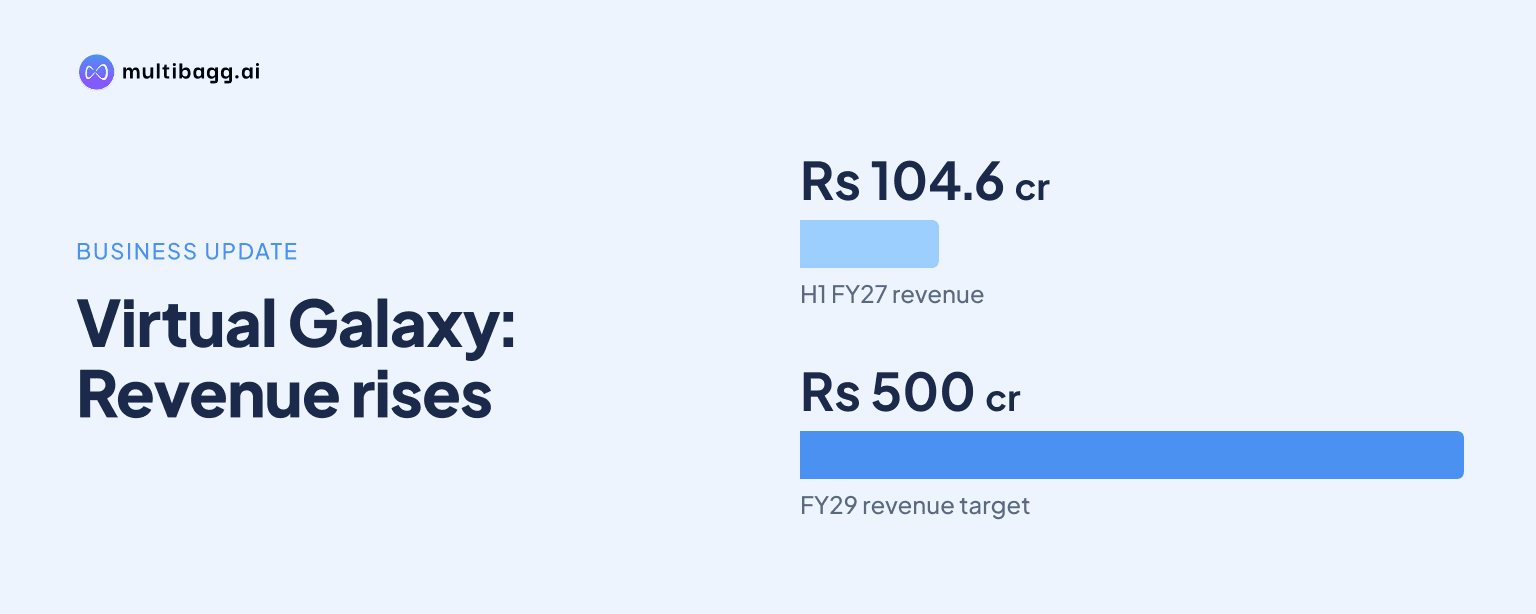
Virtual Galaxy Infotech Limited reported H1 FY27 revenue of ₹104.6 crore, up 21% year-on-year, alongside EBITDA of ₹54.0 crore and a 51.7% margin. The update matters because VGIL retained its 40% FY27 revenue-growth guidance while its order book rose to ₹148.9 crore.
Know Virtual Galaxy Infotech inside out
Results, valuation, peers and who's buying, in one view.
What did VGIL report for H1 FY27?
VGIL reported revenue from operations of ₹104.6 crore for the first half of FY27, with EBITDA of ₹54.0 crore and profit after tax of ₹24.6 crore. EBITDA margin expanded by 704 basis points year-on-year to 51.7%, while PAT margin stood at 23.6%, down 201 basis points.
The company disclosed the financial update in an investor presentation filed with the National Stock Exchange on November 15, 2026. The presentation also reaffirmed management's FY27 revenue-growth guidance of 40% and outlined a longer-term target of ₹500 crore in revenue by FY29.
How did the second quarter contribute to the half-year result?
Q2 FY27 revenue was ₹64.2 crore, up 59% sequentially from the preceding quarter, according to VGIL's presentation. Q2 EBITDA was ₹31.5 crore and Q2 PAT was ₹15 crore, showing that the second quarter accounted for a substantial part of the H1 result.
The reported Q1 FY27 revenue was ₹40.4 crore. The sequential increase in Q2 therefore lifted H1 revenue to ₹104.6 crore. The company also reported that it is pursuing expansion in banking infrastructure, artificial intelligence and cybersecurity offerings.
What is driving VGIL's revenue visibility?
VGIL said its unexecuted order book stood at ₹148.9 crore, a 46% year-on-year increase. It also identified a bid pipeline of ₹1,000 crore, which represents opportunities under pursuit rather than secured business.
The company builds enterprise software and digital infrastructure for areas including core banking, enterprise resource planning, e-governance, digital payments, AI and cybersecurity. Its product portfolio includes E-Banker, IBS, V-Pay, Virtual Vaani and V-SOC, alongside data-centre, disaster-recovery and systems-integration services.
The company has stated that it has more than 100 active projects across 15 Indian states. Its operations also extend to select overseas markets, including multiple African countries. These business lines form the operational context for its order book and bid pipeline disclosures.
Got a follow-up? Ask IRIS
Why did profitability differ between EBITDA and PAT?
VGIL's H1 EBITDA margin improved to 51.7%, but PAT margin fell by 201 basis points to 23.6%. The company attributed the pressure below the operating-profit level to higher depreciation and amortisation, which rose 165%, and finance costs, which increased 55%.
The difference is important for investors because operating-margin expansion did not fully translate into net-profit-margin expansion. H1 PAT nevertheless rose 12% year-on-year to ₹24.6 crore, indicating that the company remained profitable despite the higher non-operating cost burden.
The presentation also flagged cash-conversion performance as an area to monitor. Cash flow from operations as a share of EBITDA was 58.6% in FY26, based on the company information cited in the update. No newer cash-conversion figure was provided for H1 FY27.
What does VGIL's FY27 outlook mean for investors?
VGIL has maintained its 40% FY27 revenue-growth guidance, supported by its reported order book and the management's assessment of continuing business momentum. The company has not changed its stated FY29 revenue target of ₹500 crore.
The company expects its build-operate-transfer assets to begin generating rental revenue from March 2027. This is a disclosed future operating milestone, rather than revenue already included in the H1 FY27 result. The timing and scale of any resulting rental income were not quantified in the presentation.
For the broader technology and digital-infrastructure segment, the update highlights demand across banking technology, government digitisation, payments, AI and cybersecurity. However, the presentation did not disclose any share-price movement following the filing, and it did not provide an earnings-call transcript for the quarter.
Conclusion
VGIL's H1 FY27 presentation showed 21% year-on-year revenue growth to ₹104.6 crore, a 51.7% EBITDA margin and a 46% increase in its order book to ₹148.9 crore. The figures support the company's decision to retain its 40% FY27 revenue-growth guidance, although the decline in PAT margin and weaker historical cash conversion remain relevant financial considerations.
Investors will next watch progress against the FY27 growth guidance, conversion of the ₹1,000 crore bid pipeline into orders, and the planned start of rental revenue from build-operate-transfer assets in March 2027. Execution on AI, cybersecurity and banking-infrastructure initiatives will also remain central to the company's stated expansion plans.