










Virtual Galaxy Builds Africa Expansion on 13 Banking Projects
Key highlights
- VGIL reports 13 overseas banking projects and says it entered Botswana after multiple tender rounds.
- VGIL identifies Tanzania and Malawi among its international execution markets and plans expansion across Africa and GCC corridors.
- FY26 revenue from operations rose to Rs 182.1 crore from Rs 120.1 crore in FY25.
- Management cites a Rs 1,000 crore bid pipeline with a 20% historical win ratio and aims to maintain 40% recurring revenue.
powered by IRIS
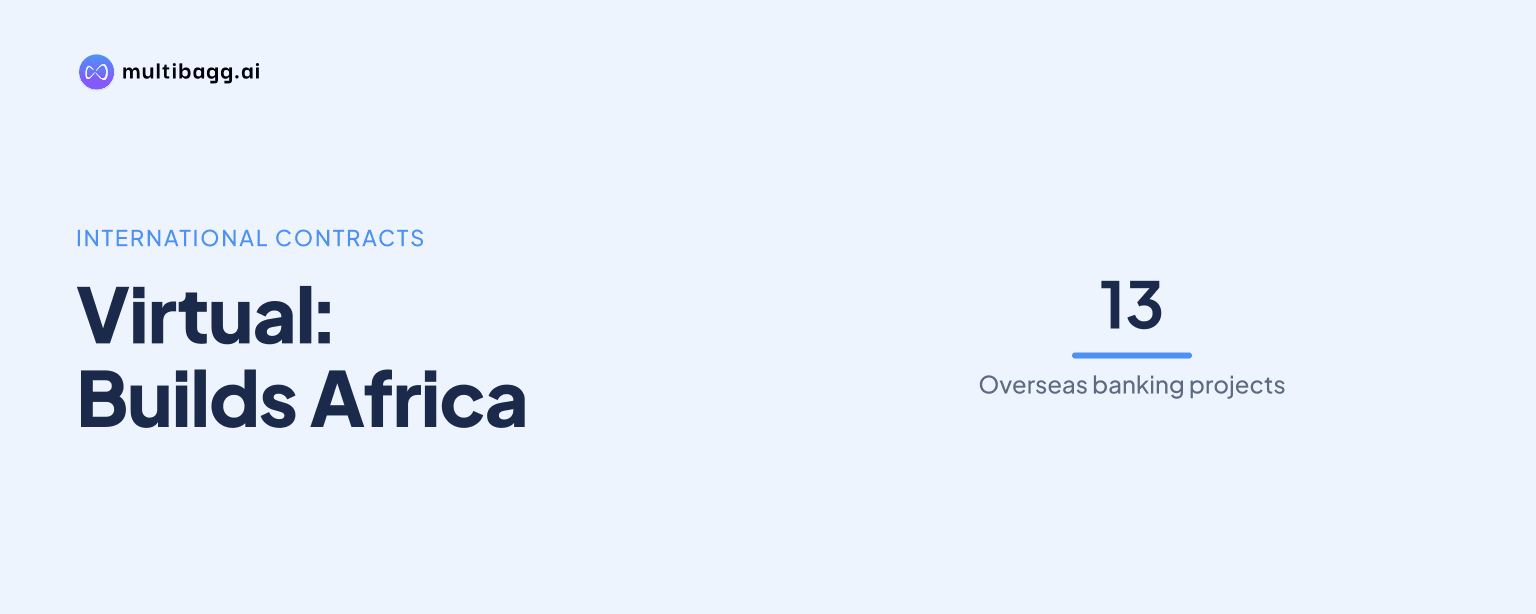
Virtual Galaxy is building an Africa and Gulf Cooperation Council expansion plan after entering Botswana, using a reported base of 13 overseas banking projects; management says it will scale export revenue through localised execution. The presentation identifies Tanzania and Malawi as international execution markets but provides no export-revenue figure or country target.
Know Virtual Galaxy Infotech inside out
Results, valuation, peers and who's buying, in one view.
What is VGIL’s Africa and GCC expansion plan?
VGIL’s stated plan is to expand across underpenetrated Africa and GCC corridors after its entry into Botswana. Management says the Botswana entry followed multiple tender rounds despite earlier lead-bidder rankings, but the presentation does not disclose the client, contract value, implementation date or revenue associated with the project.
The company says it is building on successful banking deployments across African markets and will scale export revenues through localised execution capabilities. Its presentation identifies Tanzania and Malawi as international markets where it has proven execution, alongside delivery across more than 15 Indian states; it does not provide a geographic revenue split for any of those markets.
VGIL describes its operating model as covering consulting, development, deployment and managed services, with complete lifecycle responsibility from development through long-term operations and maintenance, or O&M. That delivery model is the disclosed mechanism for serving international banking clients, although the presentation does not specify local staffing, offices, partnerships or investment plans in Botswana, Africa or GCC countries.
Management separately cites a Rs 1,000 crore bid pipeline and a 20% historical win ratio while discussing delivery infrastructure. The source does not state how much of that pipeline relates to export opportunities, Botswana, African banking contracts or GCC markets, so no expected international revenue can be derived from the cited pipeline.
How extensive is VGIL’s overseas banking project base?
VGIL reports 13 overseas banking projects, which is the clearest stated measure of its international banking execution base. The presentation names DCB Commercial Bank Plc, Reserve Bank of Malawi, Wazo Hill Savings & Credit Co-operative Society and Bandarini SACCOs Ltd among its international banking engagements.
The international-project table visibly lists 11 organisations: DCB Commercial Bank Plc, Reserve Bank of Malawi, Wazo Hill Savings & Credit Co-operative Society, transcosmos, Bandarini SACCOs Ltd, Nyombo SACCOS, Arusha Women in Business SACCO Ltd, Lulu SACCOs Limited, Wazalendo SACCOs Ltd, TRA SACCOs Ltd and WAT SACCOs Ltd. SACCOs are savings and credit cooperative organisations.
There is a numerical disclosure gap between the 13-project summary and the 11 names shown in the international banking table. VGIL does not explain whether two projects are not listed, whether individual organisations represent more than one project, or whether the count and table use different reporting dates.
The overseas base is smaller by count than VGIL’s reported domestic institutional footprint. The company reports more than 70 urban co-operative banks, more than 50 co-operative societies, 11 district central co-operative banks, two state co-operative banks and five World Bank projects, compared with 13 overseas banking projects.
Got a follow-up? Ask IRIS
Which VGIL products can support international banking delivery?
VGIL says it has eight proprietary platforms built over nearly three decades: E-Banker, V-Pay, IBS-ERP, E-APMC, V-SOC, E-Autopsy, VGST and LOS. The presentation does not identify which of these eight products has been deployed at any of the 13 overseas banking projects.
Cyber Sentinel is VGIL’s cybersecurity service for banks and enterprises, offering real-time threat detection, log monitoring, intrusion detection, file-integrity monitoring and compliance reporting. The company says the service lets smaller institutions access security-operations-centre capabilities without establishing dedicated teams or infrastructure, but it gives no customer count or revenue figure for the product.
Virtual Vaani is an artificial intelligence-powered voice and chat assistant for banks and enterprises that handles customer queries, routine service interactions and voice-based banking guidance. The platform uses natural language processing, while the source says it can reduce banks’ reliance on human agents for repetitive tasks and provide around-the-clock availability; no contract, implementation or revenue data are disclosed.
VGIL also offers data-centre and disaster-recovery infrastructure under capital-expenditure or operating-expenditure models, as well as mobile applications for banking field operations and customer-facing use cases in low-bandwidth settings. These services add infrastructure and managed-delivery components to the company’s banking software offering, although no overseas project-level scope is provided.
What financial measures support VGIL’s expansion plan?
VGIL says 40% of revenue is recurring, supported by long-standing customer relationships, software-as-a-service contracts, annual maintenance contracts and annual technical support agreements. Management’s plan is to maintain the 40% recurring-revenue share while expanding cross-selling within existing relationships and pursuing long-duration enterprise contracts.
Company-wide revenue from operations rose to Rs 182.1 crore in FY26 from Rs 120.1 crore in FY25, while earnings before interest, tax, depreciation and amortisation, or EBITDA, increased to Rs 84.2 crore from Rs 55.3 crore. Those figures show growth in the overall business, but the source gives no export revenue or Africa and GCC contribution to either year.
In H1 FY27, revenue was Rs 104.6 crore compared with Rs 86.1 crore in H1 FY26, an increase of 21%. EBITDA rose 41% to Rs 54 crore and profit after tax rose 12% to Rs 24.6 crore, while the profit-after-tax margin declined by 201 basis points to 23.6% from 25.6%.
Cash from operating activities increased to Rs 49.4 crore in FY26 from Rs 43.2 crore in FY25. Closing cash and cash equivalents were Rs 11.4 crore at H1 FY27, down from Rs 31.2 crore at FY26, while management says it is developing a 10-acre integrated technology campus at Mihan Special Economic Zone without disclosing its cost or completion date.
Conclusion
VGIL’s international expansion case rests on a stated base of 13 overseas banking projects, an entry into Botswana and prior execution in Tanzania and Malawi. Its product set spans banking platforms, cybersecurity, conversational artificial intelligence, infrastructure and managed services, while management’s stated 40% recurring-revenue objective provides the intended commercial framework for longer-duration engagements.
The next disclosures to watch are whether VGIL reports export revenue, identifies additional Africa or GCC markets, and reconciles the 13 overseas-project total with the 11 named organisations. Management also plans to support a Rs 1,000 crore bid pipeline with a cited 20% historical win ratio, maintain 40% recurring revenue and sustain a 25% profit-after-tax margin alongside research and development investment, but the presentation gives no timetable for these objectives.