










Virtual Galaxy expands enterprise platform beyond core banking
Key highlights
- VGIL reported H1 FY27 revenue from operations of Rs 104.6 crore, up 21% year on year.
- E-Banker is deployed at more than 150 banks and societies and has processed more than 30 billion transactions.
- VGIL’s biomedical asset-management platform is deployed at Grant Government Medical College and Sir J.J. Group of Hospitals in Mumbai.
- VGIL reported an H1 FY27 unexecuted order book of Rs 148.9 crore, up 46% year on year.
powered by IRIS
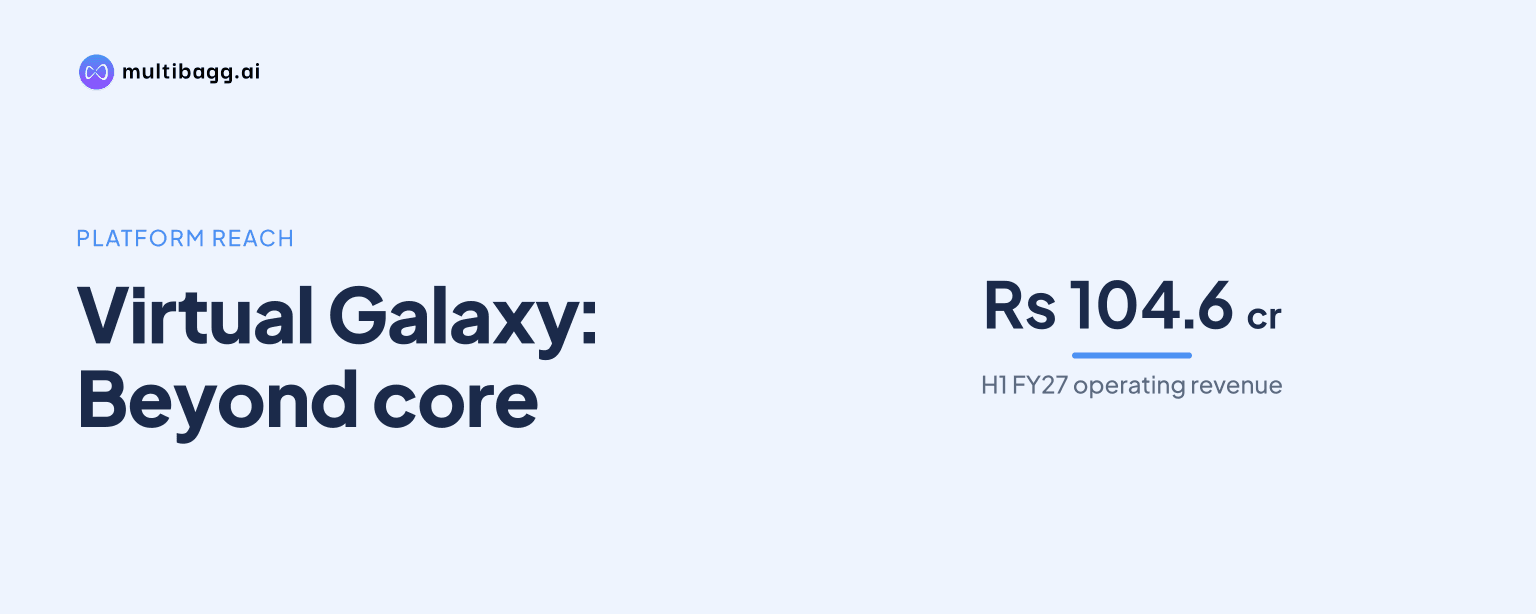
Virtual Galaxy is broadening its enterprise technology platform beyond core banking into government software, healthcare, artificial intelligence and cybersecurity, while its E-Banker system remains deployed at more than 150 banks and societies and has processed more than 30 billion transactions. H1 FY27 revenue reached Rs 104.6 crore, up 21% year on year.
Know Virtual Galaxy Infotech inside out
Results, valuation, peers and who's buying, in one view.
How is VGIL diversifying beyond core banking?
VGIL is diversifying through products for government agencies, healthcare institutions, enterprises and financial institutions, rather than positioning itself only as a core-banking supplier. The presentation identifies more than 13 software platforms across banking, enterprise resource planning, or ERP, and e-governance, with active deployments in more than 15 Indian states and 13 international banking projects across Africa and the Gulf Cooperation Council, or GCC.
The portfolio includes e-APMC for agricultural-market administration, E-Autopsy for forensic departments, IBS-ERP for manufacturers, Virtual Vaani for conversational AI and a cybersecurity service for banks and enterprises. The presentation does not disclose revenue, margins or order-book shares for these individual non-banking products, so their present financial contribution cannot be separated from total product and software-as-a-service, or SaaS, revenue.
H1 FY27 results show growth in both major reported revenue categories. Revenue from operations rose 21% year on year to Rs 104.6 crore, while core revenue, excluding non-core hardware and related sales, increased 32% to Rs 103.6 crore. Product sales rose 33% to Rs 55.6 crore and SaaS revenue increased 32% to Rs 47.9 crore, indicating both categories grew faster than reported revenue from operations.
What remains VGIL’s main platform foundation?
VGIL’s banking and financial infrastructure remains its largest business vertical, led by the E-Banker core-banking platform. E-Banker is deployed at more than 150 banks and societies, manages more than 10 million accounts and has processed more than 30 billion transactions with 99.9% uptime, according to the presentation. It is live internationally in Tanzania, Malawi, Botswana and Zimbabwe.
The banking suite extends beyond core processing through payments, management information and compliance tools. V-Pay connects cooperative and urban banks to Unified Payments Interface, or UPI, National Automated Clearing House, or NACH, National Electronic Funds Transfer, or NEFT, Real Time Gross Settlement, or RTGS, and Immediate Payment Service, or IMPS. iMIS provides management dashboards, while Transact Core, Audit Flux and FinFlow address transaction processing, audit tracking and internal fund-flow functions.
VGIL reported an unexecuted order book of Rs 148.9 crore at the end of H1 FY27, up 46% year on year, and an active bid pipeline of about Rs 1,000 crore. Management said it is pursuing opportunities among cooperative banks and non-banking financial companies, or NBFCs, while deepening existing banking relationships. The presentation does not allocate the order book or bid pipeline between banking and newer technology verticals.
Banking delivery is also linked to investments intended to create rental income. Tangible assets under development increased to Rs 57.9 crore on September 30, 2026, from Rs 9.8 crore at FY26-end, mainly for Build, Operate and Transfer, or BOT, banking infrastructure projects. Management said projects commissioned from March 2027 are expected to generate monthly rental revenues.
What government and enterprise software does VGIL offer?
VGIL offers e-APMC, an e-governance platform for Agricultural Produce Market Committees that handles commodity arrivals, auctions, trader settlements and market-fee collection. It is deployed across Maharashtra APMCs under the MAPC project and at NSAMB Pune. The system replaces paper-based agricultural-market workflows with a digital process for auctions and settlement administration.
E-Autopsy is VGIL’s platform for post-mortem department management at government medical colleges. It covers body receipt, autopsy scheduling, examination records and medico-legal report generation. The wider delivery portfolio also includes application development, data-centre and disaster-recovery infrastructure, Goods and Services Tax compliance services, mobile computing and digital-transformation work.
IBS-ERP is VGIL’s full-stack ERP product for mid-sized manufacturers, integrating finance, human resources, manufacturing, customer relationship management, inventory and supply-chain functions. The presentation identifies textiles, sugar, steel and solvex among its user industries and reports more than 50 ERP projects. This provides a non-financial enterprise software offering alongside the company’s banking products.
VGIL reported 476 employees in H1 FY27, up 21% year on year, and stated it has more than 28 years of technology and domain expertise. Its enterprise record lists more than 15 government projects, although the presentation does not identify the revenue attached to those projects. The stated deployment footprint therefore demonstrates project activity, not a disclosed segment-level financial result.
Got a follow-up? Ask IRIS
How is VGIL addressing healthcare technology?
VGIL’s biomedical asset-management platform is deployed in the Radiology Department at Grant Government Medical College and Sir J.J. Group of Hospitals in Mumbai. The system digitises equipment management through quick-response, or QR, asset identification and radio-frequency identification, or RFID, tracking, recording location, warranties, annual maintenance contracts, service history and calibration data.
The healthcare product includes fleet-health dashboards intended to monitor equipment utilisation, overdue maintenance and replacement requirements. This disclosed deployment is specifically for asset management and monitoring. The presentation does not state the contract value, revenue contribution or deployment count for the healthcare portfolio beyond the named Mumbai hospital location.
VGIL also offers a Radiology Information System and Picture Archiving and Communication System, or RIS-PACS, described as a 25-module radiology workflow platform. Its stated features run from ABHA and Aadhaar-based registration, scheduling and queue management to image archiving, reporting and digital delivery of diagnostic results.
The RIS-PACS platform includes a browser-based diagnostic viewer with 3D reconstruction, multi-planar reconstruction, vessel analysis, image fusion and AI-assisted segmentation. It also supports voice-dictated reports and electronic approvals. While the presentation places RIS-PACS within the healthcare portfolio, it does not state that RIS-PACS itself has been deployed at Grant Government Medical College and Sir J.J. Group of Hospitals.
How is VGIL building AI and cybersecurity capabilities?
VGIL’s cybersecurity offering is delivered as a service to banks and enterprises, with functions including real-time threat detection, log monitoring, intrusion detection, file-integrity monitoring and compliance reporting. The company says the service provides smaller institutions access to security-operations-centre capabilities without requiring dedicated security teams or infrastructure. No customer count or cybersecurity revenue is disclosed.
The presentation also identifies V-SOC as a platform for monitoring, detecting and protecting digital workflows from cyber threats. Cybersecurity is therefore presented as an adjacent enterprise service rather than a replacement for the banking business, which management described as its largest vertical. The source does not disclose the number of V-SOC deployments or its share of the Rs 47.9 crore H1 FY27 SaaS revenue.
Virtual Vaani is VGIL’s AI-powered voice and chat assistant for banks and enterprises. It is designed to handle customer queries, automate routine service interactions and provide voice-based banking guidance. The product uses natural language processing, or NLP, according to the presentation, but the company does not report its customer base, transaction volumes or revenue.
Management said Samruddhi Pande leads a nine-member team working across Virtual Vaani and Finix, an AI-enabled digital-lending solution. This is a disclosed organisational commitment to product development, while the financial outcome remains unquantified. Management also retained FY27 revenue growth guidance of 40%, with about 60% of annual revenue typically generated in H2.
Conclusion
VGIL’s disclosures describe an enterprise technology portfolio in which banking supplies the largest vertical, installed base and order opportunity, while government software, ERP, healthcare, AI and cybersecurity address additional institutional workflows. H1 FY27 product sales of Rs 55.6 crore and SaaS revenue of Rs 47.9 crore both grew by more than 30% year on year, while the unexecuted order book reached Rs 148.9 crore.
The next issues to watch are management’s stated 40% FY27 revenue-growth guidance, conversion of the approximately Rs 1,000 crore bid pipeline and commissioning of BOT projects from March 2027. Management said proprietary software investments are expected to support incremental SaaS revenue from H2 FY27, subject to approvals and implementation, while it is targeting Rs 500 crore of revenue by FY29.