










Namo eWaste runs Hyderabad plant partially pending approval
Key highlights
- Namo eWaste began partial operations at its 25,000-metric-tonne-a-year Hyderabad plant in late Q2 FY27.
- Hyderabad can reduce 10 locally collected e-waste truckloads to two outbound loads before further recycling.
- Namo eWaste reported H1 FY27 income from operations of about Rs 124 crore, up 41% year on year.
- Management expects Hyderabad utilisation to remain in single digits in FY27 while approval is pending.
powered by IRIS
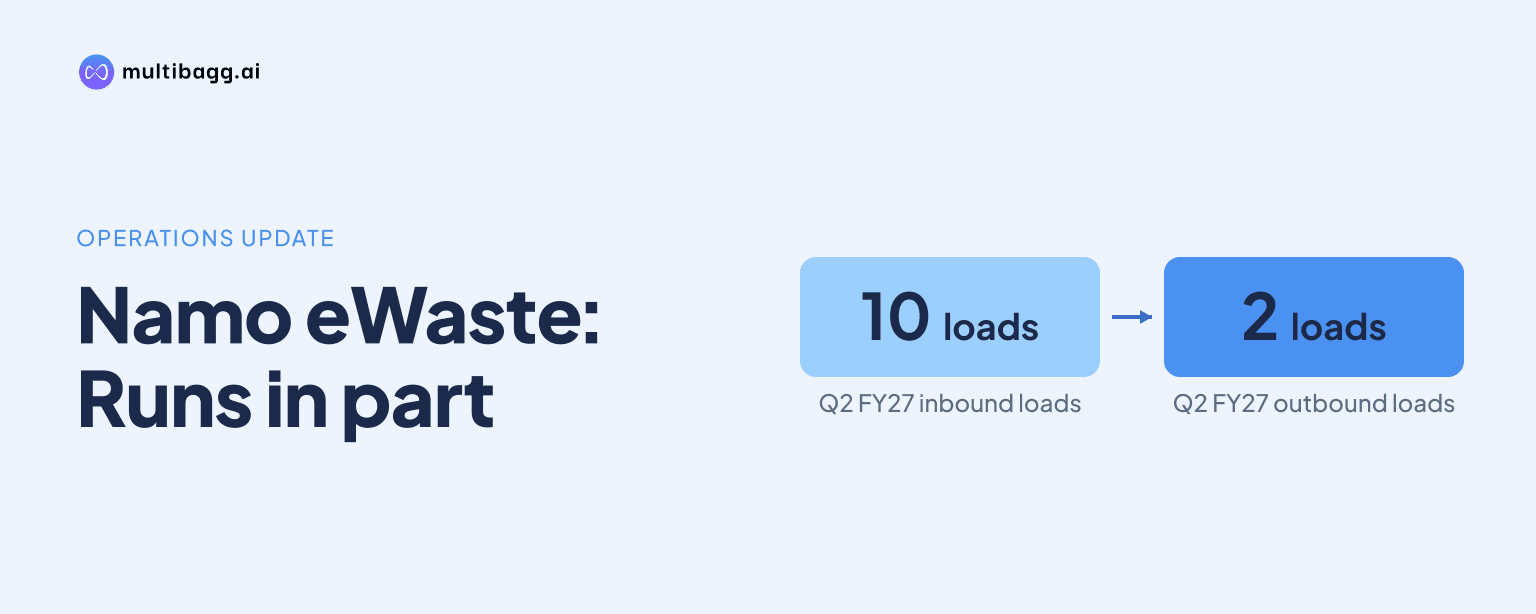
Namo eWaste Management Limited began partial commercial operations at its 25,000-metric-tonne-a-year Hyderabad plant in late Q2 FY27, but full recycling approval remained pending on November 18, 2026. Management said the site could cut 10 locally collected e-waste truckloads to two outbound loads, while related revenue continued to be recorded through Nashik or Palwal.
Know Namo eWaste Management inside out
Results, valuation, peers and who's buying, in one view.
Why is Namo eWaste’s Hyderabad plant operating only partially?
Namo eWaste is operating Hyderabad only within the activities possible before its recycling licence is granted by the state pollution board. Management said it had filed the required papers and had recently visited the authorities a few days before the November 18, 2026 call. The plant started partial commercial operations in late Q2 FY27, but it had not received approval to operate as a full recycling facility.
Management attributed the delay to the regulatory process rather than an operational problem at the 25,000-metric-tonne facility. It said the pollution board meets Central Pollution Control Board officials once a month, but a committee meeting had not occurred in the previous month. Management expected the licence very soon and indicated December as the latest expected timing, which remains management’s expectation rather than a confirmed approval date.
The missing licence means Hyderabad is not yet independently reporting recycling revenue. When asked about an earlier indication of Rs 30 crore to Rs 40 crore of FY27 revenue from Hyderabad, management said material sourced there was still generating revenue at the Nashik or Palwal facilities. It said the company would be better able to identify Hyderabad’s independent contribution by the end of FY27.
How is Namo eWaste using Hyderabad before approval arrives?
Namo eWaste is using Hyderabad as a pre-processing and logistics point that reduces the volume of e-waste sent to its other facilities. Management illustrated the process with 10 truckloads procured in Hyderabad, of which only two truckloads may need to be shipped to Delhi after the waste’s bulkiness is removed locally. The mechanism is intended to reduce reverse-logistics volumes before full recycling can begin.
Management said the delayed approval was not causing a loss of FY27 revenue opportunity because material can still be processed through existing infrastructure. Hyderabad-origin waste is being captured, handled locally to reduce transport volume, and then recycled elsewhere. This allows the site to support regional sourcing and logistics, although the revenue is not yet recognised as Hyderabad’s standalone processing revenue.
Hyderabad increased Namo eWaste’s total installed e-waste and battery-recycling capacity to 82,000 metric tonnes a year. Management expects only single-digit utilisation at Hyderabad in FY27 because operations began late and remain partial. For its first full year of operation, management indicated an initial utilisation level of about 30%.
Will the approval delay change Namo eWaste’s FY27 revenue plan?
Namo eWaste said Hyderabad’s pending approval would not prevent it from pursuing its FY27 revenue plan because waste can be routed to Nashik and Palwal. H1 FY27 income from operations rose 41% year on year to about Rs 124 crore. Management described Rs 350 crore as its first FY27 benchmark, said Rs 350 crore to Rs 400 crore remained achievable, and also said it was comfortable with at least Rs 300 crore.
The company expects the second half to carry more of the year’s revenue because disposal activity and Extended Producer Responsibility, or EPR, compliance are concentrated toward the financial year-end. Management identified January to March as the period with the highest revenue potential. Of H1 FY27 revenue, about Rs 35 crore came from battery recycling, Rs 8 crore from EPR, and about Rs 80 crore from IT and e-waste activities.
Namo eWaste is targeting about Rs 125 crore of battery-recycling revenue for FY27, including battery material held in inventory at the half-year stage. Management said battery scrap prices range from Rs 100 to Rs 400 a kilogram, depending on battery type, and cited battery gross margins of about 22% to 25%. It also said a late-September order from an original equipment manufacturer, or OEM, exceeded Rs 35 crore for nickel manganese cobalt, or NMC, batteries.
Got a follow-up? Ask IRIS
What do Hyderabad and battery operations mean for margins and capacity use?
Namo eWaste reported H1 FY27 earnings before interest, tax, depreciation and amortisation, or EBITDA, of about Rs 16 crore, up 41% year on year, at a margin of almost 13%. Profit after tax rose 29% to about Rs 9 crore. Management said team building, new facilities and pre-operative costs had increased during expansion, while newer infrastructure could support margin improvement once operating more fully.
The Nashik battery-recycling unit operated above 30% utilisation in H1 FY27, and management expects about 60% to 65% utilisation for the full year. Management said battery chemistry changes the revenue generated at a given utilisation rate: lithium iron phosphate, or LFP, batteries can require more capacity for lower revenue, while NMC batteries can yield higher revenue at lower utilisation. This makes capacity percentages an incomplete measure of battery-recycling revenue.
Management said sourcing is the principal constraint across its recycling operations, with about 60% of the team’s effort directed to sourcing. Namo eWaste said it works with more than 50 OEMs and collects about 5% of procurement directly from consumers through on-ground initiatives. The company also cited app-based collection tie-ups, regional sourcing teams and increased business-development staffing as part of its feedstock effort.
What must happen before Namo eWaste can scale Hyderabad further?
Namo eWaste must receive its pollution-board recycling licence and secure regional feedstock before Hyderabad can move beyond its partial role. Management’s 30% utilisation indication for the first full operating year shows that approval alone would not imply immediate operation at full capacity. The South India location is intended to improve access to the regional e-waste ecosystem and lower reverse-logistics requirements.
The Hyderabad rollout is occurring alongside Namo eWaste’s planned move into hydrometallurgical refining of black mass, the material produced from battery recycling. Management said its Nashik pilot plant, with capacity of 1 metric tonne a day, should begin commercial production before the end of March FY27. The proposed subsequent plant would process 5 metric tonnes a day, or about 2,000 tonnes annually, over a targeted 12 to 18 months.
Management estimated capital expenditure of about Rs 6 crore for the Nashik pilot and more than Rs 70 crore for the larger hydrometallurgy plant, excluding working capital. It said debt was its first funding choice for the larger project. Management also said the 5-metric-tonne-a-day facility could process about 1,500 tonnes of black mass generated at 60% battery capacity utilisation, and could be sufficient for two to two-and-a-half years.
Conclusion
Namo eWaste is gaining a logistics and sourcing foothold in South India before Hyderabad can become a fully operating recycling site. The partial setup lets the company reduce transport volumes and preserve access to material, while its established Nashik and Palwal facilities continue to perform the recycling and record the associated revenue. The arrangement supports the FY27 plan but leaves Hyderabad’s standalone contribution unresolved.
The immediate item to watch is the pollution-board approval that management expected by December 2026. Investors can then assess whether Hyderabad advances from single-digit FY27 utilisation toward the indicated 30% in its first full year, alongside the planned Nashik hydrometallurgy pilot before the end of March FY27.