










BSE remains below double-digit cash share despite initiatives
Key highlights
- BSE recorded its highest equity cash average daily turnover of Rs 1.0494 lakh crore in Q2 FY27.
- BSE said cash-equity market share remained below double digits in Q2 FY27.
- Index-options premium-volume ADTV fell from Rs 2.9615 lakh crore in Q1 FY27 to Rs 2.2531 lakh crore in Q2 FY27.
- BSE reported 32 main-board IPO listings in September 2026, raising Rs 4.0354 lakh crore.
powered by IRIS
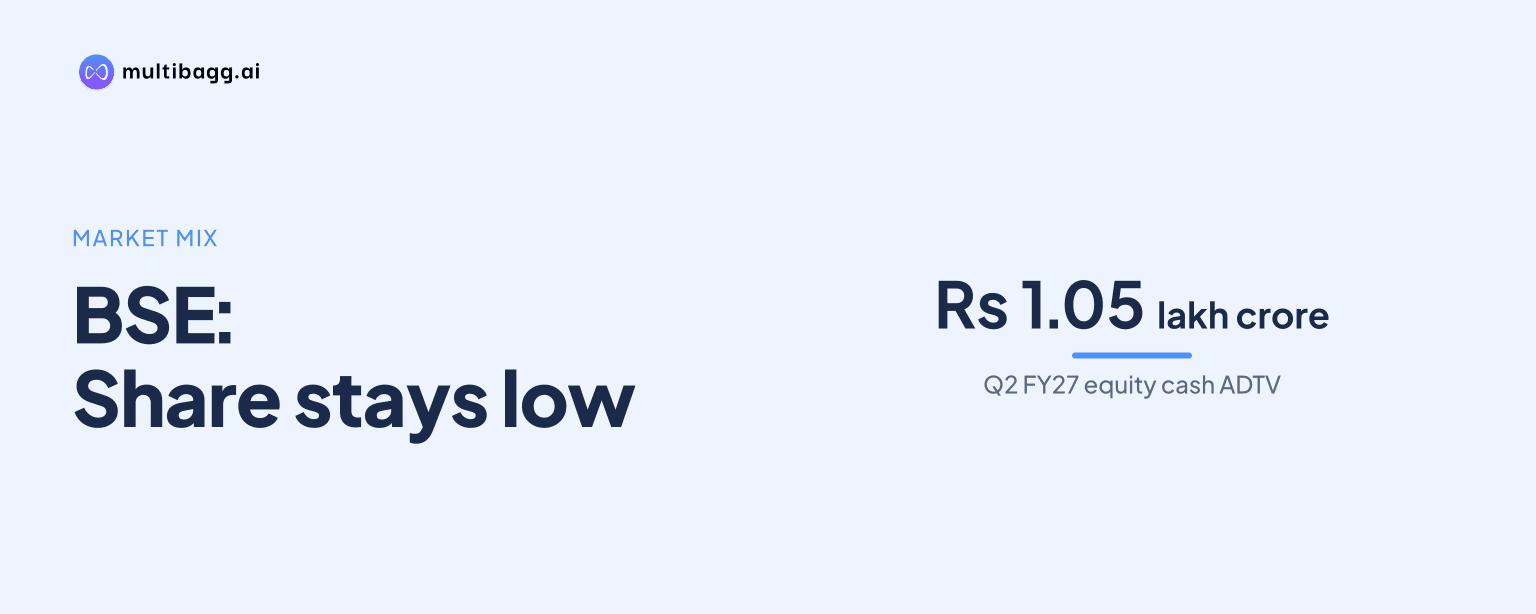
BSE remained below double-digit cash-equity market share in Q2 FY27 despite recording its highest quarterly average daily turnover of Rs 1.0494 lakh crore, as management cited incomplete broker-client activation, limited best-price execution and lower-than-expected trading volumes in some new listings.
Know BSE inside out
Results, valuation, peers and who's buying, in one view.
Why has BSE not reached double-digit cash-equity market share?
BSE has not yet reached double-digit cash-equity market share, according to S. Ramamurthy, who said the exchange continues to track this measure while reporting progress in broker and foreign portfolio investor, or FPI, additions. Management did not disclose the current cash-equity share in the call, but said broker and FPI growth was tracking its internal expectations and that detailed figures were available in its presentation.
The shortfall is not described simply as a loss of competitive position. Management said some operational facilitation, including a common contract note, has already been implemented. Yet it said a meaningful group of broker clients that have completed know-your-customer, or KYC, requirements and can trade equity on both BSE and NSE have not been enabled to trade on BSE.
BSE is working with those brokers to make the BSE segment available to eligible clients, according to management. The stated objective is to give clients a fair and equitable opportunity to participate on both exchanges to the extent they choose, rather than to require activity on a particular venue. Management said this change should support BSE's market-share progress.
Which execution issues are holding back BSE cash trading?
Best-price execution is not occurring at the scale BSE wants, and management identified that as a second operational constraint on cash-market share. Ramamurthy said market participants may need time to adopt best-price execution more fully, particularly after other issues had taken their attention.
Best-price execution matters because it concerns whether an order can be routed to the venue offering the best available price. Management did not quantify the share of orders affected or set a date for resolution. It said, however, that it expects further progress in coming days as participants increasingly absorb the process alongside the completed common-contract-note facilitation.
The exchange's comments distinguish market-access improvements from broader trading activity. BSE said it is working with brokers on client activation, while describing best-price execution as a market-participant adoption issue. Both mechanisms could increase the set of cash orders that can reach BSE, but management did not offer a numerical market-share target or a timetable for achieving double digits.
What evidence shows BSE cash-market activity has grown?
BSE reported its highest-ever quarterly average daily turnover, or ADTV, in equity cash trading at Rs 1.0494 lakh crore in Q2 FY27. That record shows higher activity on the exchange even as management said its cash-equity market share remained below double digits.
The cash-market result contrasts with the reported sequential movement in index options during the same period. Index-options premium-volume ADTV was Rs 2.2531 lakh crore in Q2 FY27, down from Rs 2.9615 lakh crore in Q1 FY27, which BSE attributed to compressed market volatility and temporary structural shifts in participation.
The derivatives measure recovered after the Q2 decline, with October 2026 reaching a monthly record of Rs 3.5481 lakh crore in premium-volume ADTV. BSE also recorded Rs 8.5356 lakh crore of single-day expiry premium turnover on October 22, 2026. These figures relate to index options rather than cash equities, so they do not establish cash-market-share gains, but they show that turnover trends differed across BSE's trading segments.
Got a follow-up? Ask IRIS
How are listings and market conditions affecting BSE cash volumes?
New listings have supported trading volumes, but BSE said the volume outcome from some listings has not yet met its initial expectations. Management said cash-market share could rise over time if the scrips for which it expected trading volumes grow to the anticipated levels.
The listing pipeline has been active. BSE reported 71 main-board initial public offerings, or IPOs, in the first half of FY27, raising more than Rs 8.4 lakh crore, and 32 main-board listings in September 2026 that raised Rs 4.0354 lakh crore. The exchange said these new IPOs were creating encouraging trading volumes, even though the expected trading activity in some new listings was still incomplete.
Broader market conditions have also affected equity volumes, management said. Ramamurthy cited FPI outflows from Indian markets as a factor affecting total equity trading volumes across the country. He characterized the setting as mixed because IPO activity was adding trading interest while the wider equity market faced lower volumes.
BSE said more than 150 companies were seeking access to capital markets through the main-board IPO pipeline, targeting approximately Rs 1.5 lakh crore of fundraising. That pipeline is not a forecast of exchange trading volumes, but it provides the source-backed basis for management's view that more listings could contribute to future cash-market activity if investor participation develops after listing.
What actions is BSE taking to expand participation?
BSE is pursuing broker-client activation and broader participant additions rather than presenting a near-term cash-share deadline. Management said its expansion in adding brokers and FPIs had not stopped, and that the exchange remained in a growth phase rather than considering itself mature in derivatives, a segment it said had completed more than three years.
Alongside trading access work, BSE reported product and infrastructure initiatives during FY27. It said its BSE-focused IT index derivatives, introduced earlier in the year, were gradually gaining participation across successive expiries. It also announced a strategic collaboration with MSCI to develop and expand MSCI-linked derivatives products, which management said would broaden exposure-management choices for domestic and international participants.
BSE reported Rs 103 crore of colocation and other connectivity revenue, including throttle charges, in H1 FY27. Management said it would expand colocation infrastructure in line with client demand and market participation. On pricing, it said any future changes to transaction, colocation or throttle charges would depend on customer feedback and be considered at an appropriate time.
Conclusion
BSE's cash-equity position combines a record Rs 1.0494 lakh crore Q2 FY27 daily turnover with a market share that management said remains below double digits. The gap reflects specific execution and access frictions: eligible clients not yet activated by brokers for BSE trading, best-price execution that has not reached the desired scale, and some newly listed shares producing less trading volume than initially expected.
The next items to watch are whether brokers enable more KYC-completed clients for BSE cash trading, whether best-price execution adoption broadens, and whether trading develops in newly listed scrips. BSE also disclosed an IPO pipeline of more than 150 companies seeking about Rs 1.5 lakh crore, while management said future pricing changes would be based on market feedback rather than a stated schedule.