










BSE’s October options premium ADTV reached Rs 35,481 crore
Key highlights
- BSE’s October 2026 index-options premium ADTV reached a record Rs 35,481 crore.
- BSE’s Q2 FY27 index-options premium ADTV was Rs 22,531 crore, versus Rs 29,615 crore in Q1 FY27.
- BSE recorded Rs 85,356 crore of index-options premium turnover on the October 22, 2026 expiry day.
- BSE’s H1 FY27 transaction charges rose 60% year on year to Rs 2,456 crore.
powered by IRIS
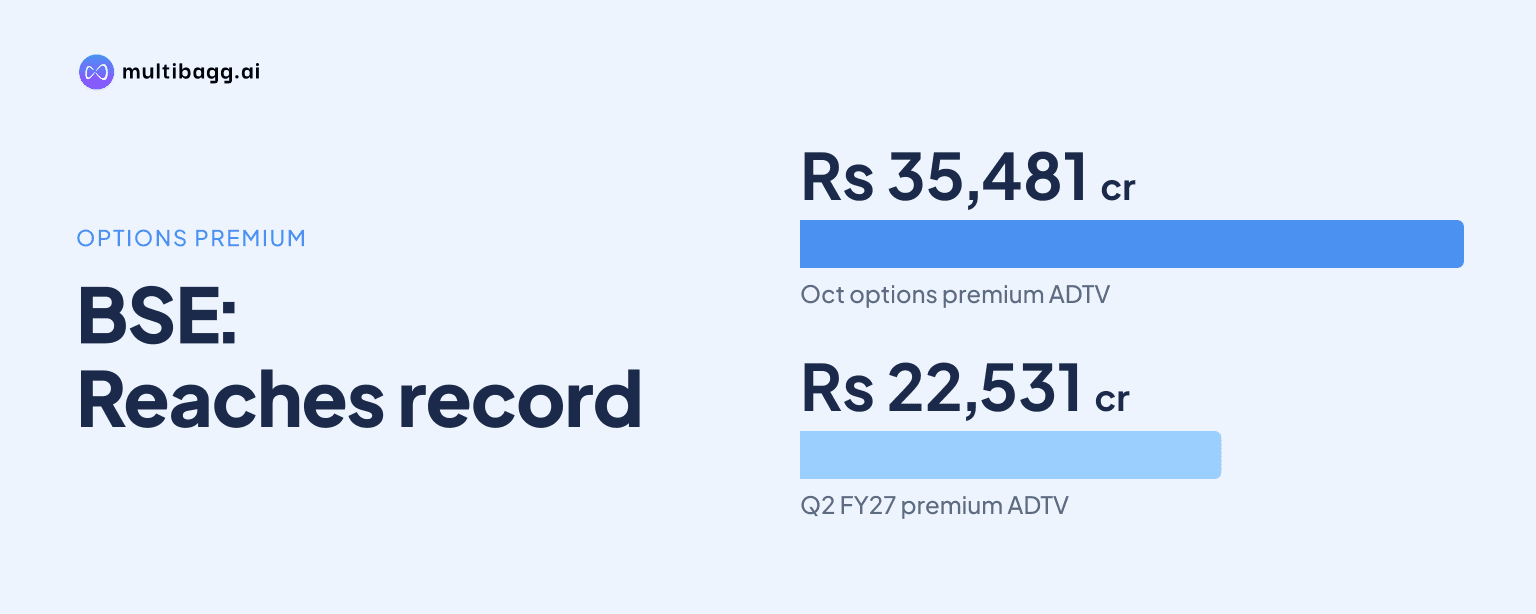
BSE Limited’s index-options premium average daily turnover (ADTV) reached a record Rs 35,481 crore in October 2026, after falling to Rs 22,531 crore in Q2 FY27 from Rs 29,615 crore in Q1 FY27. Management attributed the quarterly decline to compressed market volatility and temporary shifts in participation.
Know BSE inside out
Results, valuation, peers and who's buying, in one view.
Why did BSE’s index-options premium volume fall in Q2 FY27?
BSE’s index-options premium ADTV fell in Q2 FY27 because market volatility was compressed and participation underwent what management called temporary structural shifts. The Q2 FY27 reading of Rs 22,531 crore was BSE’s first sequential quarterly contraction, compared with Rs 29,615 crore in Q1 FY27.
The decline occurred even as BSE reported its highest-ever quarterly equity-cash ADTV of Rs 10,494 crore in Q2 FY27. Management therefore presented the options decline as a derivatives-specific movement rather than a uniform reduction in trading activity, while saying the exchange saw a decisive recovery in September 2026.
BSE’s October 2026 figure exceeded both the Q2 FY27 and Q1 FY27 levels. BSE did not disclose a September 2026 premium-ADTV figure on the call, so the reported September recovery cannot be quantified from the available remarks.
How large was BSE’s October index-options recovery?
BSE’s October 2026 index-options premium ADTV reached Rs 35,481 crore, Rs 12,950 crore above the Q2 FY27 level of Rs 22,531 crore. The October figure was also Rs 5,866 crore above Q1 FY27’s Rs 29,615 crore, reversing the sequential decline reported for the July-to-September quarter.
BSE also recorded its highest single-day expiry premium turnover of Rs 85,356 crore on October 22, 2026. Management said the expiry-day record reinforced its view of liquidity resilience and expanding derivatives-platform market share, although it did not provide a market-share percentage on the call.
The monthly ADTV record and the expiry-day record measure different periods. The Rs 35,481 crore figure is an October 2026 average daily measure based on premium volumes, while Rs 85,356 crore was premium turnover on the single expiry day of October 22, 2026.
What is BSE doing to broaden its derivatives products?
BSE is broadening its derivatives offering through focused information-technology, or IT, index contracts and a collaboration with MSCI. Management said BSE-focused IT index derivatives, introduced earlier in FY27, were gradually establishing themselves on the platform, with participation developing across successive expiries.
BSE has also entered a strategic collaboration with MSCI to develop and expand MSCI-linked derivatives products. Management said the intended products would combine BSE’s market-infrastructure capabilities with MSCI’s index expertise and give participants additional ways to manage exposure to global and Indian markets.
BSE’s product expansion sits alongside trading infrastructure that generated Rs 103 crore in co-location and other connectivity charges, including throttle charges, in H1 FY27. Management said it would further expand co-location infrastructure in line with client demand and growing market participation.
BSE’s stated objective is to offer differentiated products rather than depend on a single derivatives contract. The October 2026 premium-ADTV record followed the Q2 FY27 decline, while BSE did not quantify future volumes from the IT-index contracts or planned MSCI-linked products.
Got a follow-up? Ask IRIS
How did the derivatives reversal fit BSE’s wider H1 FY27 performance?
BSE’s derivatives recovery followed H1 FY27 consolidated revenue growth of 49% year on year to Rs 3,257 crore from Rs 2,184 crore. Operational revenue increased 48% to Rs 2,999 crore, while transaction charges across equity cash, equity derivatives, mutual funds and clearing rose 60% to Rs 2,456 crore.
Operating expenses increased 36% to Rs 980 crore in H1 FY27 from Rs 721 crore a year earlier. Management said 50% of total operating expenses related to regulatory fees and clearing and settlement expenses that are directly correlated with transaction volumes.
Operating earnings before interest, tax, depreciation and amortisation, or EBITDA, including the contribution to the core settlement guarantee fund, rose 55% to Rs 2,019 crore from Rs 1,306 crore. Net profit attributable to shareholders rose 53% to Rs 1,680 crore from Rs 1,095 crore, and management reported a 52% net-profit margin.
Other operating lines also expanded in H1 FY27. BSE StAR MF processed 24.5 crore transactions in Q2 FY27, up 22% year on year, while its H1 FY27 revenue rose 11% to Rs 146 crore. In primary markets, BSE reported 71 main-board initial public offerings in H1 FY27 that raised more than Rs 84,000 crore.
Conclusion
BSE’s reported sequence of a Q2 FY27 options contraction, a September 2026 recovery and October records indicates that derivatives activity improved after volatility and participation affected the quarter. This came alongside 60% H1 FY27 growth in transaction charges to Rs 2,456 crore and a record quarterly equity-cash ADTV of Rs 10,494 crore.
The next points to watch are participation in BSE’s IT-index derivatives across future expiries and management’s plan to develop MSCI-linked products. Management also cited more than 150 companies seeking to access capital markets with targeted fundraising of about Rs 1.5 lakh crore, a disclosed pipeline relevant to BSE’s listing and broader trading activity.