










BSE Says Its 65%-70% EBITDA Margin Can Remain Sustainable
Key highlights
- BSE said its current EBITDA margin is 67%-68% and that a 65%-70% range appears sustainable.
- BSE said monthly market-share volume was about 2%-3%, while non-expiry-week volume share was regularly 6%-7%.
- BSE has around 500 allocated co-location racks and is creating a buffer of about 175-190 additional racks.
- BSE said Sensex 30 derivatives started in May 2023 after feedback from more than 350 brokers.
powered by IRIS
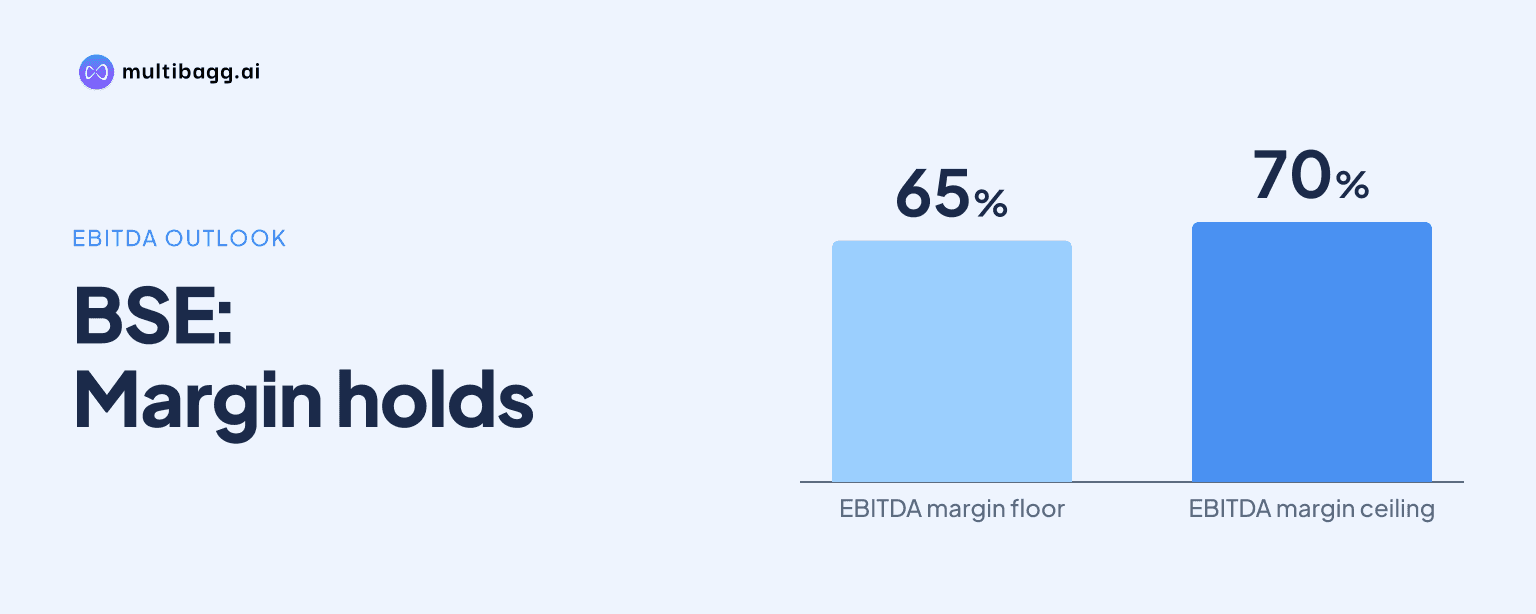
On its earnings call, BSE Limited said its current 67%-68% earnings before interest, tax, depreciation and amortisation (EBITDA) margin can remain within a 65%-70% range because revenue growth exceeds the rise in volume-linked regulatory, clearing and settlement costs. Management said cyber and global-market risks could change that position.
Know BSE inside out
Results, valuation, peers and who's buying, in one view.
Can BSE sustain a 65%-70% EBITDA margin?
BSE said it sees no current reason why its EBITDA margin should not remain sustainable at 65%-70%, after maintaining a 67%-68% margin for some time. Managing Director and Chief Executive Officer S. Ramamurthy attributed that outlook to high cost controls and discipline, while acknowledging that part of the exchange’s cost base rises as trading activity grows.
The outlook is management’s assessment rather than a formal numerical earnings forecast for a specified financial year. Its stated mechanism is that regulatory fees and clearing and settlement fees are variable costs, meaning they increase with volumes, but management said the associated increase in revenue is greater than the increase in expenditure. That relationship is the basis for retaining the 65%-70% range.
Why do BSE's volume-linked costs not undermine margins?
BSE said regulatory fees and clearing and settlement fees are its main costs that vary with volumes, and it does not control those charges. This means the margin argument is not based on costs staying fixed: expenditure is expected to rise when volumes rise, but management said revenue grows faster than those variable charges.
BSE also described a more calibrated approach to Settlement Guarantee Fund (SGF) provisioning. It said it now provides for SGF over the full one-year period instead of waiting for sudden increases in volumes or SGF requirements, which had previously created quarterly spikes. Management said there has been no structural change in SGF computation methodology, and that smoother provisioning explains the sequential decline raised by an analyst.
Technology spending is not expected to become a source of permanent cost reduction. Deepak Goel said technology expense charged to the profit and loss account has not been reduced, although it can move temporarily from one quarter to another. BSE’s margin outlook therefore relies on cost discipline and the revenue relationship with variable fees, rather than an announced reduction in recurring technology spending.
What could disrupt BSE's EBITDA margin outlook?
BSE identified cyber risk as the foremost operational concern for an infrastructure institution, saying it is present at all times and can arise in different forms. Management said BSE remains vigilant, but did not quantify a potential financial impact or disclose a specific cyber-spending target during the call.
Management also pointed to global turmoil, supply-chain changes and a possible rise in living costs as risks to market participation. Its stated concern is that higher living costs could reduce disposable income, savings and the ability to invest, affecting activity on BSE. The duration and scale of global uncertainty were described as factors outside management’s control.
A further risk is a flight to safety during pronounced global uncertainty. BSE said this could lead to capital outflows from emerging markets such as India, depleting capital available in those markets. Management explicitly said the 65%-70% margin outlook could change if such risks materialise, making the range conditional rather than unconditional guidance.
Got a follow-up? Ask IRIS
How do derivatives growth and spending plans affect BSE's margins?
BSE’s derivatives expansion provides context for management’s volume-and-revenue explanation. The company said its monthly market-share volume was about 2%-3%, while its share outside expiry week was regularly 6%-7%. Management said the latter measure had grown quickly before structural market changes and uncertainty caused a lull during the previous two to three months.
In equity derivatives, management linked growth to the Sensex 30 derivatives product started in May 2023 after feedback from more than 350 brokers. It said the product met demand for an original Sensex 30 contract rather than Sensex 50 derivatives, and also cited customers’ desire for another exchange to reduce concentration risk. An analyst referred to about 50% year-on-year growth in average daily premium turnover, although BSE did not provide underlying turnover figures in its response.
BSE does not plan to slow capital expenditure despite lower cash outflow in the first and second quarters than in the first half of the prior year. Goel said commitments had been made but cash flow might not yet have occurred, and that BSE was upgrading various systems. Management said investors would probably see the full picture by the end of the year, rather than describing the earlier cash-flow comparison as a reduced investment plan.
What operating investments is BSE making next?
BSE had around 500 co-location racks in its data centre, all allocated, and was building a buffer of about 175-190 additional racks within the existing building. Management said construction could be expedited if demand rises, or the capacity could be used for current requirements and released later. The plan provides additional capacity but includes no stated revenue or margin contribution target.
BSE had also received an allocation letter from the Mumbai Metropolitan Region Development Authority for a BKC plot. Management said it must complete formalities, obtain possession and determine what, how and when to build before commenting on a BKC co-location timeline. The existing 500-rack site and planned 175-190-rack buffer are therefore the more immediate disclosed capacity actions.
Conclusion
BSE’s stated 65%-70% EBITDA-margin outlook rests on a specific operating relationship: clearing, settlement and regulatory costs rise with market volumes, but management expects revenue to rise by more. The current 67%-68% margin, smoother one-year SGF provisioning and derivatives activity provide the context for that assessment, while cyber incidents and global-market disruption remain material risks.
The next disclosed markers are the end-of-year picture on capital expenditure, progress on the 175-190 additional co-location racks, and completion of BKC land formalities. Investors can also watch whether BSE’s 2%-3% monthly volume share and 6%-7% non-expiry-week share continue to improve, and whether global uncertainty affects capital flows or trading activity as management cautioned.