










BSE Limited H1 Revenue Rises 49%, Sees 65-70% EBITDA Margin
Key highlights
- BSE reported H1 FY27 consolidated revenue of ₹3,257 crore, up 49% year-on-year.
- H1 FY27 net profit rose 53% year-on-year to ₹1,680 crore, with a 52% net profit margin.
- BSE recorded an EBITDA margin of about 67-68% in Q2 FY27 and guided for a 65-70% range.
- Q2 FY27 index-options average daily turnover declined 24% quarter-on-quarter.
powered by IRIS
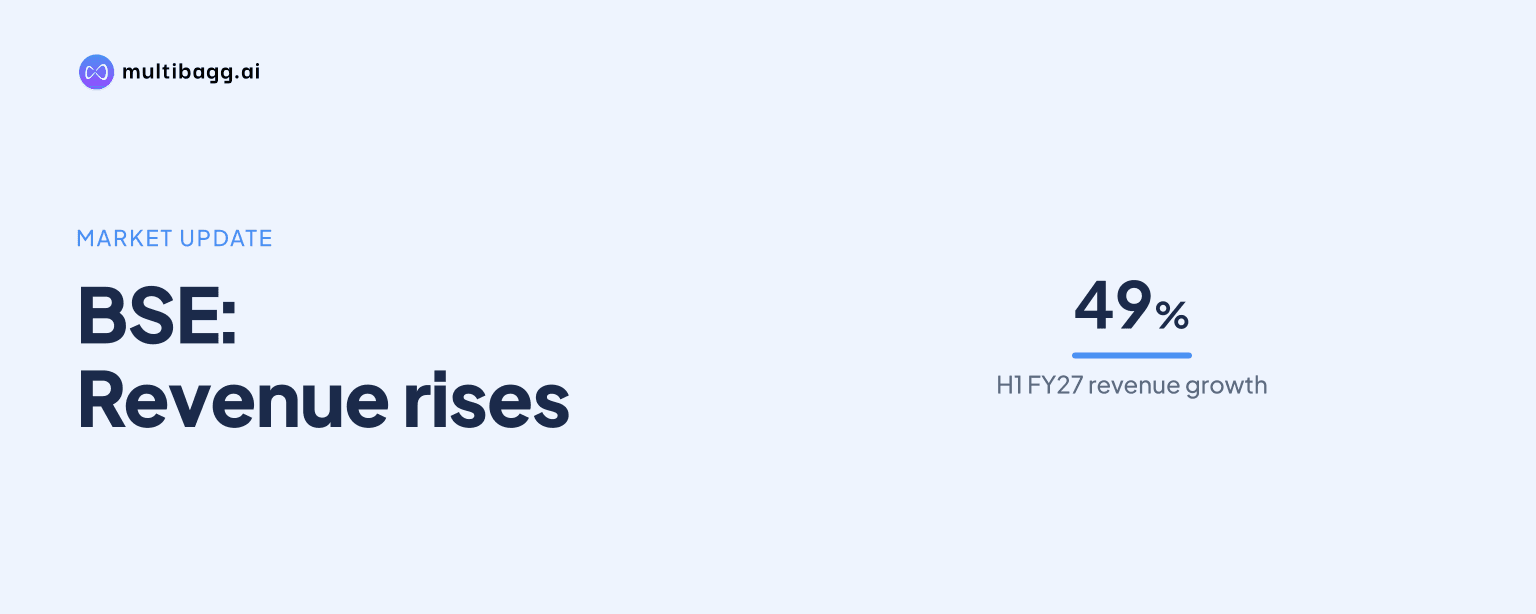
BSE Limited reported consolidated revenue of ₹3,257 crore for H1 FY27, up 49% year-on-year, and said its current 65-70% EBITDA margin range appears sustainable over the next one to two years, subject to identified macroeconomic risks not materialising.
Know BSE inside out
Results, valuation, peers and who's buying, in one view.
What did BSE report for H1 FY27?
BSE reported strong first-half growth, with consolidated revenue rising to ₹3,257 crore from ₹2,184 crore a year earlier. Operational revenue increased 48% year-on-year to ₹2,999 crore, while consolidated net profit grew 53% to ₹1,680 crore. The net profit margin for the period was 52%.
The exchange held its Q2 FY27 earnings call on November 4, 2026, where management linked the performance to continued participation in Indian financial markets and the scale-up of its businesses. It also noted that revenue of ₹146 crore in H1 FY27 rose 11% year-on-year in a business linked to the expanding mutual fund ecosystem.
For the June-September quarter, BSE reported revenue from operations of ₹1,541 crore, up 35.9% year-on-year. Net profit for Q2 FY27 was ₹807.5 crore, a 45.0% increase from the corresponding quarter of the previous year.
Why is BSE confident about its EBITDA margin?
BSE said EBITDA margin was about 67-68% in Q2 FY27 and that this level had been sustained for some time. Management attributed the margin profile to tight cost controls and operating discipline, while noting that the business has benefited from operating leverage as revenue expands faster than expenses.
The company’s current guidance is for EBITDA margin of 65-70%. Management said this range appears sustainable through FY28 and FY29, provided the risks flagged on the call do not materialise. This was not presented as an unconditional forecast, but as an outlook based on current business conditions and cost management.
The call summary indicated that transaction charges rose 60%, compared with a 36% increase in operating expenditure. That difference helps explain why profitability expanded alongside revenue, although future margins will remain dependent on market activity, product demand and the company’s cost base.
What market conditions did management highlight?
BSE placed its results in the context of resilient domestic economic and investment activity. India’s real GDP grew 7.8% in the first quarter of FY27, according to the figures cited on the call. Mutual fund assets under management reached about ₹82.64 lakh crore in September 2026 and expanded 12.5% during the first half of FY27.
Domestic institutional flows continued to contrast with foreign investor selling. Foreign institutional investors were net sellers of about ₹35,861 crore of Indian equities in September 2026, while domestic institutional investors deployed about ₹76,030 crore. Management views the growing domestic investor base, mutual fund participation and product diversification as structural supports for India’s financial-market architecture.
But the company also identified risks outside its control. These include global turmoil and supply-chain changes that could raise the cost of living and reduce households’ ability to save and invest. Management also cited the possibility of a flight-to-safety trade, which could lead to capital outflows from emerging markets including India during periods of heightened uncertainty.
Got a follow-up? Ask IRIS
What did BSE say about trading volumes and market share?
BSE did not provide numeric volume guidance on the call. Management said it hoped that government intervention aimed at deepening market liquidity would take effect and that global conditions would stabilise, but it did not offer a timeline for either development.
The Q2 period included a sequential decline in index-options turnover, described as the first such fall, with average daily turnover down 24% quarter-on-quarter. The exchange’s cash-market share also remained below double digits. Management did not specify a timetable for improving that position when questioned by analysts.
The company nevertheless reiterated confidence in its long-term direction, which is based on multi-asset product diversification and technology-led innovation. Separately, BSE acquired additional equity in India International Bullion Holding IFSC Limited through a ₹9.28 crore rights issue, raising its stake to 5.54%.
Why do BSE’s results matter to investors?
The results show that BSE’s earnings remain closely tied to the level and composition of activity in Indian capital markets. The 49% revenue increase and 53% profit growth in H1 FY27 demonstrate the financial effect of higher operating scale, while the 65-70% margin outlook provides a stated framework for assessing near-term profitability.
At the same time, the call underscored that trading activity can vary. The sequential fall in index-options turnover and the cash-market share position are relevant operational indicators, especially because management did not give volume targets. Domestic institutional inflows have supported market participation, but foreign outflows and global risk conditions remain important external variables.
Conclusion
BSE delivered 49% consolidated revenue growth and 53% net profit growth in H1 FY27, supported by higher operational revenue and a high-margin cost structure. Management’s 65-70% EBITDA margin outlook suggests it expects operating discipline and business scale to remain central to financial performance over the next one to two years.
Investors will watch whether index-options activity stabilises, whether cash-market share improves, and how domestic flows hold up against global uncertainty. The company has not disclosed numeric volume guidance, making future quarterly market-activity data and management commentary the main indicators to track.