










BSE Clearing Limited lifts equity trade capacity to 10 crore
Key highlights
- BSECL increased daily equity trade capacity from 2 crore to 10 crore trades.
- BSECL raised daily derivatives trade capacity from 4 crore to 9 crore trades.
- BSECL increased member-client capacity from 3,000 to 27,000 trades per second.
- BSECL settled 7.16 billion EQD contracts in Apr-26 to Sep-26, versus 5.41 billion a year earlier.
powered by IRIS
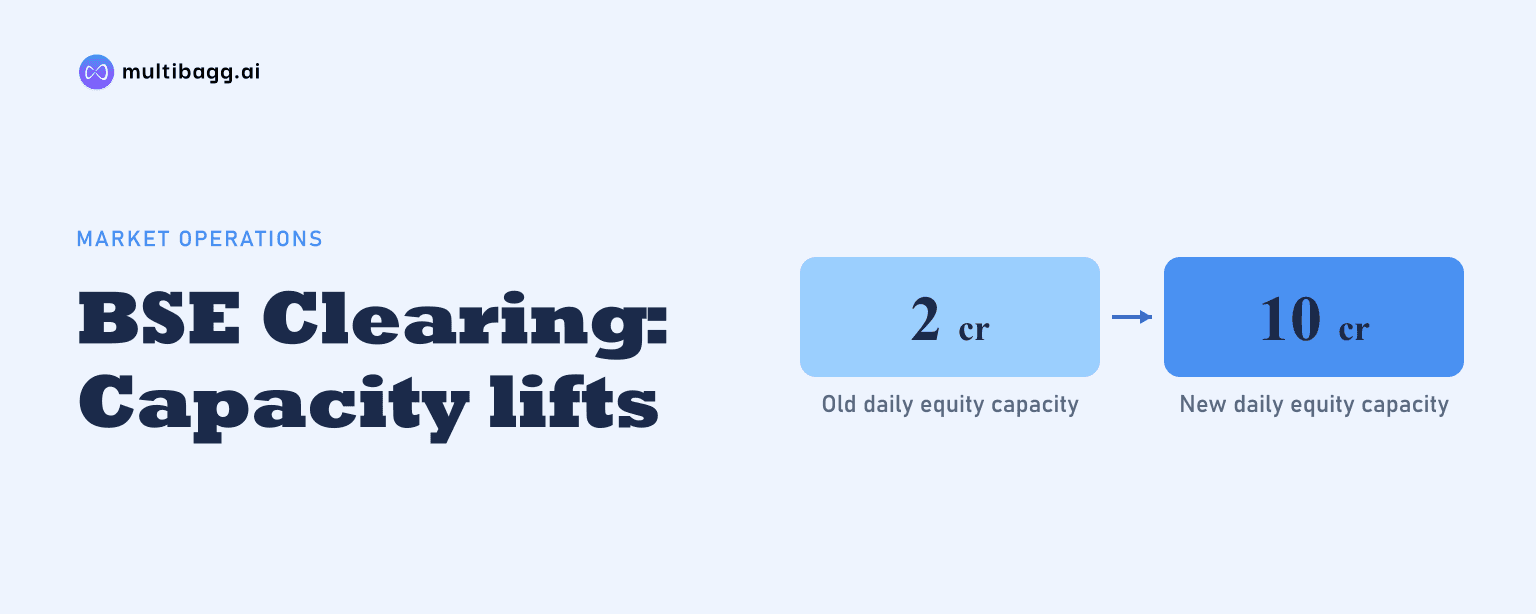
BSE Clearing Limited said its daily equity trade capacity has risen fivefold from 2 crore to 10 crore trades, alongside a rise in derivatives capacity from 4 crore to 9 crore and a ninefold increase in member-client processing capacity to 27,000 trades per second. The upgrades followed changes to its real-time risk management system.
Know BSE inside out
Results, valuation, peers and who's buying, in one view.
What capacity has BSECL added?
BSECL has increased daily equity trade capacity by 8 crore trades, taking it from 2 crore to 10 crore, while daily derivatives capacity has increased by 5 crore trades from 4 crore to 9 crore. The equity threshold is five times the earlier level, while derivatives capacity is 2.25 times the prior level.
The presentation attributes the changes to an upgraded real-time risk management system for equity and derivatives. It does not disclose the completion date, capital expenditure, utilisation rate or actual peak volumes for the upgrade, but it states the new daily operating thresholds separately for the equity and derivatives segments.
BSECL operates in the post-trade layer rather than as the trading venue. It was established in 2007 as a wholly owned subsidiary of BSE Ltd. and is recognised by the Securities and Exchange Board of India under the Securities Contracts Regulations (2018) as BSE's clearing corporation, with functions covering collateral, risk management, clearing and settlement.
How much faster can BSECL process trades?
BSECL says processing capacity per member per client has increased from 3,000 to 27,000 trades a second, a ninefold rise. This throughput measure is distinct from the 10-crore daily equity threshold and 9-crore daily derivatives threshold because it applies to each member-client combination rather than to a full day's trades.
The increase of 24,000 trades per second per member per client was disclosed as part of the real-time risk management upgrade. The presentation does not provide actual peak trades-per-second data before or after the change, so it does not show the extent to which the 27,000 threshold has been used in live market conditions.
BSECL also lists ISO 22301 for business continuity and ISO 27001 for information security among its quality measures. It reports AAA ratings from India Ratings and Care Ratings, while describing an enterprise risk management, or ERM, upgrade as an ongoing initiative intended to create unified risk oversight; no timetable or performance target is given.
Are BSECL's settled equity derivatives contracts rising?
BSECL settled 7.16 billion equity derivatives, or EQD, contracts from Apr-26 to Sep-26, compared with 5.41 billion contracts in Apr-25 to Sep-25. The comparable six-month total therefore increased by 1.75 billion contracts, even though activity was uneven during the more recent period.
The EQD series rose from 0.19 billion contracts in Apr-25 to 1.26 billion in Sep-25 and later reached its displayed peak of 1.49 billion in Jan-26. In the Apr-26 to Sep-26 period, monthly contracts began at 1.35 billion in Apr-26, fell to 0.89 billion in Aug-26 and recovered to 1.02 billion in Sep-26.
Sep-26 EQD contracts of 1.02 billion were 0.24 billion below the 1.26 billion reported in Sep-25, despite the higher six-month total. The presentation does not identify the causes of the Aug-26 decline or the Sep-26 recovery, and it does not link the capacity upgrade directly to the movement in settled contracts.
Got a follow-up? Ask IRIS
What does BSECL's settled turnover show?
BSECL's September 2026 settled turnover moved differently across equity turnover, or EQT, and EQD. EQT settled turnover was Rs 3,09,500 crore in Sep-26, up from Rs 2,91,800 crore in Sep-25, while EQD settled turnover was Rs 3,02,800 crore, down from Rs 4,30,900 crore a year earlier.
The month-on-month comparison also shows differing trends. EQT rose by Rs 21,700 crore from Rs 2,87,800 crore in Aug-26 to Rs 3,09,500 crore in Sep-26, whereas EQD fell by Rs 30,200 crore from Rs 3,33,000 crore to Rs 3,02,800 crore over the same two months.
The highest displayed monthly EQT turnover was Rs 3,94,200 crore in Apr-26. EQD turnover reached its displayed high of Rs 5,67,600 crore in Mar-26, when settled EQD contracts were 1.40 billion; these figures represent turnover and contracts settled, not BSECL revenue, profitability or market share.
How is BSECL developing its clearing operations?
BSECL says it engaged more than 160 members to strengthen its ecosystem and conducted webinars intended to improve operational ease and inclusive growth. These member initiatives sit alongside the rise from 3,000 to 27,000 trades per second per member per client, although the presentation gives neither webinar dates nor an outcome measure for the engagement programme.
The disclosed programme focuses on collateral, real-time risk management, clearing and settlement rather than on a revenue target. BSECL identifies its ERM upgrade as the continuing initiative in this area, with unified risk oversight as the stated objective, while the 10-crore equity and 9-crore derivatives thresholds define the capacity now disclosed for its clearing operations.
Conclusion
BSECL has reported a material increase in the processing thresholds of its clearing infrastructure: daily equity capacity is 10 crore trades against 2 crore previously, daily derivatives capacity is 9 crore against 4 crore, and member-client throughput is 27,000 trades per second against 3,000. Settled EQD contracts also rose to 7.16 billion in Apr-26 to Sep-26 from 5.41 billion in the comparable prior-year period, although September monthly activity was lower year on year.
The next disclosed development to watch is the ERM upgrade for unified risk oversight, for which BSECL provides no schedule or target. Subsequent disclosures could also show whether utilisation of the 10-crore equity and 9-crore derivatives capacities changes alongside settled turnover, which showed higher EQT but lower EQD turnover in Sep-26 than a year earlier.