










Burger King India sees 15% EBITDA margin route in volumes
Key highlights
- Burger King reported Rs 55 crore of company EBITDA, equal to 7.8% of quarterly revenue.
- Restaurant EBITDA was about 13%, up 2.5 percentage points year on year, with management describing a route toward 15%.
- SSSG was 14% for a second consecutive quarter and revenue rose 24% year on year to more than Rs 700 crore.
- Burger King had 619 restaurants and opened 12 restaurants in the current month.
powered by IRIS
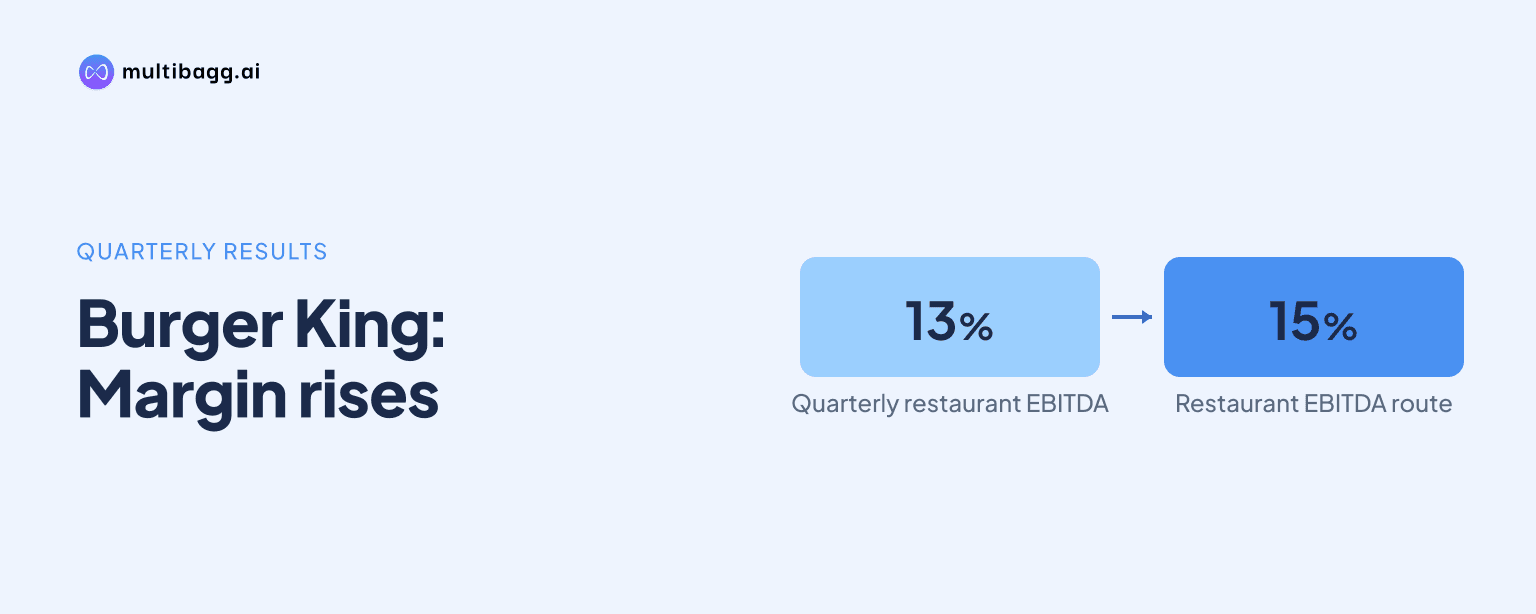
Burger King India said restaurant earnings before interest, tax, depreciation and amortisation, or EBITDA, can rise from about 13% toward 15% as traffic, family programmes and distribution density add operating leverage, after reporting Rs 55 crore of company EBITDA, equal to 7.8% of revenue, and 14% same-store sales growth in the quarter.
Know Restaurant Brands Asia inside out
Results, valuation, peers and who's buying, in one view.
How can Burger King reach a 15% restaurant EBITDA margin?
Burger King said higher restaurant volumes are the main route from the current level of about 13% restaurant EBITDA to 15%. Management said same-store sales growth, or SSSG, is a top-line measure, while continued restaurant openings introduce newer outlets with lower average daily sales, or ADS, and lower initial margins that dilute the blended network result.
The reported quarter showed that profitability had already improved despite that dilution. Company EBITDA nearly doubled to Rs 55 crore from Rs 28 crore in the year-earlier quarter, while revenue rose 24% year on year to more than Rs 700 crore. Restaurant-level profitability improved by 2.5 percentage points from a year earlier and company-level profitability increased by 2.8 percentage points.
Management said the family programme and a kids programme due in December should add visits and provide volume leverage. It also said efficiency work would continue, but the rate of improvement may not match earlier gains because Burger King has already built an efficient operating system at current volumes. Management therefore described the expected progression as margins moving above 13% and toward 15% as sales volumes increase.
What is keeping Burger King’s restaurant margin near 13%?
Burger King said new-store dilution, chicken-cost pressure and utility inflation have kept the restaurant EBITDA margin around 13%, even as SSSG reached 14% for a second consecutive quarter. New restaurants begin with lower ADS and lower margins than mature locations, so openings can reduce the group’s blended margin before their sales develop.
Management said chicken costs caused a small quarter-on-quarter decline in gross margin. It attributed the movement to a sudden market-wide chicken-cost headwind and said it did not expect the pressure to be long term. Burger King also cited work under way on chicken proteins and the vegetarian menu, although it gave no quantified saving target.
Utilities were another cost pressure, but management said operational measures and investments had offset the full utility-inflation effect in the reported quarter without relying on sales leverage. It added that annual planning includes labour inflation, including minimum-wage increases. Gross margin was around 70.4% to 70.5%, a range management said it viewed positively while pursuing further improvement.
How will distribution density improve Burger King’s gross margin?
Burger King expects restaurant clusters around distribution centres, or DCs, to reduce transport costs and improve gross margin in markets with higher food-logistics costs. Management said more restaurants near a DC make shipment loads larger, lowering distribution costs per location and providing relief to markets where food costs are elevated by delivery distance.
The network had crossed 600 restaurants and stood at 619 at the time of the call, including 12 restaurants opened in the current month. Management said a potential annual pace of 80 to 100 openings was possible, compared with roughly 60 to 70 restaurants, but stressed that expansion would remain subject to its existing payback and return evaluation process.
Management said local distribution benefits may initially have a limited effect on the consolidated profit and loss account because each cluster starts from a small base. But it expects savings to accumulate as restaurants are added around DCs. Purchasing scale may also increase as the network moves from 600 toward 800 restaurants, alongside continuing work on packaging and supply-chain costs.
Got a follow-up? Ask IRIS
Is Burger King’s growth coming from traffic or customer spending?
Burger King said its sales growth is primarily coming from traffic rather than higher average customer spending. Management said average check had remained broadly unchanged over many quarters, while positive dine-in traffic growth had continued for 14 consecutive quarters through value offers and product innovation.
App-only dine-in offers produced a 7% year-on-year increase in frequency among users claiming those deals. Burger King cited its 2 for 79 and 99 offers on the app as part of the value programme, and said its focus remains on bringing more customers into restaurants rather than increasing spending by the same customer.
Premium limited-time products can still lift the blended check, management said, though that is not the central sales strategy. Korean Season 2 delivered 30% higher volumes than Korean Season 1, and the Peri-Peri programme delivered 30% higher volumes than Korean Season 2. Management said those products were in the Rs 200 range, while family offerings are intended to attract additional customer groups.
What should investors watch in Burger King’s margin plan?
Burger King’s next test is whether traffic-led growth and the December kids programme raise mature-store volumes while new openings continue. Management declined to make a forward-looking statement on whether double-digit SSSG would continue into the next two quarters, although it said it was happy with the start to the current quarter.
Management also said Navratri had only a minimal effect because Burger King has a balanced vegetarian and non-vegetarian menu. It said traffic increases had significantly outweighed the seasonal effect. That differs from the more material footfall impact that the analyst said Navratri can have for some quick-service restaurant peers.
Opening discipline is another measure to follow. Burger King said it has shifted to a more linear opening schedule, with growth becoming more balanced from August and 12 openings already completed in October. It now develops a restaurant pipeline six to eight quarters ahead, rather than concentrating planning on the next year, to allow greater scrutiny of locations and investment decisions.
Conclusion
Burger King’s stated route to a 15% restaurant EBITDA margin combines traffic-led sales, family programmes, recovery from chicken-cost pressure, utility-efficiency work and lower distribution costs from denser clusters. The reported quarter supplied evidence of progress, with 14% SSSG, more than Rs 700 crore of revenue and Rs 55 crore of company EBITDA, while new stores continued to dilute the mature network’s margin.
The next disclosed milestones are the December kids programme, the development of gross margin from the 70.4% to 70.5% range and the pace of openings from the 619-restaurant network. Management also said it would share a robust plan for capital allocation after receiving primary capital, with liquidity of close to Rs 1,000 crore and potential additional warrant proceeds of about Rs 450 crore.