










Restaurant Brands Asia sees 80-100 annual store openings
Key highlights
- RBA said annual India restaurant openings could potentially rise to 80-100 from 60-70.
- RBA had reached 619 India restaurants by its Q2 FY27 earnings call and opened 12 stores in October.
- Q2 FY27 consolidated revenue rose 20% year on year to Rs 844 crore, while company-level EBITDA reached Rs 43.2 crore.
- India reported 14% same-store sales growth in Q2 FY27 and restaurant-level EBITDA of about 13%.
powered by IRIS
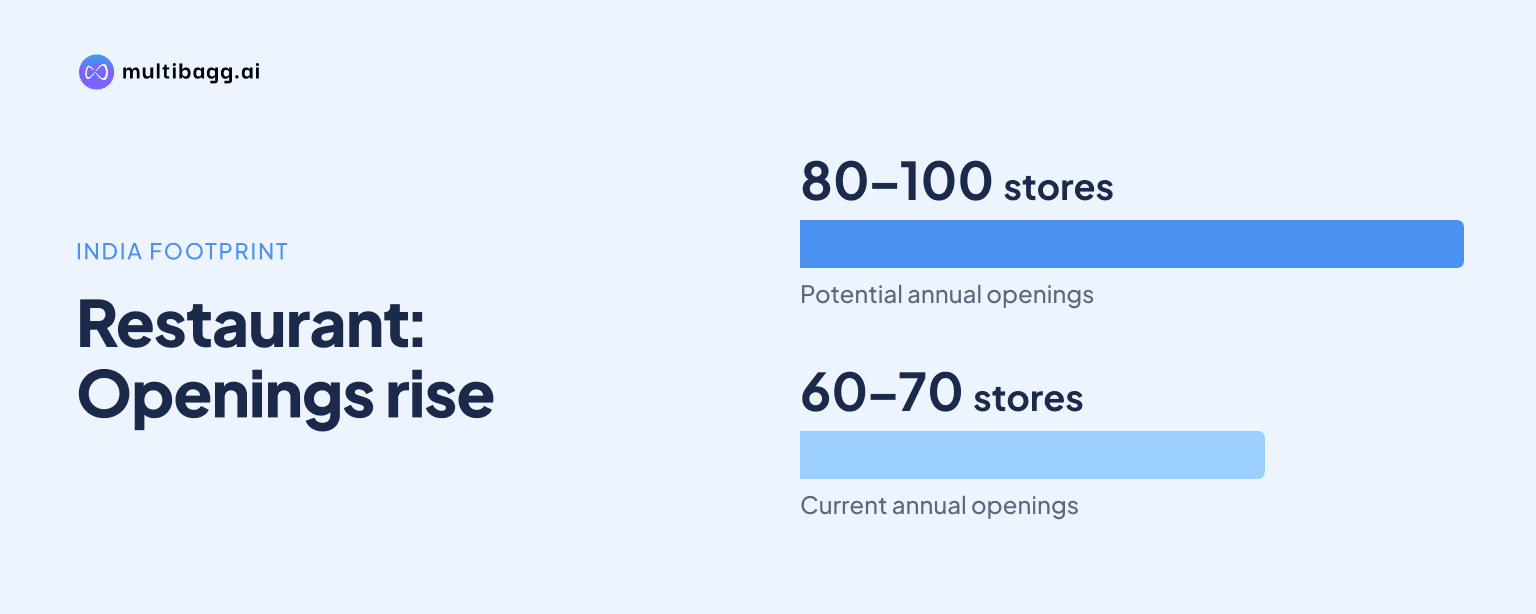
In Q2 FY27, Restaurant Brands Asia said it could raise annual India restaurant openings to 80-100 from 60-70, supported by 619 restaurants at the call date and a pipeline planned six to eight quarters ahead. RBA said this was a potential opportunity rather than formal guidance and that site-selection discipline would remain in place.
Know Restaurant Brands Asia inside out
Results, valuation, peers and who's buying, in one view.
Why does RBA see scope for 80-100 annual openings?
RBA sees scope for 80-100 annual India restaurant openings because management said improved profitability, capital expenditure work and a longer prepared pipeline could support a faster rollout. Management described the prior pace as 60-70 restaurants annually and said the higher range could become possible as better earnings before interest, tax, depreciation and amortisation, or EBITDA, flow-through supports expansion.
The India business had 607 restaurants in 144 cities at the end of Q2 FY27, and management said it had reached 619 restaurants by the earnings call. It also opened 12 India restaurants in October, following a more balanced opening pattern from August and September. Management said the increased pace reflects identified locations rather than a need to rapidly assemble a new pipeline.
India represented 83% of RBA revenue at the time of the call, compared with 17% for Indonesia. Management expects India to contribute more than 90% of revenue by the end of March, making the Indian network the principal driver of the proposed opening increase. India average daily sales, or ADS, were Rs 1.31 lakh in Q2 FY27.
How will RBA avoid a rushed restaurant rollout?
RBA said it will avoid a rushed rollout by retaining its payback and return evaluation criteria, opening restaurants more evenly through the year and assessing its pipeline six to eight quarters ahead. Management said it would not take a “cowboy approach” and characterised the 80-100 range as a potential outcome of responsible growth.
Management said investment in the growth team has helped shift openings away from a bulked-up quarter-end pattern toward a more linear schedule. The 12 October openings followed growth that had become more balanced in August and September. RBA said this process gives the team greater attention for each site and supports more deliberate investment decisions.
New restaurants can temporarily lower network averages because they begin with lower ADS and lower margins than mature sites, management said. India reported 14% same-store sales growth, or SSSG, in Q2 FY27, its second consecutive quarter at that level, while restaurant-level EBITDA remained around 13%. Management said mature-store sales growth and new-store dilution can therefore occur at the same time.
RBA also linked site growth to distribution efficiency. As it opens more restaurants around distribution centres, or DCs, management expects transportation costs to decline in markets with higher food costs. It said a substantial number of openings were planned for the current and following quarter, with the added density intended to improve freight economics as well as increase sales.
Got a follow-up? Ask IRIS
What do RBA’s Q2 FY27 results show about expansion capacity?
RBA’s Q2 FY27 results showed higher consolidated revenue and EBITDA than a year earlier, which management cited as support for its expansion potential. Consolidated revenue increased 20% year on year to Rs 844 crore, restaurant-level EBITDA rose 73% to Rs 91.8 crore, and company-level EBITDA reached Rs 43.2 crore from Rs 11.3 crore.
For India, management said quarterly revenue crossed Rs 700 crore and company-level EBITDA was Rs 55 crore, equal to 7.8% of revenue. It said India restaurant-level EBITDA had been around 13% over recent quarters, a 2.5-percentage-point improvement from the previous year, while company-level profitability improved by 2.8 percentage points.
Gross margin declined by about 0.4 percentage points amid chicken-cost pressure, according to management. RBA said energy-efficient equipment, solar installations and equipment upgrades were reducing utility spending, while annual planning accounted for labour and minimum-wage inflation. Management said more restaurants around DCs could also reduce distribution costs, although it did not forecast a linear margin improvement.
What demand drivers could support RBA’s larger India network?
RBA is relying on traffic growth, app-led value offers, premium menu launches and its Families platform to support a larger India restaurant base. Management said its value programme delivered 14 consecutive quarters of positive dine-in traffic growth, with 2-for-Rs 79 and 2-for-Rs 99 offers available on the Burger King app.
App-use frequency for claiming those deals increased 7% year on year in Q2 FY27. Management said the business remains focused on increasing customer traffic rather than materially raising average customer spending. It said regular industry pricing of 4-5% annually would continue, but traffic would remain the main sales lever.
Premium product launches have added volumes alongside the value menu. Korean Season 2 generated 30% higher volumes than Korean Season 1, and Peri-Peri generated 30% higher volumes than Korean Season 2, management said. These products were priced in the Rs 200 range and were intended to bring different customer occasions into the restaurants.
RBA launched its Families pillar in November and said a kids’ family programme would begin in December. Management expects these initiatives to add volume and operating leverage, but did not provide Q3 FY27 or Q4 FY27 SSSG guidance. It said only that it was pleased with the start of the quarter, including October, when Navratri and Shraadh fell in the period.
Conclusion
RBA’s potential move from 60-70 to 80-100 annual India restaurant openings rests on a larger planned pipeline, 619 restaurants at the call date and improved operating results. Q2 FY27 consolidated revenue rose 20% to Rs 844 crore, while India delivered 14% SSSG and restaurant-level EBITDA of about 13%, providing management with greater confidence to consider a faster but controlled rollout.
The next measures to watch are the opening pace after the 12 restaurants added in October, the November Families launch and the December kids’ programme. Management also expects India to account for more than 90% of revenue by the end of March, while planned restaurant density around DCs is intended to address distribution costs and support gross-margin progress.