










Burger King India traffic drives 14% same-store sales growth
Key highlights
- Burger King reported 14% same-store sales growth in the quarter, driven by customer traffic rather than ticket-size growth.
- Burger King recorded positive dine-in traffic growth for 14 consecutive quarters.
- Customers using Burger King app deals did so 7% more frequently year on year in the reported quarter.
- Burger King reported Rs 55 crore of company EBITDA, equal to 7.8% of revenue above Rs 700 crore.
powered by IRIS
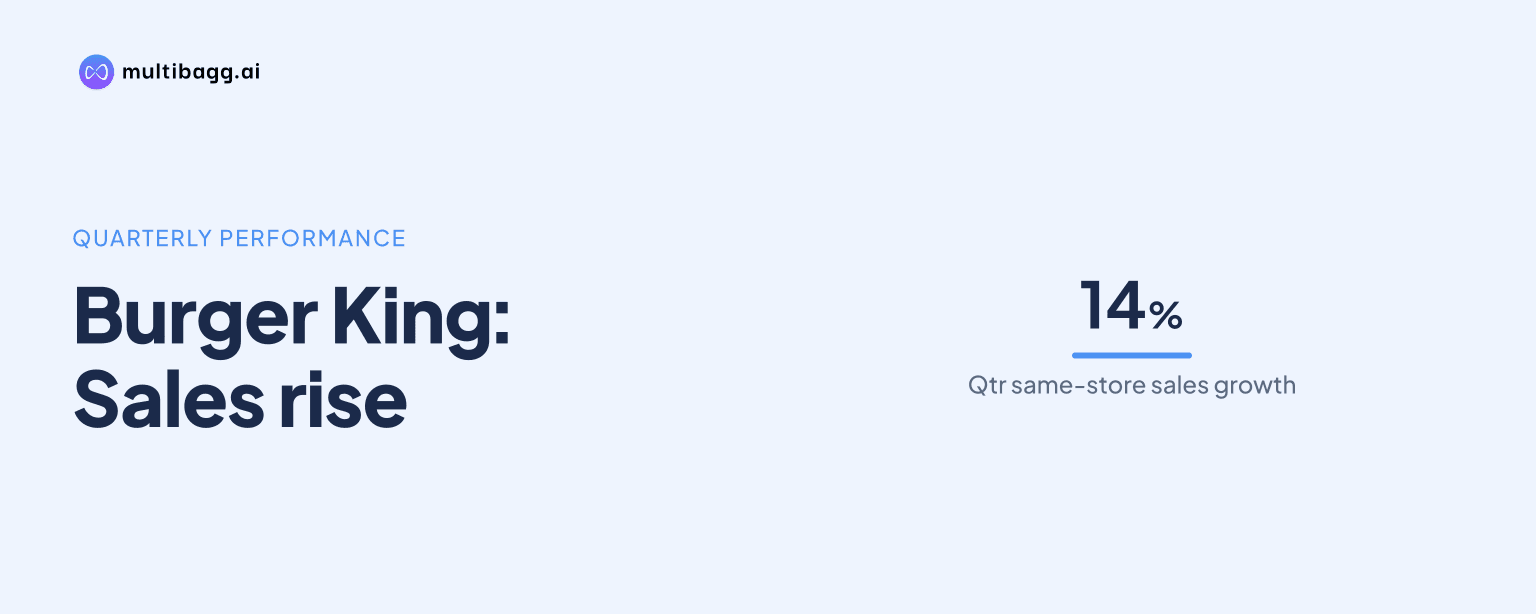
Burger King India said its reported-quarter 14% same-store sales growth came from customer traffic, not higher spending per visit, extending positive dine-in traffic growth to 14 consecutive quarters. Average daily sales were Rs 1.31 lakh, similar to the preceding quarter, while management said ticket sizes had remained broadly unchanged for several quarters.
Know Restaurant Brands Asia inside out
Results, valuation, peers and who's buying, in one view.
What drove Burger King’s same-store sales growth?
Burger King said its 14% same-store sales growth, or SSSG, was driven by more customer visits rather than a larger average bill. The company reported its second consecutive quarter of 14% SSSG and said dine-in traffic had increased for 14 consecutive quarters. Management described traffic, rather than customer spending per visit, as the source of sales growth across the recent periods.
Management linked this traffic focus to its value strategy, including its “2 for 79, 99” programme and app-led offers. Customers using Dine-In Crazy App Deals, which are available only through the Burger King app, increased their usage frequency by 7% year on year in the same quarter. The company said value remains a key strategic priority because it helps recruit customers into restaurants.
How stable was Burger King’s customer spend per visit?
Burger King said customer checks, or ticket sizes, have remained broadly stable for many quarters, making traffic the principal comparable-sales lever. Responding to an analyst’s question on the difference between traffic and sales growth, management said all growth was coming through traffic and that the check had remained “there or thereabouts the same.” Average daily sales, or ADS, were Rs 1.31 lakh, similar to the preceding quarter.
Management said ticket size could still change through a mix of routine pricing and product mix. It referred to industry pricing of about 4% to 5% annually and said family occasions and premium limited-time offerings could raise average checks. However, it said its focus for the next several years would remain increasing traffic, rather than seeking to raise spending from the same customer.
Premium products could affect mix because Korean and Peri-Peri burgers were priced in the Rs 200 range, management said. The company said these products are intended to bring different consumer groups into the business, while the Family pillar may also contribute to ticket size. That approach separates its value-led traffic strategy from the role of premium innovation in expanding customer occasions.
Which Burger King programmes are bringing customers into restaurants?
Burger King is using value offers to increase traffic and flavour-led launches to broaden its customer base. Korean Season 2 delivered volumes 30% higher than Korean Season 1, and the later Peri-Peri launch delivered volumes 30% higher than Korean Season 2. Management said those launches support taste credentials while the value programme remains the central driver of customer recruitment.
The next disclosed product campaign was an Avengers partnership covering products, packaging and a broader programme. Management said app pre-booking would begin the day after the call, followed by a launch across all stores. The company had reached 600 restaurants during the quarter and said it was at 619 after opening 12 stores in the following month, increasing the network available for these campaigns.
Got a follow-up? Ask IRIS
How did traffic-led sales affect Burger King’s profitability?
Burger King reported Rs 55 crore of company earnings before interest, taxes, depreciation and amortisation, or EBITDA, in the quarter, equal to 7.8% of revenue. Revenue exceeded Rs 700 crore and grew 24% year on year, while restaurant-level EBITDA was about 13%. Company EBITDA was Rs 28 crore in the comparable prior-year quarter, making the reported increase Rs 27 crore.
Management said the opening of new restaurants can initially dilute network profitability because new sites begin with lower ADS and margins. It said future customer volumes from the Family programme and a kids programme planned for December could provide operating leverage. Asked about a potential 15% restaurant EBITDA margin, management said movement from above 13% towards that level would come through volume growth.
Management also said the pace of efficiency gains should not be assumed to remain unchanged. Its view was that the system had already become efficient at current volumes, while incremental traffic could improve the EBITDA outcome. That distinction means the reported 14% SSSG and the planned traffic programmes are central to management’s margin pathway, alongside cost initiatives.
What could affect Burger King’s margins as traffic rises?
Burger King said more restaurant openings around distribution centres could reduce transportation costs in markets with higher food costs and support gross margin. Management attributed a small quarter-on-quarter gross-margin decline to a sudden chicken-cost headwind across the market. It said it did not expect the chicken-cost effect to be long term and was also working on chicken proteins and the vegetarian menu.
On operating costs, management said efficiency initiatives had fully offset utility inflation in the reported quarter, independently of sales leverage. It also said labour inflation, including potential minimum-wage increases, is included in annual planning. Management cited gross margins of about 70.4% to 70.5% as the current range and said it had a defined path to improvement, although the progression was unlikely to be linear.
Burger King also said Navratri had only a minimal effect on current-period demand because its menu is balanced between vegetarian and non-vegetarian offerings. Management said the increase in restaurant traffic had significantly overcome the seasonal effect. This suggests that the company viewed customer visits, rather than the calendar shift of Navratri and Shraadh into October, as the more important factor in the quarter’s trading start.
Conclusion
Burger King’s 14% SSSG was principally a traffic-led result: positive dine-in traffic extended to 14 consecutive quarters, app-deal usage frequency rose 7% year on year, and management said ticket sizes were broadly stable. The sales performance coincided with revenue above Rs 700 crore, company EBITDA of Rs 55 crore and restaurant EBITDA of about 13%, though new restaurant openings can initially reduce network averages.
The next items to watch are the Family programme, the kids programme scheduled for December and the rollout of the Avengers campaign across stores. Management also identified chicken costs, distribution savings from future openings and the pace of traffic growth as variables affecting gross margin and progress from restaurant EBITDA above 13% towards the 15% level raised by an analyst.