










Cantabil Q2 PAT gained about Rs 3 crore from lease reset
Key highlights
- Cantabil said its July 1 lease-estimate change added approximately Rs 3 crore to Q2 FY27 PAT.
- Cantabil reported Q2 FY27 PAT of Rs 7 crore, compared with Rs 6.8 crore in Q2 FY26.
- Cantabil recalculated lease liabilities and ROU assets for all leases using a six-year standard.
- Cantabil reported Q2 FY27 revenue of Rs 191.7 crore and negative 2% same-store growth.
powered by IRIS
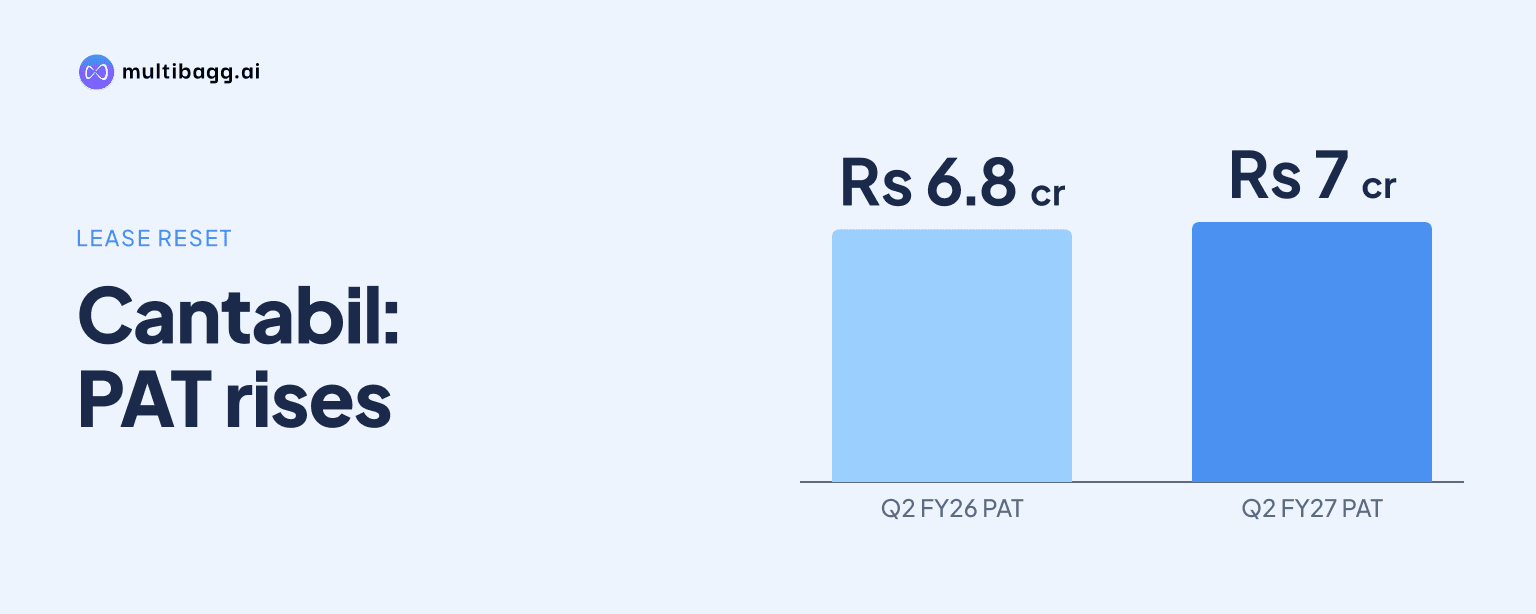
Cantabil Retail India Limited said its lease-accounting estimate change effective July 1 increased Q2 FY27 profit after tax, or PAT, by approximately Rs 3 crore, against reported quarterly PAT of Rs 7 crore. The company recalculated lease liabilities and right-of-use assets using a six-year term, contributing to their reduction despite continued store additions.
Know Cantabil Retail India inside out
Results, valuation, peers and who's buying, in one view.
What lease-accounting change did Cantabil make in Q2 FY27?
Cantabil changed its lease-accounting estimate from July 1, using a six-year standard to calculate lease liabilities and right-of-use, or ROU, assets for all leases. Management said the decision reflected changing business dynamics, internal decisions and the company’s move towards bigger stores. It also said the related note was included in the Q2 FY27 results release.
Before the revision, management said around 52% or 58% of its leases had terms of nine years or longer. Resetting the accounting term to six years therefore shortened the calculation period for a substantial portion of the portfolio. Management described the approach as consistent with what other industry peers were doing and said it was intended to keep the balance sheet light.
An ROU asset records the accounting right to use a leased property, while a lease liability represents the related payment obligation. Cantabil said it recomputed both measures across its lease base rather than applying the six-year estimate only to leases for newly opened stores. The call did not disclose the exact value of lease liabilities or ROU assets before and after the revision.
How much did the lease revision add to Cantabil's Q2 profit?
Cantabil said the accounting-estimate change increased Q2 FY27 PAT by approximately Rs 3 crore. Reported Q2 PAT was Rs 7 crore, up from Rs 6.8 crore in Q2 FY26, while the reported PAT margin was 3.7%. Management did not provide an adjusted Q2 PAT figure excluding the effect of the revised lease assumption.
The disclosed Rs 3 crore effect exceeds the approximately Rs 0.2 crore year-on-year increase in reported Q2 PAT. That means the reported comparison between Rs 7 crore in Q2 FY27 and Rs 6.8 crore a year earlier includes an accounting effect that management specifically identified. The call did not quantify how the revision affected depreciation, finance costs or individual lease-related line items.
Revenue and earnings before interest, tax, depreciation and amortisation, or EBITDA, continued to rise in Q2 FY27. Revenue from operations increased 9% to Rs 191.7 crore from Rs 176 crore in Q2 FY26, while EBITDA grew 5% to Rs 44.4 crore from Rs 42.1 crore. EBITDA margin stood at 23.2% in Q2 FY27.
Why did Cantabil's lease liabilities fall despite store additions?
Cantabil attributed the decline in lease liabilities and ROU assets to the six-year recalculation rather than a reduction in its physical retail network. Analyst Raj Shah said lease liabilities had fallen by almost Rs 200 crore versus March 2026 despite store additions. Management confirmed that an accounting-estimate change had been made but did not state the opening or closing liability balance during the call.
Cantabil was still expanding its network, with 690 stores and retail area of 9.89 lakh square feet at the time of the Q2 and H1 FY27 call. Management said it added 80,000 square feet during Q1 and Q2 and aspired to add at least 55,000 square feet in Q3. The balance-sheet movement therefore occurred alongside, rather than instead of, retail-space growth.
The company opened 23 stores in Q2 FY27, with family stores accounting for 70% and men’s, ladies’ and kids’ formats making up the rest. Management linked the revised lease estimate in part to the opening of bigger stores. It did not provide store-level lease terms, lease costs or a quantified connection between specific formats and the accounting change.
Got a follow-up? Ask IRIS
How did Cantabil's Q2 trading compare with reported profit growth?
Cantabil reported 9% revenue growth and 5% EBITDA growth in Q2 FY27, while same-store growth, or SSG, was negative 2%. Management attributed the weaker same-store result to a changed festive calendar, including an additional Hindu month in July, delayed weddings and Durga Puja sales moving from September to October.
Management said the negative 2% Q2 SSG had a marginal effect on pre-Ind AS profitability. Ind AS means Indian Accounting Standards, under which lease accounting affects the presentation of assets, liabilities and profit. Management also said festive sales were positive on a like-to-like basis, although it did not disclose a separate festive-sales growth rate.
For H1 FY27, Cantabil reported revenue of Rs 370.5 crore, up 11% from Rs 334.7 crore in H1 FY26. EBITDA increased 14% to Rs 103.8 crore from Rs 91.9 crore, lifting EBITDA margin to 28% from 27.2%. H1 PAT rose 9% to Rs 23.4 crore from Rs 21.4 crore, but management identified the lease-estimate effect specifically for Q2 rather than for the entire half year.
What does Cantabil expect after the Q2 lease revision?
Cantabil retained its FY27 revenue target of Rs 1,000 crore, with management allowing a variance of plus or minus 4% to 5%. Management said revenue at the time of the call was around Rs 375 crore to Rs 380 crore and that Q3 and Q4 would show whether delayed festive and wedding demand could support the target.
Management also maintained its communicated 4% to 5% SSG target over a five-year compound annual growth rate, or CAGR, basis. It said H1 SSG was 1%, meaning second-half SSG would need to be at least 7% to 8% to meet that stated annual objective. This was management’s target and not an estimate derived from the lease-accounting revision.
On store expansion, management said franchise opportunities remained open, but larger stores require more capital than many franchisees can deploy. Cantabil expects to open a couple of franchise stores in H2. Online sales contributed approximately 5.5% of Q2 sales, and management said that channel’s margin had not materially improved from the previous quarter.
Conclusion
Cantabil’s Q2 FY27 results combined continued revenue and EBITDA growth with a significant accounting-estimate effect on PAT. Revenue rose to Rs 191.7 crore and EBITDA reached Rs 44.4 crore, but the reported Rs 7 crore PAT included approximately Rs 3 crore from the six-year lease recalculation. The same change helps explain lower lease liabilities and ROU assets despite network expansion.
The next test is Q3 FY27, when management expects wedding-season demand and shifted festive sales to help reverse the negative 2% Q2 SSG. Investors can watch whether Cantabil adds its planned 55,000 square feet in Q3, meets its stated 4% to 5% SSG objective and progresses towards the Rs 1,000 crore FY27 revenue target.