










Cantabil keeps owned-store expansion after 80,000 sq ft
Key highlights
- Cantabil added 80,000 square feet in Q1 and Q2 FY27 and plans at least 55,000 square feet in Q3.
- Cantabil operated 690 stores covering 9.89 lakh square feet at the reported period-end.
- Revenue from operations rose 11% year on year to Rs 370.5 crore in H1 FY27.
- Family stores accounted for 70% of Cantabil’s 23 Q2 FY27 store openings.
powered by IRIS
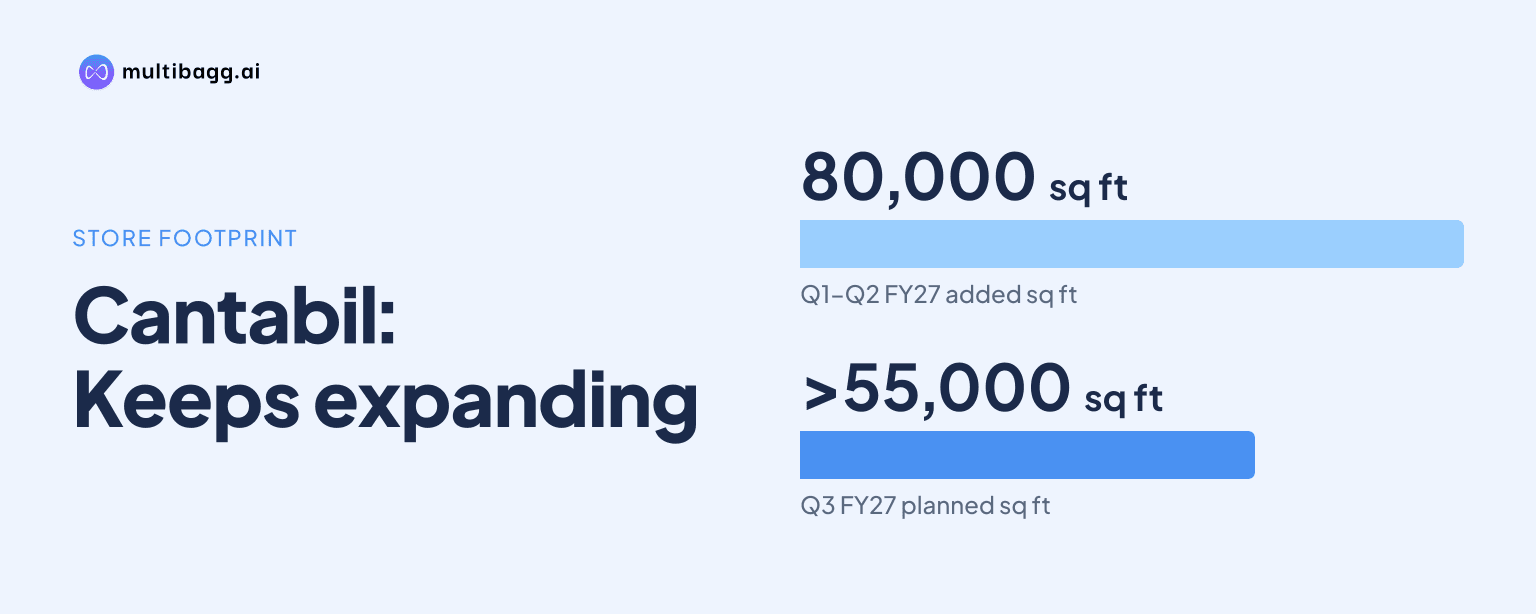
In H1 FY27, Cantabil Retail India Limited added 80,000 square feet and said it would continue expanding company-owned family stores because many franchisees cannot finance larger formats. Management plans at least 55,000 square feet of additional area in Q3 and said company stores offer better returns and longer operating lives.
Know Cantabil Retail India inside out
Results, valuation, peers and who's buying, in one view.
How much new retail area did Cantabil add?
Cantabil added 80,000 square feet across Q1 and Q2 FY27 and said it aspired to add at least 55,000 square feet in Q3 alone. The expansion came as its network reached 690 stores nationwide with 9.89 lakh square feet of retail area at the end of the reported period. Management linked the Q3 opening plan to its effort to recover sales deferred from the first half by the changed festive calendar.
The store additions are tilted toward the larger family-store format rather than only gender-specific outlets. Of the 23 stores opened in Q2 FY27, management said 70% were family stores, with the remaining stores serving men’s, women’s and kids’ categories. That mix places family stores at the centre of the current physical expansion programme, even while kidswear contributed only about 3% to 4% of sales.
Why is Cantabil prioritising company-owned family stores?
Cantabil said it is prioritising company-owned locations because the newer family stores are bigger and many franchisees cannot commit the required capital. Management said the franchise policy remains open, but the higher investment required for the larger format has reduced franchise participation. The rationale was a direct response to an analyst’s question about increasing capital allocation to self-owned family stores while sales momentum had moderated.
Management also said suitable locations can be available directly to the company rather than through franchisees. It stated that return on investment is good at company stores and that these stores are more stable and have longer lifetimes than franchise-operated sites. Those are management’s assessments, rather than a disclosed store-level return metric, but they explain why Cantabil is retaining ownership where it secures a preferred site.
The company described expansion capital allocation as a long-term decision that should not be changed because of one or two quarters of disruption. In Q2 FY27, sales were affected by an additional Hindu month in July, which reduced weddings during that period, while Durga Puja sales shifted from September into October. Management therefore separated the short-term trading effect from the longer-duration decision to build a larger store base.
Got a follow-up? Ask IRIS
How did sales momentum affect Cantabil’s store strategy?
Cantabil reported growth in both H1 and Q2 FY27, although the quarterly revenue growth rate was below the first-half rate. Revenue from operations rose 11% year on year in H1 FY27 to Rs 370.5 crore, while Q2 revenue rose 9% to Rs 191.7 crore. Management attributed the uneven timing partly to the festival shift and said it expected Q3 festivities to compensate for lower Q1 and Q2 sales.
Earnings before interest, tax, depreciation and amortisation, or EBITDA, increased 14% in H1 FY27 to Rs 103.8 crore, exceeding the 11% revenue growth rate, and its margin rose to 28.0% from 27.2%. Profit after tax, or PAT, rose 9% to Rs 23.4 crore in H1. In Q2, however, management said same-store sales growth was negative 2%, which it cited as the main reason for pressure on pre-Ind AS profitability measures.
Management did not present the Q2 same-store decline as a reason to halt new company-owned locations. Instead, it said festive sales had returned to positive like-to-like growth once the season occurred, while the wedding season had yet to begin at the time of the November 16, 2026 call. The company said consolidated Q3 results would provide a clearer picture after wedding-season trading, which it expected to affect Q3 and Q4 inventory release as well.
What are Cantabil’s franchise and second-half plans?
Cantabil has not abandoned franchising and said it would open a couple of franchise stores in H2 FY27. Management’s position is that the model depends on individual opportunities: franchisees may lack both the capital for larger family stores and access to desirable locations. This leaves room for franchise openings, while allowing the company to own stores in locations or formats where it sees a better operational case.
The immediate second-half priority is the planned Q3 addition of at least 55,000 square feet following the 80,000 square feet opened in Q1 and Q2. Management said the objective was to get near to its yearly target, but it did not state that target in the discussion of store area. The Q3 plan is therefore a disclosed operating aspiration, not a completed expansion figure.
The product and channel mix remains relevant to how the larger family format is used. Online sales accounted for approximately 5.5% of Q2 FY27 sales, and management said online margins had shown little change from the prior quarter. Meanwhile, kidswear was expected to be added to the online channel, though management said the category’s current sales contribution remained around 3% to 4%.
Conclusion
Cantabil’s expansion strategy is based on format size, location access and management’s stated preference for the economics and longevity of company-operated stores, rather than a return to a predominantly franchise-led model. The company added 80,000 square feet in Q1 and Q2 FY27 despite Q2 same-store sales falling 2%, while H1 revenue still rose 11% to Rs 370.5 crore.
The next measure to watch is Q3 FY27, when Cantabil plans at least 55,000 square feet of additional retail area and expects festive and wedding-season demand to offset the calendar-related shift from Q2. Management said the wedding period had not started by the November 16, 2026 call, making the forthcoming Q3 results its stated test of whether sales momentum and same-store growth recover.