










Capital Small Finance Bank Q2 PAT Rises 30.7% to ₹45.61 Crore
Key highlights
- Capital Small Finance Bank's Q2 FY27 profit after tax rose 30.7% year-on-year to ₹45.61 crore.
- Gross advances increased 23.4% year-on-year to ₹9,755 crore as of September 30, 2026.
- Total deposits rose 16.2% year-on-year to ₹10,831 crore, with CASA deposits at ₹3,734 crore.
- Net interest margin improved to 4.24% from 4.04%, while GNPA declined to 2.36%.
powered by IRIS
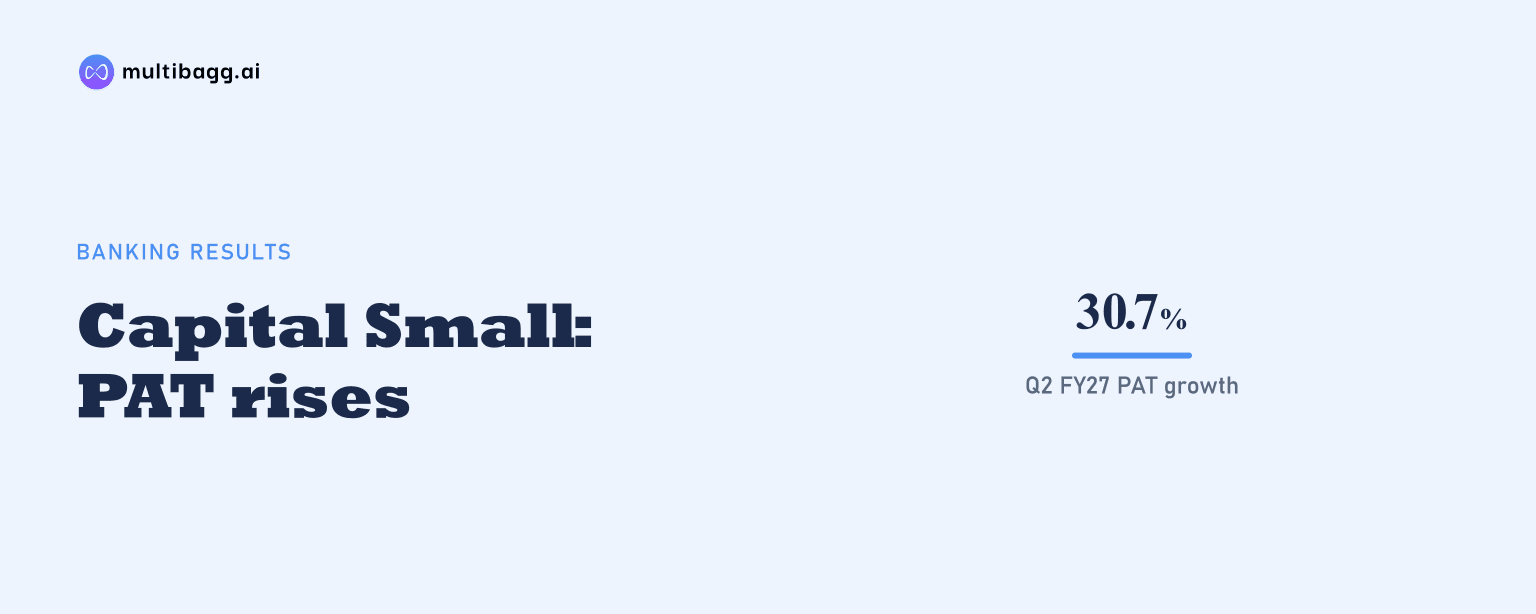
Capital Small Finance Bank Limited reported profit after tax of ₹45.61 crore for Q2 FY27, up 30.7% year-on-year, supported by 23.4% growth in gross advances to ₹9,755 crore and an improvement in net interest margin to 4.24% as of September 30, 2026.
Know Capital Small Finance Bank inside out
Results, valuation, peers and who's buying, in one view.
What did Capital Small Finance Bank report for Q2 FY27?
Capital Small Finance Bank reported unaudited results for the quarter and half year ended September 30, 2026, on October 29, 2026. Quarterly profit after tax increased to ₹45.61 crore from ₹34.89 crore in Q2 FY26. The result reflects growth in lending, net interest income and pre-provision operating profit during the period.
Net interest income rose 24.2% year-on-year to ₹138.7 crore, while other income was reported at ₹30 crore, compared with ₹24 crore a year earlier. Pre-provision operating profit increased 30.9% to ₹67.92 crore. The bank also reported an operating margin of 2.08% of average assets, compared with 1.88% in Q2 FY26.
How did lending and deposits change during the quarter?
Capital Small Finance Bank's gross advances stood at ₹9,755 crore at the end of September 2026, representing growth of 23.4% from a year earlier and 7.5% from the preceding quarter. This advance growth was higher than the 16.2% year-on-year increase in total deposits, which reached ₹10,831 crore.
CASA deposits were ₹3,734 crore and accounted for 34.5% of total deposits. The bank's stated customer focus includes middle-income households, farmers and micro, small and medium enterprises, with branch operations concentrated in North India. The reported figures show continued expansion of its lending and deposit base within this operating model.
For the first half of FY27, profit after tax was ₹86.91 crore, up 29.9% from ₹66.90 crore in H1 FY26. The half-year result provides a broader view of the quarterly performance and indicates that the higher profit in Q2 was part of the bank's reported first-half growth.
What happened to Capital Small Finance Bank's margins and asset quality?
Capital Small Finance Bank's net interest margin improved to 4.24% in Q2 FY27 from 4.04% in Q2 FY26. Return on assets rose to 1.39% from 1.26% over the same period. These measures accompanied the increase in net interest income and pre-provision operating profit.
Asset-quality indicators also improved year-on-year. Gross non-performing assets declined to 2.36%, while net non-performing assets declined to 1.12%. In Q2 FY26, the bank had reported gross and net NPA ratios of 2.70% and 1.38%, respectively.
The change in these ratios is relevant because loan growth and asset quality are both central to a bank's reported financial performance. The Q2 FY27 release presents lower reported NPA ratios alongside a larger advances book, without providing an earnings-call transcript or management guidance for the quarter.
Got a follow-up? Ask IRIS
How does the quarter compare with Capital Small Finance Bank's earlier results?
Capital Small Finance Bank's Q2 FY27 results followed Q2 FY26, when it reported profit after tax of ₹35 crore, gross advances of ₹7,907 crore and deposits of ₹9,317 crore. In that earlier quarter, disbursements rose 36.2% year-on-year to ₹805 crore, and the capital adequacy ratio was reported at 24.2%.
The latest quarter recorded a higher profit figure, larger advances and deposits, and improved NPA ratios compared with the prior-year period. The available Q2 FY27 materials also stated that the bank had not published an earnings-call transcript, meaning the reported figures are based on the investor presentation and financial-result disclosures rather than additional management commentary.
For investors, the margin movement is another reported change to monitor. Net interest margin rose by 20 basis points year-on-year, while CASA deposits formed more than one-third of total deposits. These disclosed measures provide context for the increase in net interest income, although the materials do not provide forward-looking guidance.
What do the Q2 FY27 results mean for investors and customers?
Capital Small Finance Bank's reported Q2 numbers show simultaneous growth in advances, deposits and profit, alongside lower reported gross and net NPA ratios. For investors, the main disclosed indicators are the 30.7% increase in quarterly profit, the 23.4% rise in gross advances and the 4.24% net interest margin.
For depositors and borrowers, the results show a larger deposit franchise and loan book at September-end. The bank's CASA balance of ₹3,734 crore and total deposit base of ₹10,831 crore are relevant operating measures, while its stated focus on households, farmers and MSMEs identifies the customer groups served by its branch-led business.
The results do not include a recorded earnings-call transcript or management projections. As a result, the available public information establishes the reported financial position for Q2 and H1 FY27 but does not confirm expectations for lending growth, margins, deposits or credit costs in later quarters.
Conclusion
Capital Small Finance Bank delivered a 30.7% year-on-year increase in Q2 FY27 profit after tax to ₹45.61 crore, with net interest income rising 24.2% and gross advances increasing 23.4% to ₹9,755 crore. Higher margins and lower reported NPA ratios accompanied the expansion in lending and deposits.
The next disclosed reference point will be the bank's subsequent financial results, where investors can assess whether advances, deposits, net interest margin and asset-quality ratios remain consistent with the Q2 FY27 position. Management guidance was not available in the materials because an earnings-call transcript had not been published for the quarter.