










Capital Small Finance Bank says 1.6% ROA plan rests on NIM
Key highlights
- Capital Small Finance Bank reported Rs 10.2 crore of Q2 bancassurance commission within about Rs 30 crore of non-fund income.
- Other fee income exceeded Rs 20 crore in Q2 and lifted the fee-income ratio to 0.92% from 0.82% in the prior quarter.
- Management said the move from 1.39% to 1.6% ROTA depends chiefly on NIM and operating-expense leverage.
- Capital Small Finance Bank reported an average credit-to-deposit ratio of 85.4% in Q2 and a deposit cost of 5.68%.
powered by IRIS
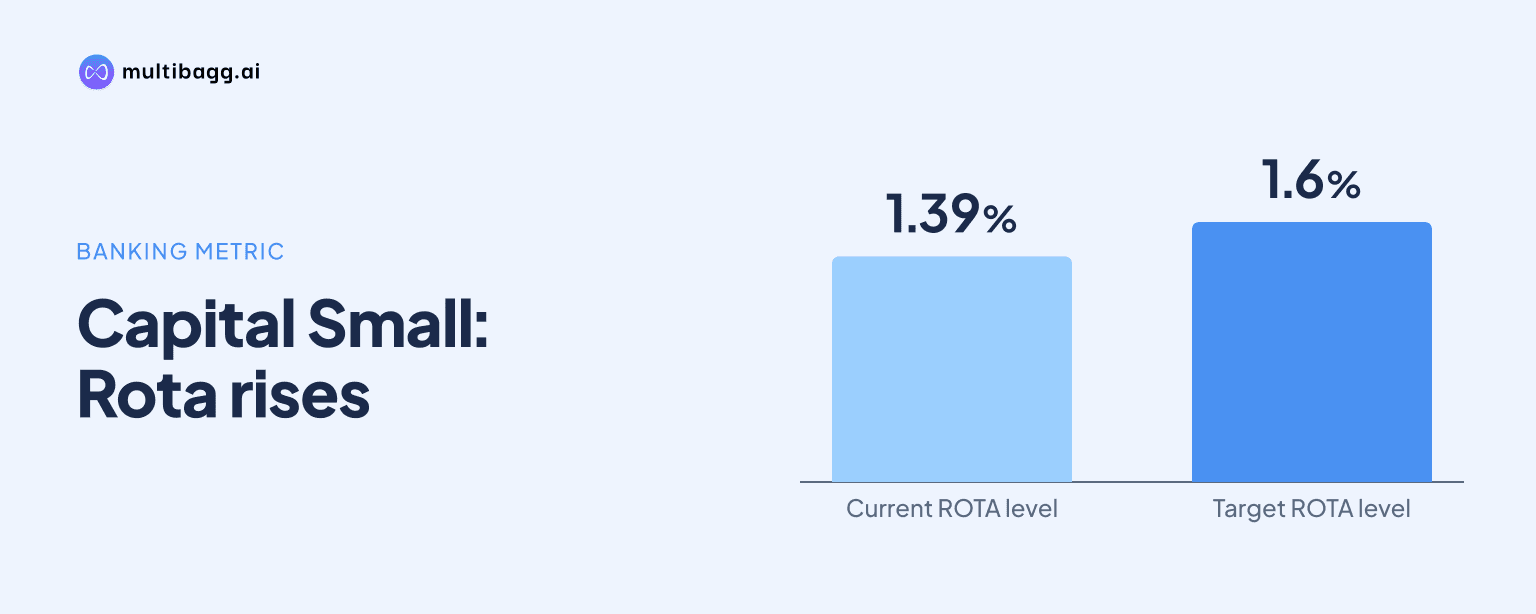
Capital Small Finance Bank Limited said its planned increase in return on total assets, or ROTA, from 1.39% to 1.6% relies chiefly on net interest margin and operating-cost leverage, despite Q2 bancassurance commission of Rs 10.2 crore within about Rs 30 crore of non-fund income. Management said other fee income exceeded Rs 20 crore.
Know Capital Small Finance Bank inside out
Results, valuation, peers and who's buying, in one view.
How exposed is Capital Small Finance Bank to distribution-income regulation?
Capital Small Finance Bank said bancassurance commission was Rs 10.2 crore in Q2, or around 33% of approximately Rs 30 crore in non-fund income. Management cautioned that bancassurance is broader than insurance distribution: it also includes three-in-one products, money-transfer services and other client offerings. The disclosed Rs 10.2 crore therefore does not establish the insurance-only portion of the income stream.
Management estimated that the overall component under discussion was equivalent to around 12% to 13% of profit before tax or profit after tax on a gross basis. It also said a direct contribution to ROTA cannot be calculated from gross income alone because operating costs and tax affect net profitability. Capital Small Finance Bank did not provide a numerical downside scenario for any change in insurance-distribution rules.
At the time of the call, management said the regulatory matter remained at a discussion-paper stage and was awaiting a draft. Capital Small Finance Bank had started internal work on possible responses, but said it would wait for the draft before changing strategy because a draft could allow a transition period of three to six months.
Why does Capital Small Finance Bank maintain its 1.6% ROA target?
Capital Small Finance Bank said its move from 1.39% ROTA to 1.6% will be driven by two factors: net interest margin, or NIM, and operating expenses, or opex. Management said non-interest income was not intended to be a major driver of the targeted ROTA expansion, limiting the direct role of bancassurance in the plan.
The bank said its original and updated plans assumed non-interest income of about 0.95% to 1%, compared with 0.92% currently. The latest 0.92% compares with 0.82% in the previous quarter and 0.86% in the same quarter a year earlier. Management said the increase came from other fee income rather than bancassurance commission.
Capital Small Finance Bank said it had prepared internal responses to different regulatory scenarios to minimise any ROTA effect. It did not name replacement products or forecast their income, stating that disclosure would be premature before the draft clarifies the regulatory framework. Its position is that potential fee-income disruption can be managed while NIM and opex remain the two stated profit levers.
What changed in Capital Small Finance Bank's fee income?
Capital Small Finance Bank said other fee income exceeded Rs 20 crore in Q2, compared with Rs 10.2 crore of bancassurance commission. This means other fee income was more than twice the disclosed bancassurance commission in the quarter. Management specifically attributed the increase in the fee-income ratio to 0.92% from 0.82% to other fee income.
The composition also means a restriction on insurance distribution would not necessarily eliminate the full Rs 10.2 crore reported under bancassurance. Capital Small Finance Bank said that category covers products beyond insurance, but did not disclose the revenue split between insurance, three-in-one offerings, money-transfer services and other activities.
Management said its retail franchise provides distribution capability and that it was considering alternative fee-income avenues. However, Capital Small Finance Bank gave no timetable for product changes, no projected replacement revenue and no revised ROTA bridge. Management's assessment that the effect would not be material for its balance sheet was an opinion, not a quantified regulatory forecast.
Got a follow-up? Ask IRIS
Can margin and operating leverage support Capital Small Finance Bank's target?
Capital Small Finance Bank identified NIM expansion as a central contributor to the path toward 1.6% ROTA. Its average credit-to-deposit ratio was 85.4% in Q2, and management said it saw room for improvement over the next 1.5 to 2 years. Management described this as a lever that could support NIM expansion alongside operating-cost leverage.
The bank said lending yields were 11% both in the current period and in Q2 a year earlier, while the cost of deposits declined to 5.68% from 5.92%. Management said 34% to 37% of deposits were in current accounts and savings accounts, or CASA, which do not reprice in the same way as term deposits. Stable reported lending yields and lower deposit costs were the mechanism management cited for margin improvement.
Portfolio diversification is another part of that margin assessment. Agriculture, mortgage and business loans are expected to account for 77% to 82% of the loan book, according to management. Business lending increased to 28% from 23% a year earlier, while agriculture was about 26%, down from roughly 35% two to three years earlier; management said loan against property within mortgage carries yields almost identical to agriculture.
What should readers watch before Capital Small Finance Bank's FY29 plan?
The first unresolved issue is the content and timing of the draft regulatory circular. Capital Small Finance Bank said it would await the draft, rather than the final rules, before making a material strategic shift. The potential revenue at risk remains unquantified because the bank did not separate insurance income from the Rs 10.2 crore bancassurance commission reported in Q2.
Management's Vision 2029 calls for about Rs 16,000 crore of assets under management, a balance sheet of roughly Rs 21,000 crore to Rs 23,000 crore, more than 300 branches, ROTA above 1.6% and return on equity above 15%. Capital Small Finance Bank said these metrics would support its aspiration to seek a universal-bank licence after FY29, rather than representing an announced application.
Conclusion
Capital Small Finance Bank has acknowledged that bancassurance-related income matters, accounting for about one-third of Q2 non-fund income and an estimated 12% to 13% of profit on a gross basis. Yet management's stated route from 1.39% to 1.6% ROTA rests on NIM and opex, while other fee income exceeded Rs 20 crore versus Rs 10.2 crore of bancassurance commission.
The next development is the draft regulatory circular, including any three-to-six-month transition period management said may be available. Readers can also watch whether the 0.92% non-interest-income ratio, 85.4% average credit-to-deposit ratio and 5.68% cost of deposits progress in line with Capital Small Finance Bank's FY29 plan.