










Capital Small Finance Bank targets FY29 NIM of 4.3-4.35%
Key highlights
- Capital Small Finance Bank targets FY29 NIM of 4.3% to 4.35%, compared with 4.2% currently.
- Management targets FY29 operating costs of 280 to 285 basis points of average assets, versus around 305 basis points currently.
- Capital Small Finance Bank aims to raise ROTA from 1.39% to 1.6% by FY29.
- The average credit-deposit ratio was 85.4% in the second quarter, with management targeting the mid- to high-80% range.
powered by IRIS
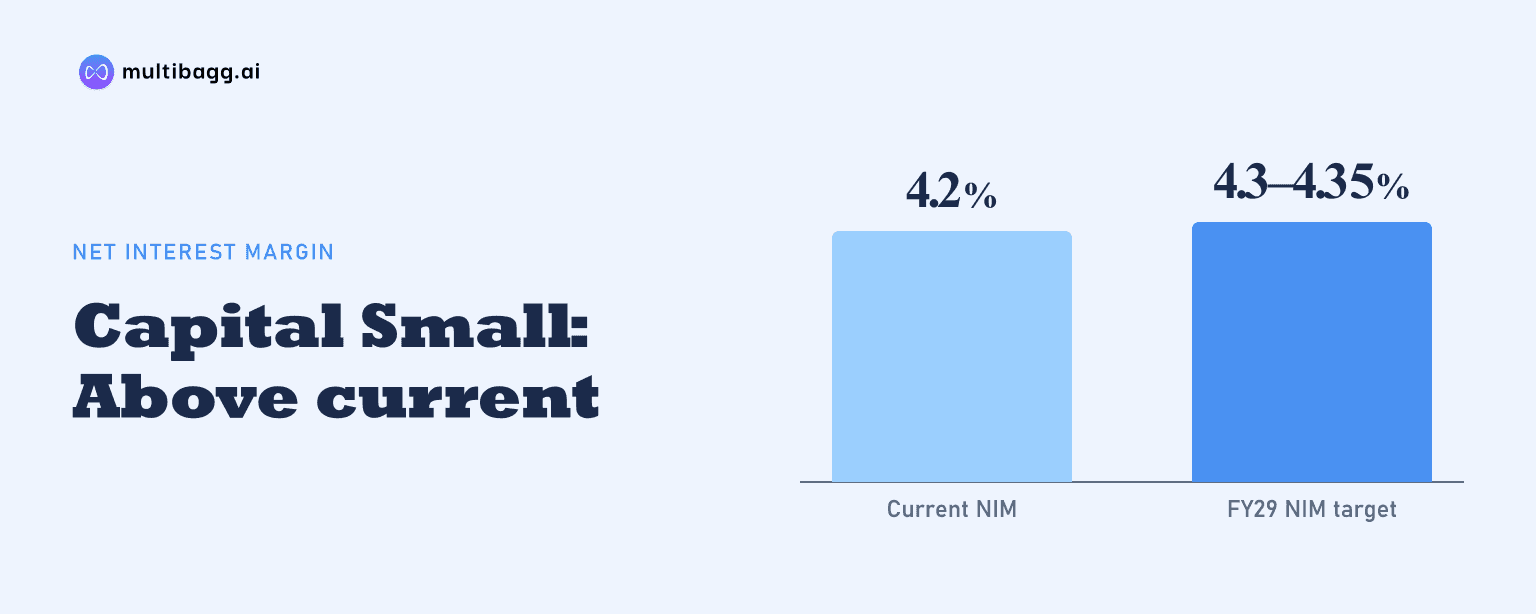
In FY29, Capital Small Finance Bank Limited targets a net interest margin of 4.3% to 4.35% and return on total assets of 1.6%, compared with its current 4.2% NIM and 1.39% ROTA. Management said higher credit deployment and lower operating cost as a share of average assets, rather than a major increase in fee income, should drive the improvement.
Know Capital Small Finance Bank inside out
Results, valuation, peers and who's buying, in one view.
What profitability targets has Capital Small Finance Bank set for FY29?
Capital Small Finance Bank targets FY29 NIM of 4.3% to 4.35%, operating costs of 280 to 285 basis points of average assets and ROTA of 1.6%. A basis point is one-hundredth of a percentage point, making the operating-cost target equivalent to 2.80% to 2.85% of average assets. Management described NIM and operating expenses as the two principal variables in moving ROTA from 1.39% to 1.6%.
The targets compare with a current NIM of 4.2% and operating cost of about 3.05%, or 305 basis points, of average assets. Management said the cost-to-income ratio is currently around 60% and should improve as the balance sheet grows, although it expects the ratio to remain relatively high in FY29 because expansion will continue.
Management said FY29 is about 2.5 years away and indicated that operating leverage should emerge from business growth over an already expanded administrative and management base. It did not provide annual milestones for NIM, ROTA or the 280-to-285-basis-point operating-cost range.
How does Capital Small Finance Bank plan to raise NIM?
Capital Small Finance Bank expects a higher credit-deposit ratio to be the main NIM lever, without changing the pricing of deposits or advances. Its average credit-deposit ratio was 85.4% in the second quarter, and management wants to take it to the mid- to high-80% range over time. Deploying a larger share of deposits into loans is the mechanism management linked to margin expansion.
Management said there was scope to improve the average credit-deposit ratio by at least 2 to 3 basis points over a medium-term period of 1.5 to 2 years. It estimated that the deployment lever could provide a 7-to-10-basis-point NIM benefit, while later describing the NIM contribution to the ROTA plan as 7 to 12 basis points. These were management expectations rather than reported results.
Loan mix is also relevant to the 4.3% to 4.35% NIM target. Management expects agriculture, mortgage and business loans together to retain a 77% to 82% share of the portfolio. It said loan against property, or LAP, within the mortgage portfolio has pricing almost identical to agriculture, which it identified as its highest-yielding product.
Management also said its micro, small and medium enterprise, or MSME, loans have maintained pricing metrics despite compression in the broader advances market. The mix approach is intended to support NIM while business lending grows faster than agriculture and while the bank expands lending outside its Punjab and Haryana markets.
Why is Capital Small Finance Bank changing its loan mix?
Capital Small Finance Bank is increasing the business-loan share as it diversifies geographically, while continuing agriculture lending in Punjab and Haryana. Business loans accounted for 28% of the portfolio, up from 23% a year earlier, while agriculture's share had fallen to around 26% from about 35% two to three years earlier. Management attributed the shift to faster business-loan growth rather than reduced interest in agriculture.
Agriculture grew 6.23% quarter on quarter, according to management, but Capital Small Finance Bank confines that activity to Punjab and Haryana. It has not opened agriculture lending in Rajasthan because management's initial assessment of that market was not encouraging. In Punjab, management said early paddy-procurement data showed productivity was the same as or better than the prior year in 25 of 26 districts.
Business lending includes cash credit, overdrafts, working-capital term loans, demand loans against property, term loans and project financing. Management said it reviews product design at half-yearly town-hall meetings with business leaders and is evaluating consumption-led products, although it characterised that work as early-stage evaluation rather than a confirmed launch plan.
Capital Small Finance Bank had seven branches in Rajasthan when management discussed its expansion plans. It said the bank was initially entering Rajasthan and the National Capital Region through the business segment, using an asset-first approach before seeking to build local deposits through customer trust and wider ecosystem participation.
Got a follow-up? Ask IRIS
How will Capital Small Finance Bank lower operating costs?
Capital Small Finance Bank expects the operating-cost ratio to decline from around 305 basis points to 280 to 285 basis points by FY29 through scale. Management said middle- and senior-management costs and fixed administrative costs have already been expanded, so additional business volumes should improve operating cost as a share of average assets.
Management estimated that operating expenses could contribute 8 to 15 or 20 basis points to the ROTA improvement from 1.39% to 1.6%. It did not identify a specific expense category for reduction or give a year-by-year cost path. The stated route is operating leverage from a growing balance sheet, rather than a discrete cost-cutting programme.
Management said it does not expect to fully optimise the cost base by FY29 because Capital Small Finance Bank will remain in an expansion phase. It expects cost-to-income improvement from the present level of around 60%, but said further optimisation could occur after FY29 rather than within the current planning horizon.
What role will fee income and deposits play in the FY29 plan?
Capital Small Finance Bank does not expect non-interest income to be a major driver of its move to 1.6% ROTA. Management said non-interest income was currently 0.92% and had generally been expected to remain around 0.95% to 1%. It allowed that the category could contribute something, but said NIM and operating expenses remained the core drivers.
This position is relevant to a possible regulatory change affecting insurance-distribution income. Management said it had prepared responses for different scenarios to minimise any ROTA impact, but would not specify alternative revenue opportunities before reviewing the regulatory draft. It said there were other ways to earn from customer servicing, while calling detailed estimates premature.
On deposits, management cited a quarterly cost of deposits of 5.68%, after referring to 5.92% and 5.6% in preceding comparisons. It said current account and savings account, or CASA, balances represented more than 34% to 37% of deposits, limiting the amount subject to term-deposit repricing. Management also cited more than 90% retail deposits and more than 90% rollover rates.
Conclusion
Capital Small Finance Bank's FY29 plan relies chiefly on lifting NIM from 4.2% to 4.3% to 4.35% through higher credit deployment and reducing operating cost from around 305 basis points to 280 to 285 basis points through scale. The changing loan mix supports that plan, with LAP intended to provide yields similar to agriculture while business loans increased to 28% from 23% a year earlier.
The next measures to watch are progress in the average credit-deposit ratio from 85.4% toward the mid- to high-80% range, movement in the cost-to-income ratio from around 60%, and the regulatory draft that could affect insurance-distribution income. Management also disclosed continuing product refinement, while consumption-led lending products remain at an early evaluation stage and agriculture remains limited to Punjab and Haryana.