










Capital Small Finance Bank’s newer markets outpace loan growth
Key highlights
- Capital Small Finance Bank’s out-of-Punjab advances grew 39% year-on-year in Q2 FY27, versus 23% for the total loan book.
- Capital Small Finance Bank had 47 branches outside Punjab, or 21% of its 222-branch network, on September 30, 2026.
- Markets outside Punjab generated 25.7% of advances but only 8.2% of deposits in Q2 FY27.
- Capital Small Finance Bank targets more than 300 branches and a loan book above Rs 16,000 crore by FY29.
powered by IRIS
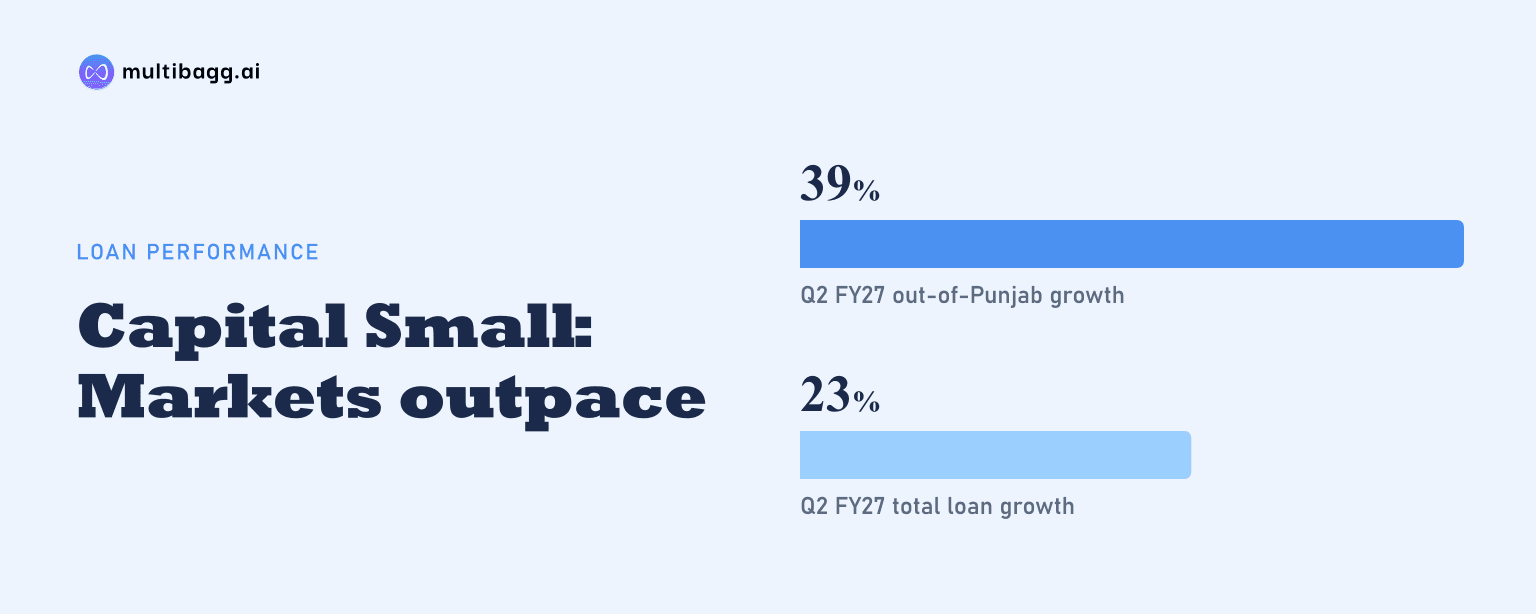
Capital Small Finance Bank Limited reported 39% year-on-year advance growth outside Punjab in Q2 FY27, ahead of 23% growth for its total loan book, but these newer markets contributed only 8.2% of deposits as of September 30, 2026. Management is targeting more than 300 branches and a loan book above Rs 16,000 crore by FY29.
Know Capital Small Finance Bank inside out
Results, valuation, peers and who's buying, in one view.
How fast are Capital Small Finance Bank’s loans growing outside Punjab?
Capital Small Finance Bank’s advances outside Punjab grew 39% year-on-year in Q2 FY27, compared with 19% growth in Punjab and 23% growth across the bank. Gross advances stood at Rs 9,755 crore on September 30, 2026, up 23.4% year-on-year and 7.5% from the preceding quarter, while quarterly disbursements rose 36% to Rs 1,095 crore.
Capital Small Finance Bank had 47 branches outside Punjab, representing 21% of its 222 branches across five states and two union territories. Those branches generated 25.7% of advances, exceeding their share of the network. Management said business per branch outside Punjab exceeded Rs 80 crore for branches operating for at least five years, up from Rs 72 crore at the end of Q4 FY26.
The geographic mix shows that loan growth has moved faster outside the home state than funding mobilisation. Capital Small Finance Bank described markets outside Punjab as a growth engine, but said building a granular retail deposit base remains a priority as it enters newer areas. The bank did not disclose a separate branch target for outside Punjab, including a 30% share, during the call.
Why are Capital Small Finance Bank’s out-of-Punjab deposits lower?
Capital Small Finance Bank’s markets outside Punjab accounted for 8.2% of deposits but 25.7% of advances in Q2 FY27, meaning credit expansion has progressed faster than deposit collection in those geographies. Total deposits were Rs 10,831 crore on September 30, 2026, rising 16.2% year-on-year and 2.2% quarter-on-quarter, below the 23.4% year-on-year increase in gross advances.
Deposit growth was 17% year-on-year in Punjab, compared with 12% outside Punjab and 16% for Capital Small Finance Bank overall. Punjab’s deposit market share rose to 1.3% of industry deposits as of June 30, 2026, from 1.17% on March 31, 2025. Management cited Punjab’s Rs 7.45 lakh crore deposit base and Haryana’s Rs 10 lakh crore deposit base as the opportunity in its operating geography.
Current account and savings account deposits, known as CASA, were 34.48% of total deposits for Capital Small Finance Bank. The CASA ratio was 35.3% in Punjab and 25.32% outside Punjab. The bank’s cost of deposits fell to 5.68% in Q2 FY27 from 5.92% a year earlier, while management said it would deepen customer relationships and adjust the funding mix in newer markets.
The average credit-to-deposit ratio was 85.4% during Q2 FY27, up from 81.5% in the corresponding period a year earlier. Management said the higher ratio reflected fund deployment, but did not give a geography-specific credit-to-deposit ratio or cost of deposits. That leaves future deposit growth in newer markets as a disclosed execution focus rather than a quantified target.
Got a follow-up? Ask IRIS
Can Capital Small Finance Bank replicate its Punjab lending model?
Capital Small Finance Bank said it is expanding selectively into markets where it can retain its relationship-led model and underwriting standards. About 97% of the loan book was secured on September 30, 2026, while 76.7% of the overall portfolio and 89% excluding corporate loans were backed by immovable property or the borrower’s own fixed deposits.
Reported asset quality was lower outside Punjab, where gross non-performing assets, or GNPA, were 0.87%, compared with 2.88% in Punjab and 2.36% across Capital Small Finance Bank. The call did not provide the age, product composition or collection history of the two geographic portfolios, so it did not establish why the GNPA ratios differed.
The loan mix also changed over the year. Business loans became the largest segment at 28% of advances, up from 23% in Q2 FY26. Mortgages were 24%, down from 26% a year earlier, agriculture was 26% versus 27% in the preceding quarter, and corporate exposure remained about 14%.
Capital Small Finance Bank reported a Rs 19.53 lakh average loan ticket in Q2 FY27, compared with Rs 17.1 lakh in Q2 FY26. Net non-performing assets were 1.12%, down from 1.38% a year earlier, while special mention accounts 1 and 2 fell to 3.31% of advances from 4.42%. Management said its objective is to reduce net NPA below 1% without compromising growth.
What is Capital Small Finance Bank’s FY29 expansion plan?
Capital Small Finance Bank targets more than 300 branches and a loan book above Rs 16,000 crore by FY29. Starting from 222 branches in September 2026, the network goal requires more than 78 additional branches over the remaining period. Management said the plan combines deeper activity in existing markets with measured expansion beyond Punjab.
Management did not state a formal FY29 target for the proportion of branches outside Punjab. It said 21% of branches, or 47 locations, were outside Punjab in Q2 FY27 and that it would enter markets where it could replicate its operating model without diluting underwriting. The more-than-300 branch target is therefore the disclosed network benchmark.
Capital Small Finance Bank said Vision 2029 rests on raising newer-market contribution, improving operating leverage as branches mature and retaining secured, granular lending. Its capital adequacy ratio was 20.8% on September 30, 2026, including Tier 1 capital of 18.5%, and its average liquidity coverage ratio was about 216%. Management said these levels meant there was no immediate need for fresh capital to fund growth.
Management also described the FY29 plan as a step toward its aspiration to become a universal bank. It said a loan book above Rs 16,000 crore could translate into a balance sheet of about Rs 21,000 crore to Rs 23,000 crore, with more than 300 branches. This is management’s strategic aspiration, not a disclosed regulatory approval timetable.
Conclusion
Capital Small Finance Bank’s expansion beyond Punjab is increasing the newer markets’ loan contribution: those markets produced 39% advance growth in Q2 FY27 and generated 25.7% of advances from 21% of branches. Their 8.2% deposit contribution, 12% deposit growth and 25.32% CASA ratio show that local funding has not yet developed at the same pace as credit.
The next measures to watch are progress toward more than 300 branches and a loan book above Rs 16,000 crore by FY29, as well as deposit and CASA growth outside Punjab. Management also aims to take net NPA below 1%, while its universal-bank aspiration depends on reaching the scale, branch network and profitability metrics outlined under Vision 2029.