










Capital Small Finance targets universal-bank licence after FY29
Key highlights
- Capital Small Finance targets a Rs 21,000 crore to Rs 23,000 crore balance sheet by FY29 before pursuing a universal-bank licence.
- The FY29 plan includes a loan book above Rs 16,000 crore, more than 300 branches, ROTA above 1.6% and ROE above 15%.
- Capital Small Finance aims to raise its share of branches outside Punjab to more than 30% by FY29 from 21%.
- Capital Small Finance reported 20.8% capital adequacy and an average liquidity coverage ratio of about 216%.
powered by IRIS
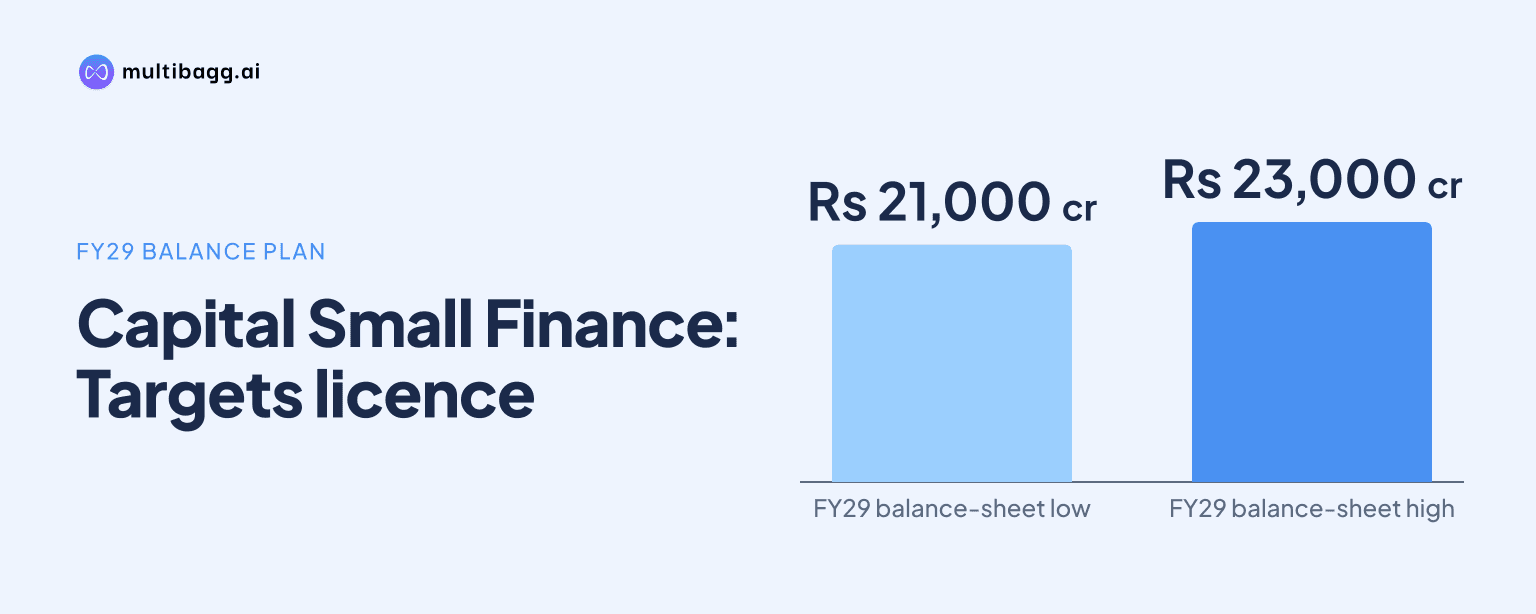
Capital Small Finance Bank plans to pursue a universal-bank licence after FY29 if it reaches a Rs 21,000 crore to Rs 23,000 crore balance sheet, supported by a Rs 16,000 crore-plus loan book, more than 300 branches and stated return targets. Management called Vision 2029 a stepping stone to that next stage rather than an immediate licence application.
Know Capital Small Finance Bank inside out
Results, valuation, peers and who's buying, in one view.
When will Capital Small Finance seek a universal-bank licence?
Capital Small Finance expects to approach the regulator after FY29, once its Vision 2029 scale, profitability, distribution and diversification milestones are in place. Managing director Munish Jain said a balance sheet of more than Rs 21,000 crore to Rs 23,000 crore would be the appropriate size at which to pursue the universal-bank aspiration.
Management did not present FY29 as a committed application date or regulatory approval timeline. Jain said the bank’s leadership aspires to become a universal bank, while Sarvjit Singh Samra said the period through the FY29 vision would be the appropriate time to move to the next level. The proposed timing therefore depends on meeting the disclosed operating measures.
The objective is broader than the loan book’s current growth pace. During the call, an analyst referred to a loan book of about Rs 9,700 crore and growth of 23% in H1FY27. Management said its run rate was ahead of the trajectory needed for the Rs 16,000 crore FY29 objective, but added that banking growth remains dependent on macroeconomic conditions.
What FY29 milestones support Capital Small Finance’s licence plan?
Capital Small Finance targets a loan book of more than Rs 16,000 crore, a Rs 21,000 crore to Rs 23,000 crore balance sheet and more than 300 branches by FY29. It also aims for return on total assets (ROTA) above 1.6% and return on equity (ROE) above 15%, which management included in its framework for approaching the regulator.
The loan-book target represents a substantial increase from the approximately Rs 9,700 crore figure discussed during the Q2FY27 call. An analyst estimated that reaching Rs 16,000 crore would require roughly 22% to 23% growth across the final two years to FY29. Management said it had guided for 20% to 22% growth in FY27 and was reporting 23% growth in H1FY27.
Jain said the FY29 figure was intended to challenge the organisation, not restrain growth if market conditions provide further opportunities. However, he also said that forecasting banking growth for three years is difficult because macroeconomic variables can change. The disclosed target is consequently management’s planned scale threshold, rather than a prediction that growth will remain at 23% every year.
How will Capital Small Finance diversify before FY29?
Capital Small Finance plans to raise its branch presence outside Punjab to more than 30% by FY29 from 21% currently, with management expecting the out-of-Punjab advance share to reach about 32% to 37%. The bank said geographic expansion and lending diversification are part of the preparation for a larger banking model.
At the time of the call, branches outside Punjab generated 25.7% of advances but only 8.2% of deposits. In the quarter discussed, advances grew 39% outside Punjab, compared with 19% in Punjab and 23% across the bank. Deposits rose 12% outside Punjab, against 17% in Punjab and 16% at bank level, showing that asset expansion was faster in newer markets while deposit growth remained higher in the core state.
Capital Small Finance described business, agriculture, mortgage, consumption and corporate lending as separate portfolio buckets serving different customer needs. Management said it was continuing to strengthen underwriting capabilities for each diversification need. Its consumption portfolio was 7% of total loans and has remained at that level since FY24 or FY25, according to management.
Asset-quality and deposit metrics also differed by geography. Gross non-performing assets (GNPA) were 0.87% outside Punjab, compared with 2.88% in Punjab and 2.36% across the bank. The current-account savings-account (CASA) ratio was 25.32% outside Punjab, below Punjab’s 35.3% and the bank-level 34.48%, while management said branch productivity outside Punjab was approaching the Punjab level.
Got a follow-up? Ask IRIS
Can Capital Small Finance grow under its current licence?
Capital Small Finance says its small-finance-bank model can support significant growth through FY29 and does not currently restrict its middle-income, granular lending strategy. Management said it intends to convert to a universal bank only after the FY29 metrics are achieved, rather than changing its operating model before then.
The bank plans to retain a secured-lending orientation while it expands. Excluding corporate loans, management said 92% of its book was collateralised. It said it was not comfortable entering standalone unsecured lending, although it was assessing options to serve long-standing customers without increasing risk metrics.
Capital Small Finance reported a capital adequacy ratio of 20.8%, including Tier 1 capital of 18.5%, and an average liquidity coverage ratio of about 216%. Management said those levels gave it room to fund growth without an immediate fresh-capital raise, while maintaining capital and liquidity buffers as the balance sheet expands.
Its core-region deposit opportunity remains large even as newer markets grow. Management put Punjab’s deposit base at Rs 7.45 lakh crore and Haryana’s at Rs 10 lakh crore. Capital Small Finance’s Punjab deposit market share rose to 1.3% from 1.17% at March 31, 2025, an increase of 13 basis points over 15 months.
What could affect Capital Small Finance’s FY29 execution?
Capital Small Finance’s FY29 plan depends on turning branch expansion and new-market lending into profitable growth while preserving credit controls. Management identified three drivers: raising newer-market contribution, improving operating leverage as branches mature, and retaining secured, granular lending with disciplined underwriting.
The bank cited H1FY27 annualised gross slippages of 1.11%, net slippages of 0.24% and credit cost of 0.24%. Special mention account categories 1 and 2, or SMA-1 and SMA-2, were 3.31%, compared with 4.42% a year earlier and 4.92% at the end of the prior financial year. Management said these measures indicated no agriculture-credit stress from deficit rainfall in its Punjab and Haryana operating areas.
Profitability measures showed improvement in Q2FY27. Net interest margin was 4.24%, versus 4.04% a year earlier and 4.21% in the preceding quarter, while the cost of deposits declined to 5.68% from about 5.9% in Q2FY26. Management said the increase in yield on advances from the preceding quarter was the main source of the quarterly margin movement.
Management said the planned increase in ROTA from 1.39% to above 1.6% would principally come from net interest margin and operating-expense improvement. It did not base the target on a major rise in non-interest income, which was 0.92% in Q2FY27, compared with 0.82% in the preceding quarter and 0.86% a year earlier.
Conclusion
Capital Small Finance has set out a measurable route from small-finance-bank operations to a possible universal-bank application: geographic reach, lending mix, branch scale, returns and balance-sheet size must progress together. Its Q2FY27 data showed faster 39% advance growth outside Punjab, while the 25.32% CASA ratio there remained below Punjab’s 35.3%, making liability mobilisation in newer markets an important part of execution.
The next disclosures to watch are progress against the FY27 20% to 22% growth guidance, movement from 21% to more than 30% of branches outside Punjab by FY29, and the stated ROTA path from 1.39% to above 1.6%. Management has also said its eventual approach to the regulator is intended for after FY29, when it believes the Rs 21,000 crore to Rs 23,000 crore balance-sheet threshold and associated targets can be met.