










CASHurDRIVE EV media spans 501 sites, 22% exclusive revenue
Key highlights
- CASHurDRIVE reports 501 EV charging-station media sites across six cities.
- Delhi contains 456 of CASHurDRIVE’s 501 disclosed EV charging stations.
- EV media contributes about 22% of CASHurDRIVE’s exclusive-media revenue.
- Exclusive-media revenue increased from Rs 2.43 crore in FY23 to Rs 59.07 crore in FY26.
powered by IRIS
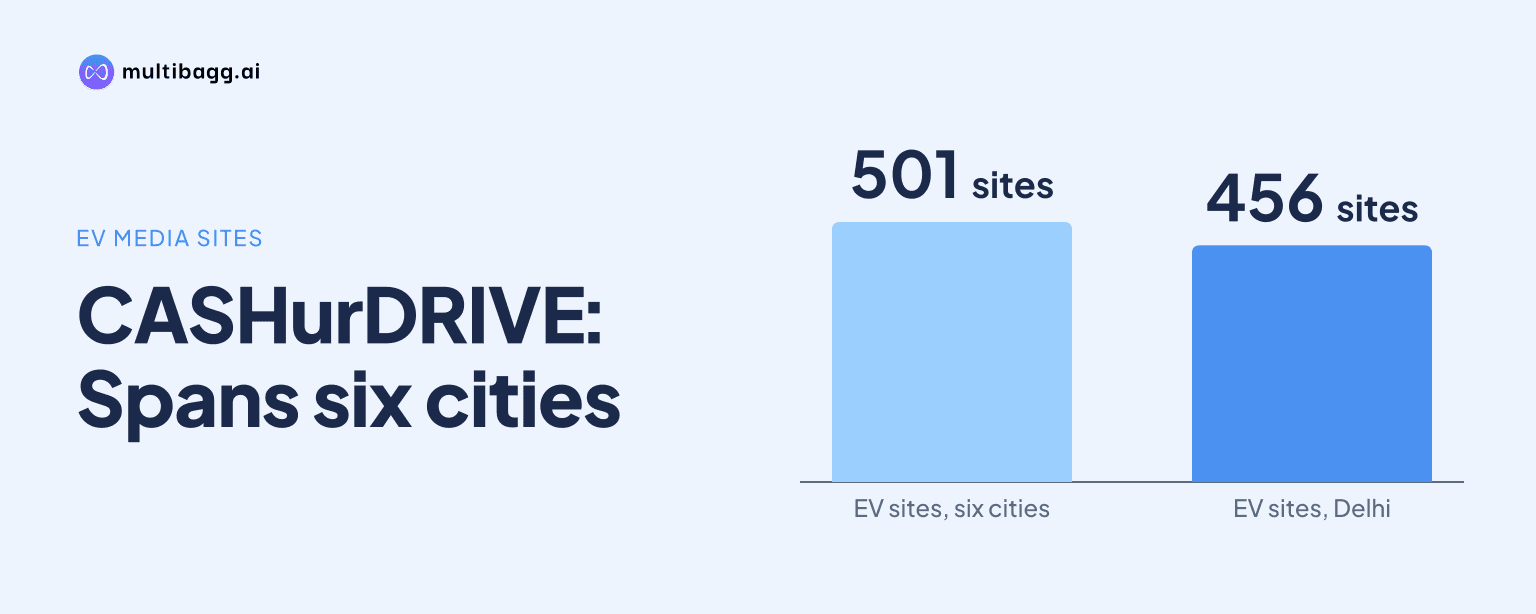
Cash Ur Drive Marketing Limited says its electric-vehicle, or EV, media layer covers 501 charging-station media sites across six cities and contributes about 22% of exclusive-media revenue. CASHurDRIVE identifies Delhi as the main location with 456 charging stations, while management also cites a 50% stake in CharjKaro and 10-year Chandigarh operating rights.
Know Cash UR Drive Marketing inside out
Results, valuation, peers and who's buying, in one view.
How large is CASHurDRIVE’s EV media footprint?
CASHurDRIVE reports 501 charging-station media sites in six cities as part of its EV media layer. The 501 total aligns with the city-level charging-station count in the presentation: 456 in Delhi, 15 in Chandigarh, seven in Dehradun, three in Agra, 10 in Rishikesh and 10 in Kashipur. Battery-swapping stations are separately listed for Chandigarh and are not needed to reach the 501 charging-site figure.
CASHurDRIVE presents the sites as media formats integrated within charging infrastructure rather than as owned charging assets. This follows its asset-light model, under which it says it operates through media rights and partnerships instead of capital-intensive infrastructure ownership. Its portfolio also includes buses, electric buses, cabs, metro trains, outdoor locations, digital out-of-home screens, print and broadcast advertising.
The footprint is geographically concentrated, with Delhi’s 456 charging stations exceeding the combined 45 charging stations listed across the other five cities. CASHurDRIVE shows campaign examples at charging locations in Delhi, Chandigarh, Dehradun, Agra and Rishikesh, including displayed work for McDonald’s and EasyMyTrip, but it does not disclose campaign revenue by city or advertiser.
Where does CASHurDRIVE’s EV network fit within its media business?
CASHurDRIVE positions EV charging media within a transit- and mobility-led advertising model that targets audiences it says spend about 80% of their time on the road. The company says it has a presence in more than 25 cities and serves more than 2,000 clients, while its EV sites operate in six cities. The charging network is therefore a defined part of a wider media platform rather than its only inventory category.
In FY26, outdoor media supplied 49.19% of CASHurDRIVE’s segment revenue mix and transit media supplied 44.84%, compared with 3.46% from print media and 2.50% from digital marketing. The presentation does not place EV charging media in a standalone segment. Instead, management describes EV inventory as a layer combining charging infrastructure with media formats and extending to electric-bus branding across cities.
Delhi matters beyond its charging-site concentration. The state accounted for 41.71% of FY26 revenue, ahead of Uttar Pradesh at 20.96%, Maharashtra at 11.54%, Haryana at 10.69%, Karnataka at 3.87% and other states at 11.23%. The presentation does not state how much of Delhi’s revenue came from EV media, but the city’s 456 stations contain most disclosed charging inventory in CASHurDRIVE’s largest reported revenue state.
CASHurDRIVE’s client list includes Diageo India, McDonald’s, IKEA, PepsiCo, Asian Paints, MakeMyTrip and Mitsubishi Electric. Its recent-project pages also show RedBus, FlixBus, Uber, Flipkart and UNIQLO. These examples show activity across transit and outdoor formats, but they do not establish that each named brand bought charging-station advertising.
Got a follow-up? Ask IRIS
How material is EV media to CASHurDRIVE’s revenue model?
CASHurDRIVE says EV media contributes about 22% of exclusive-media revenue, making it a disclosed component of its contracted-inventory business rather than a separately reported revenue line. Exclusive media consists of secured or contracted inventory with direct control and longer-term campaigns, while trade media involves third-party inventory procured for flexible, shorter-term campaigns.
Exclusive-media revenue rose from Rs 2.43 crore in FY23 to Rs 11.7 crore in FY24, Rs 26.5 crore in FY25 and Rs 59.07 crore in FY26. Over the same period, trade-media revenue increased from Rs 76.98 crore to Rs 82.05 crore, Rs 112.83 crore and Rs 127.6 crore. The faster expansion of exclusive media changed its reported revenue share from 19% in FY25 to 32% in FY26, while trade media’s share fell from 81% to 68%.
The presentation does not disclose the rupee value represented by EV media’s approximately 22% contribution to exclusive revenue, nor does it provide EV-media revenue for FY23, FY24 or FY25. It therefore supports a conclusion about EV media’s stated share of the exclusive category, but not a precise EV revenue calculation or a separately reported growth rate for the EV business.
CASHurDRIVE says exclusive inventory offers controlled pricing and availability under long-tenure rights, but notes that it has no order book because each order is a time-bound campaign. It says repeat clients account for 25% to 30% of revenue visibility, government campaigns account for 37%, and the second half, or H2, represented 58% of FY26 revenue. Those categories overlap and should not be added together.
What rights and plans support CASHurDRIVE’s EV media strategy?
CASHurDRIVE identifies a 50% stake in CharjKaro as part of the EV media layer and says Chandigarh has 10 stations under a 10-year operation-and-maintenance, or O&M, arrangement. The operational-footprint page, however, lists 15 EV charging stations and 19 battery-swapping stations in Chandigarh. The presentation does not explain whether the 10 O&M stations are a subset of the 15 charging stations or whether the figures use different definitions.
Management’s three-year target is to lift exclusive media to about 50% of revenue from 32% in FY26, matching trade media’s targeted 50% share. It says exclusive-media contracts generally run for three to five years, with concessions of up to 10 years. These are management targets and business-model descriptions, not a projection that EV media will reach a specified revenue share.
For FY27, management targets inventory utilisation of 50% to 55%, up from about 45%, compared with an industry average it cites of about 65%. CASHurDRIVE also cites a Pune city-bus advertising letter of award, or LOA, and identifies metros, airports, trains, public transport, South India and Tier 2 and 3 cities as expansion areas. The presentation does not give a site-count target for EV charging media.
CASHurDRIVE further lists initial public offering capital expenditure of Rs 5.97 crore for an in-house printing facility and Rs 5.22 crore invested in artificial-intelligence-led planning and return-on-investment tracking. Management says the printing facility is intended to reduce production costs, while technology is intended to support campaign planning, route analysis, visibility assessment and heatmaps. Neither item is presented as EV-specific spending.
Conclusion
CASHurDRIVE’s disclosed EV media proposition is measurable through 501 charging-station sites across six cities and an approximately 22% contribution to exclusive-media revenue. Delhi dominates the physical network with 456 sites and was also the largest FY26 revenue state at 41.71%, while the wider revenue mix shifted toward exclusive media, whose share rose from 19% in FY25 to 32% in FY26.
The next disclosed milestones are management’s target of about 50% exclusive-media revenue share within three years and FY27 utilisation of 50% to 55%. Investors will also need clarity on the Chandigarh figures, where the presentation lists 15 charging stations in the footprint but separately cites 10 stations with 10-year O&M rights, along with future disclosure on EV-media revenue and site expansion beyond the current 501 locations.