










CASHurDRIVE exclusive media revenue reaches Rs 59.07 crore
Key highlights
- CASHurDRIVE’s exclusive-media revenue increased from Rs 2.43 crore in FY23 to Rs 59.07 crore in FY26.
- Exclusive media represented 32% of CASHurDRIVE revenue in FY26, up from 19% in FY25.
- Trade media generated Rs 127.6 crore in FY26 and accounted for 68% of revenue.
- CASHurDRIVE’s presentation sets a three-year target of a 50% exclusive-media and 50% trade-media revenue mix.
powered by IRIS
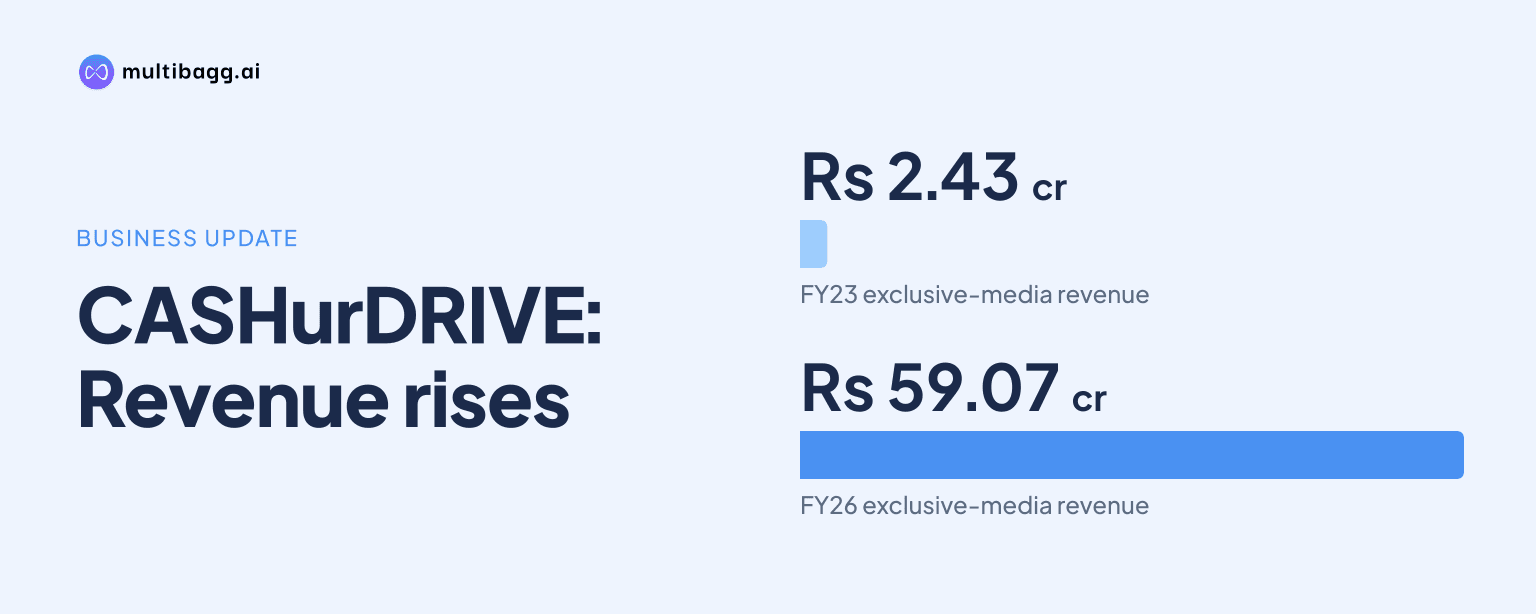
CASHurDRIVE’s exclusive-media revenue rose from Rs 2.43 crore in FY23 to Rs 59.07 crore in FY26, and its share of revenue increased from 19% in FY25 to 32% in FY26. The presentation identifies exclusive media as secured or contracted inventory, while trade media remained the larger FY26 revenue source at Rs 127.6 crore.
Know Cash UR Drive Marketing inside out
Results, valuation, peers and who's buying, in one view.
How quickly did CASHurDRIVE’s exclusive-media revenue grow?
CASHurDRIVE’s exclusive-media revenue increased by Rs 56.64 crore between FY23 and FY26, rising from Rs 2.43 crore to Rs 59.07 crore. The annual figures show an expanding contribution in each period: Rs 11.7 crore in FY24 and Rs 26.5 crore in FY25, before reaching Rs 59.07 crore in FY26. The presentation defines this category as secured or contracted inventory.
Trade-media revenue also increased over the same period, but by Rs 50.62 crore, from Rs 76.98 crore in FY23 to Rs 127.6 crore in FY26. Trade media contributed Rs 82.05 crore in FY24 and Rs 112.83 crore in FY25. The FY26 gap between trade and exclusive media was Rs 68.53 crore, meaning third-party inventory procurement remained the larger revenue stream despite exclusive media’s faster increase.
What changed in CASHurDRIVE’s revenue mix in FY26?
CASHurDRIVE’s exclusive-media share rose by 13 percentage points to 32% in FY26 from 19% in FY25, while trade media’s share declined by 13 percentage points to 68% from 81%. The shift increased the portion of revenue attributed to controlled inventory, although trade media still supplied more than two-thirds of FY26 revenue. The presentation labels this comparison as exclusive versus trade media share of revenue.
CASHurDRIVE’s presentation sets a three-year target of a 50% share each for exclusive media and trade media. From the FY26 mix of 32% exclusive media and 68% trade media, exclusive media would need to gain a further 18 percentage points to reach that stated target. The presentation does not provide annual milestones, future revenue amounts or a timetable within the three-year period.
The two models differ in their stated operating structure. CASHurDRIVE describes exclusive media as direct, controlled and associated with long-term campaigns, while trade media uses external or third-party inventory for short-term campaigns. The move from a 19% exclusive-media share in FY25 to 32% in FY26 therefore reflects a greater role for contracted inventory, rather than the replacement of trade media, which generated Rs 127.6 crore in FY26.
Got a follow-up? Ask IRIS
How does CASHurDRIVE describe revenue visibility?
CASHurDRIVE identifies exclusive media, representing 32% of FY26 revenue, as contracted inventory on long-tenure rights where pricing and availability are controlled. It places repeat clients, representing 25% to 30%, on its revenue-visibility ladder because brands return for campaigns. The presentation says these categories overlap, so the 32% exclusive-media share and 25% to 30% repeat-client range cannot be added to calculate a separate visibility total.
CASHurDRIVE states that it has no order book because every order is a time-bound campaign. It says visibility instead comes from contracted inventory and repeat clients, while H2, or the second half, accounted for 58% of FY26 revenue. This indicates that reported revenue was weighted toward the latter half of the financial year rather than distributed evenly across the two halves.
Government campaigns are another component of the visibility ladder, representing 37% in the rounded ladder and 37.3% in the FY26 revenue split. CASHurDRIVE says national and state campaigns have the same 90-to-120-day payment cycle. Non-government revenue accounted for 62.7% of FY26 revenue, making the government and non-government figures a customer-type split rather than a separate media-inventory classification.
Where is CASHurDRIVE’s FY26 revenue concentrated?
CASHurDRIVE generated 41.71% of FY26 revenue from Delhi, its largest disclosed state contribution, followed by Uttar Pradesh at 20.96%. Maharashtra contributed 11.54%, Haryana 10.69%, Karnataka 3.87%, and the group of other listed locations 11.23%. Delhi and Uttar Pradesh together accounted for 62.67% of FY26 revenue.
By advertising format, outdoor media represented 49.19% of FY26 revenue and transit media represented 44.84%, together accounting for 94.03%. Print media contributed 3.46% and digital marketing contributed 2.50%. The presentation also lists 456 electric-vehicle charging stations in Delhi and 64 charging or battery-swapping stations across Chandigarh, Dehradun, Agra, Rishikesh and Kashipur, but does not disclose revenue generated from those sites.
CASHurDRIVE’s recent-project material names campaigns involving RedBus, FlixBus, Uber, Flipkart, McDonald’s, UNIQLO and Ikea. These projects illustrate the campaign-led activity described in the presentation, but no revenue amount, campaign duration or exclusive-versus-trade classification is disclosed for any individual project. The FY26 revenue mix is therefore the clearer disclosed measure of the split between the two media models.
Conclusion
CASHurDRIVE’s revenue mix changed materially between FY23 and FY26 as exclusive media increased from Rs 2.43 crore to Rs 59.07 crore and reached 32% of FY26 revenue. Trade media still generated Rs 127.6 crore and held a 68% share, so the disclosed shift is toward a larger controlled-inventory component within a business that remains campaign-led.
The next disclosed marker is CASHurDRIVE’s three-year target of a 50:50 split between exclusive and trade media, compared with 32:68 in FY26. Readers can watch whether contracted inventory and repeat-client activity continue to translate into revenue, particularly because CASHurDRIVE reports no order book and says H2 contributed 58% of FY26 revenue.