










Castrol sees India's oil demand rise to 18 EJ as mix diversifies
Key highlights
- Castrol projects Indian oil demand to rise from 11 EJ in 2023 to 18 EJ in 2050.
- Renewables including hydro, biofuels and nuclear are projected to reach 29.7% of primary energy in 2050, from 21.6% in 2023.
- India’s total primary-energy demand is projected to increase from 45 EJ in 2023 to 81 EJ in 2050.
- India’s vehicle parc was about 32.8 crore in March 2026, including 24.3 crore two-wheelers.
powered by IRIS
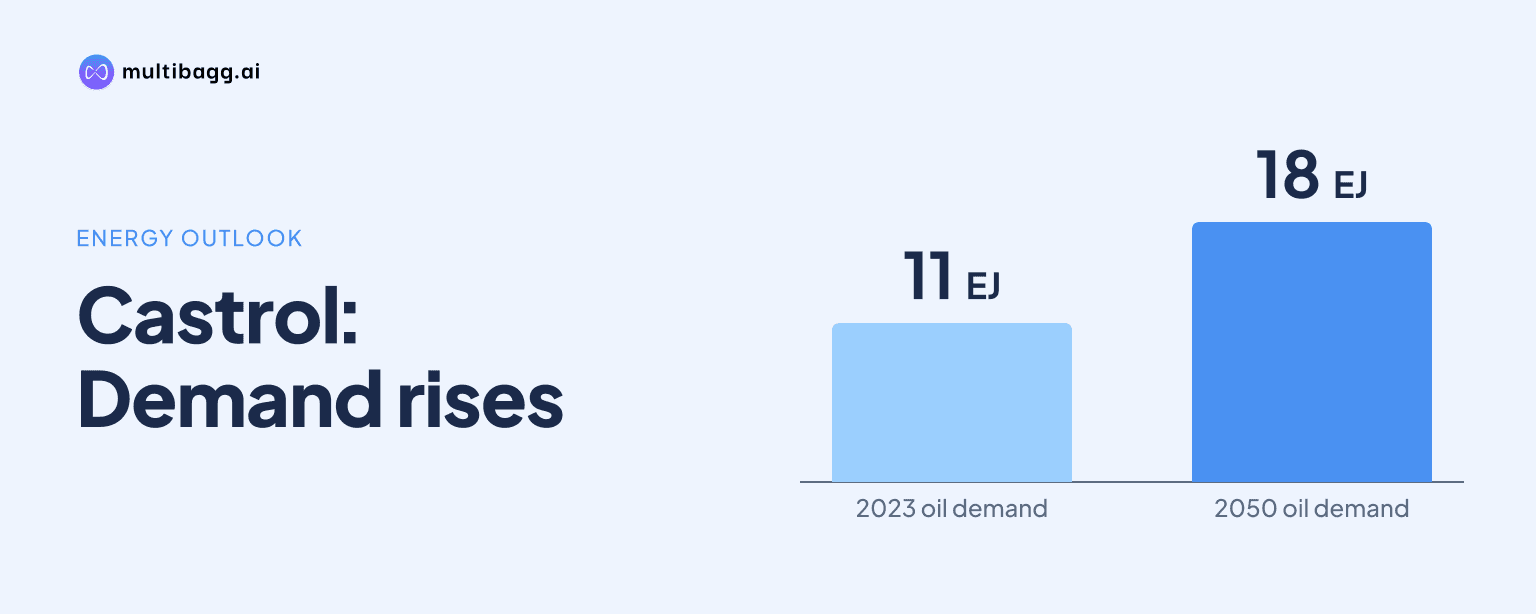
Castrol projects India’s oil demand will rise from 11 exajoules (EJ) in 2023 to 18 EJ by 2050, despite a lower share of the primary-energy mix. Its current-trajectory outlook puts total primary energy at 81 EJ and renewables including hydro, biofuels and nuclear at 29.7%, framing the transition as added fuels rather than replacement.
Know Castrol India inside out
Results, valuation, peers and who's buying, in one view.
How does India’s primary energy mix change by 2050?
India’s total primary-energy demand is projected to rise from 45 EJ in 2023 to 81 EJ in 2050, an increase of about 80% in Castrol’s current-trajectory outlook. That expansion means each fuel category shown in the presentation rises in absolute energy terms, including categories whose share of the mix declines.
Renewables including hydro, biofuels and nuclear show the largest share gain, rising to 29.7% in 2050 from 21.6% in 2023. Coal remains the largest component at 42% in 2050, although its share falls from 49%, while gas rises from 5.1% to 6.8% and oil declines from 24% to 22%.
Why does Castrol expect oil demand to rise as renewables expand?
Castrol expects oil consumption to increase by 7 EJ, from 11 EJ in 2023 to 18 EJ in 2050, because total energy demand expands faster than oil’s share contracts. Oil represents 22% of an 81 EJ energy system in the 2050 current-trajectory case, compared with 24% of 45 EJ in 2023.
The presentation describes India’s lower-carbon transition as diversification of primary energy rather than direct substitution of oil by renewables. Castrol says renewables, bioenergy and gas will have growing roles while oil demand remains resilient, alongside projected energy-demand growth at a 10.7% compound annual growth rate from 2024 to 2035.
The near-term system additions also indicate the scale of demand anticipated. India is expected to add about 48 lakh gigawatt-hours of energy over the next decade, with about 35% renewable, and the presentation identifies a need for 150 gigawatts of additional power capacity by 2030.
Which demand trends support Castrol’s wider energy outlook?
Castrol links its energy outlook to mobility, manufacturing and infrastructure rather than to a single transport technology. It identifies increasing sport-utility-vehicle adoption and pre-owned-car consumption in urban markets, alongside rural contributions to two-wheeler sales growth, as mobility-demand mechanisms.
The presentation also points to growth beyond India’s largest urban centres. Households across the top 100 cities are shown increasing from 6.17 crore in 2025-2026 to 7.93 crore in 2030-2031, with other cities adding 1.02 crore households versus 74 lakh households in the Big Six cities.
Infrastructure and industrial activity provide further demand mechanisms in Castrol’s assessment. India has about 1.5 lakh kilometres of highways and a commercial-vehicle parc of 1.2 crore as of March 2026, while manufacturing contributes about 25% of gross domestic product and the industrial market is projected to grow at a 7.26% compound annual growth rate through 2031.
Got a follow-up? Ask IRIS
How does Castrol see lower-carbon mobility developing?
Castrol expects multiple powertrains and fuels to coexist as mobility moves toward lower-energy solutions. Its presentation lists flex fuels, hybrids, compressed natural gas, liquefied petroleum gas, electric vehicles, plug-in hybrids, biogas, hydrogen internal-combustion engines and more-efficient internal-combustion engines.
That multi-pathway approach reflects the scale of the existing vehicle base. India’s total vehicle parc was about 32.8 crore in March 2026, including 24.3 crore two-wheelers and 5 crore four-wheelers, creating simultaneous service requirements for conventional, hybrid and electric vehicles.
Castrol’s stated participation includes advanced lubricants for engines and transmissions, products being tested for hydrogen internal-combustion engines, and lubricants for flex-fuel and hybrid vehicles. It also lists fluids for electric motors, transmissions and batteries under its Next Generation Cool proposition.
How is Castrol positioning its portfolio for the transition?
Castrol is positioning its portfolio across established lubricant demand and products intended for emerging mobility and industrial applications. Its Forward strategy identifies an autocare range, services, electric-vehicle-ready fluids and data-centre cooling solutions as diversification areas.
Circularity is another product mechanism in the presentation. Castrol identifies re-refined base-oil solutions through its More Circular Lubricants proposition, alongside products for hydrogen engines, flex-fuel vehicles, hybrids and electric-vehicle components.
The industrial offer is tied to manufacturing-led demand across products and services. Castrol lists localised coolants, cleaners, chain oils, gear oils and greases, as well as Chemical Management Services and Smart Control, which provides real-time measurement of fluid parameters to automate tasks.
Conclusion
Castrol’s outlook presents India’s energy transition as growth in total demand across several fuels rather than a one-for-one replacement of oil. Renewables including hydro, biofuels and nuclear gain the largest share increase, reaching 29.7% by 2050, while oil rises by 7 EJ as total primary-energy demand increases from 45 EJ to 81 EJ.
The next area to watch is execution of Castrol’s Forward plan in electric-vehicle-ready fluids and data-centre cooling, alongside products for hybrid, flex-fuel and hydrogen-engine applications. The presentation does not disclose sales targets or a timetable for these product lines, leaving future company disclosures to show how these initiatives translate into business activity.