










Castrol India Limited Revenue Rises 27% as Q3 Margin Falls
Key highlights
- Castrol India Limited's Q3 2026 revenue rose 27% year-on-year to INR 1,735 crore.
- Q3 2026 EBITDA declined 19% year-on-year to INR 262 crore, with margin at approximately 15%.
- Q3 2026 profit after tax fell 23% year-on-year to INR 176 crore.
- Nine-month 2026 revenue reached INR 5,151 crore, up 20%, while profit after tax rose 9% to INR 766 crore.
powered by IRIS
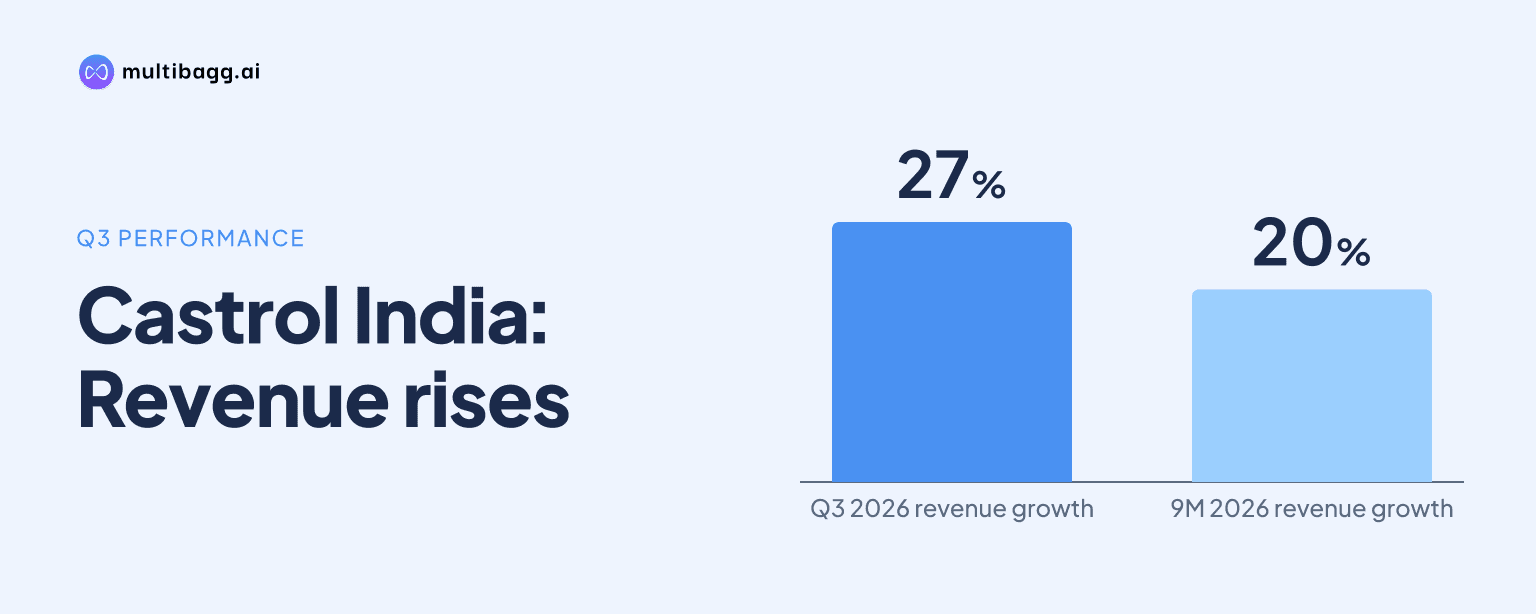
Castrol India Limited reported revenue from operations of INR 1,735 crore for the quarter ended 30 September 2026, up 27% year-on-year, but its EBITDA margin fell to about 15% as higher raw-material costs and unfavourable currency movements weighed on profitability. Profit after tax declined 23% to INR 176 crore.
Know Castrol India inside out
Results, valuation, peers and who's buying, in one view.
What did Castrol India Limited report for Q3 2026?
Castrol India Limited reported strong year-on-year revenue growth but lower quarterly profit and operating margin in the September 2026 quarter. Revenue from operations rose 27% from a year earlier to INR 1,735 crore. However, revenue was down 7% sequentially, showing that the quarter-on-quarter performance was weaker than the preceding period.
EBITDA for the quarter stood at INR 262 crore, down 19% year-on-year and 47% sequentially. The resulting EBITDA margin was approximately 15%, compared with the company's stated guided range of 21% to 24%. Profit after tax was INR 176 crore, down 23% from the corresponding quarter a year earlier and 49% sequentially.
The financial outcome underlines the difference between sales growth and profit conversion during the quarter. While pricing actions supported revenue expansion, the increase in input costs and adverse currency movements reduced the benefit flowing through to EBITDA and net profit.
Why did Castrol India Limited's Q3 margin decline?
Castrol India Limited said the quarter was marked by a sharp rise in raw-material costs and adverse currency movements. These factors pressured the company's cost base and reduced profitability despite the 27% growth in revenue from operations.
Management said that early pricing actions contributed to the revenue increase. Pricing can help a lubricants company recover part of cost inflation, but the Q3 figures show that the recovery was not sufficient to prevent a year-on-year decline in EBITDA and profit after tax during the period.
The approximately 15% EBITDA margin was below the 21% to 24% range referred to in the earnings-call material. The company indicated that margins were expected to remain outside that range in the short to medium term. It did not provide near-term financial guidance amid the prevailing input-cost inflation.
This makes cost movements central to the Q3 result. The disclosed data does not separately quantify the impact of raw materials, foreign exchange or pricing. It does, however, establish that these were the principal factors management cited in explaining the lower quarterly profitability.
How did Castrol India Limited perform in the first nine months of 2026?
Castrol India Limited's nine-month performance remained positive, with revenue rising 20% year-on-year to INR 5,151 crore for the period ended 30 September 2026. The cumulative figures were stronger than the standalone Q3 profit trend, reflecting growth over the broader nine-month period.
Nine-month EBITDA increased 11% year-on-year to INR 1,086 crore, while EBITDA margin was about 21%. Profit before tax rose 10% to INR 1,043 crore, and profit after tax grew 9% to INR 766 crore.
The difference between the Q3 and nine-month margin figures is notable. Q3 EBITDA margin was approximately 15%, whereas the nine-month margin was approximately 21%. This indicates that the September-quarter cost pressure affected the cumulative profitability trend, even as the company remained ahead of the previous year's nine-month revenue and profit levels.
Got a follow-up? Ask IRIS
What did management disclose to investors and analysts?
Castrol India Limited held its post-earnings call with analysts and investors on 26 October 2026, covering the quarter and nine months ended 30 September 2026. The company had earlier scheduled the call for 12:30 p.m. to 1:15 p.m. IST following adoption of the unaudited financial results.
During the call, management described the revenue performance as resilient in a period of high raw-material costs and adverse currency movements. It reiterated the key financial figures, including Q3 revenue of INR 1,735 crore, EBITDA of INR 262 crore and profit after tax of INR 176 crore.
The company also disclosed that the transcript of the post-earnings call was available on its website under its investor-call details. Separately, Castrol India Limited said it had published extracts of its unaudited quarterly and nine-month financial results in Financial Express and Sakal in line with SEBI disclosure requirements.
For investors, the important management message was the absence of near-term guidance amid input inflation and the indication that EBITDA margins may remain outside the earlier 21% to 24% range in the short to medium term. The disclosure provides context for evaluating the gap between revenue growth and the lower Q3 profitability.
How does the Q3 result affect investors and the lubricants business?
Castrol India Limited's results show that revenue growth alone did not offset the effect of higher input costs and currency movements in Q3. The company delivered a 27% rise in quarterly revenue, but EBITDA fell 19% and profit after tax fell 23% from a year earlier. This is the central financial issue for investors assessing the period.
The lubricants business depends on the relationship between product pricing, raw-material costs and currency conditions. Castrol India Limited's early pricing actions supported sales growth, while the lower EBITDA margin showed the pressure on the cost side during the quarter. The source material does not provide volume data, market-share data or a detailed cost breakdown.
The nine-month figures offer a broader perspective. Revenue, EBITDA and profit after tax all increased year-on-year through September, but the Q3 decline in margin and profit shows that cost pressures became more visible during the latest reported quarter. Investors therefore have both a higher nine-month earnings base and a weaker latest-quarter margin trend to consider.
Conclusion
Castrol India Limited ended the September 2026 quarter with revenue growth of 27% to INR 1,735 crore, supported by pricing actions, but higher raw-material costs and adverse currency movements reduced EBITDA margin to approximately 15% and lowered profit after tax by 23%. For the nine months, revenue increased 20% to INR 5,151 crore and profit after tax rose 9% to INR 766 crore.
The key item to watch is whether input-cost and currency pressures continue to keep margins outside the company's earlier 21% to 24% range. Castrol India Limited has not issued near-term guidance, making future disclosures on pricing, costs and operating margins important for assessing the financial trend.