










Castrol maps growth through industrial, rural and cooling
Key highlights
- Castrol’s Rural Service Express offer includes about 1,000 mobile maintenance kiosks.
- Castrol FASTSCAN records more than 150,000 transactions a day among mechanics and retailers.
- Castrol SMART records more than 15,000 distributor sales calls a day.
- India’s vehicle parc is shown at about 328 million in March 2026, including about 243 million two-wheelers.
powered by IRIS
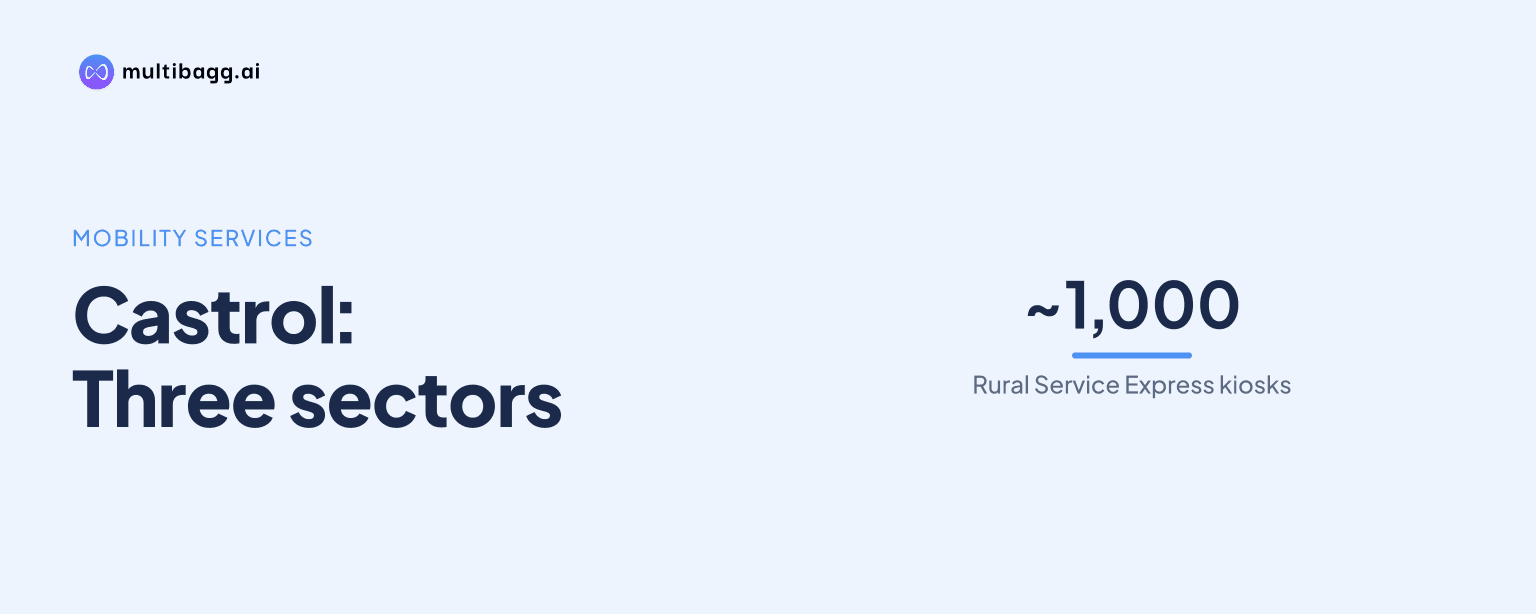
Castrol is pursuing growth through industrial fluid services, about 1,000 Rural Service Express kiosks, EV-ready fluids and single-phase immersion cooling, while its FASTSCAN platform records more than 150,000 transactions a day. The strategy extends Castrol’s offer across mobility, industrial operations, rural maintenance and digital infrastructure.
Know Castrol India inside out
Results, valuation, peers and who's buying, in one view.
What is Castrol’s Onward, Upward, Forward strategy?
Castrol’s Onward, Upward, Forward strategy divides its growth agenda into mobility, industrial performance and future diversification. Onward covers an innovation-driven portfolio and network expansion; Upward focuses on step-out sectors and Chemical Management Services, or CMS; and Forward includes autocare, services, EV-ready fluids and data-centre cooling solutions.
The mobility pillar is set against a vehicle parc of about 328 million in March 2026, including about 243 million two-wheelers and 50 million four-wheelers. Castrol also identifies logistics and infrastructure as demand drivers, citing about 1.5 lakh km of highways and a commercial-vehicle parc of 12 million in March 2026.
Castrol’s presentation places conventional and lower-carbon energy sources alongside one another. It cites Indian energy-demand growth of 10.7% compound annual growth rate, or CAGR, from 2024 to 2035 and a need for 150 gigawatts of additional power capacity by 2030. Total primary energy demand is shown rising from 45 exajoules in 2023 to 81 exajoules in the 2050 current-trajectory case.
How will industrial solutions support Castrol’s growth?
Castrol will pursue industrial growth through specialised products, product localisation, CMS and Smart Control. CMS is described as an end-to-end service in which Castrol manages all aspects of customers’ lubricants and fluids, while Smart Control measures fluid parameters in real time to automate tasks.
The industrial agenda covers machinery, cement, automotive and steel. The presentation cites growth rates of 10% for machinery, 8% for cement, 8% for automotive and 7% for steel, making machinery the fastest-growing sector among the four listed. Castrol’s products are positioned to address friction, corrosion and wear across application requirements.
Product localisation covers coolants, cleaners, chain oils, gear oils and greases. Castrol names Hysol, Rustilo, Tribol, Optigear, Alusol and Techniclean in its industrial portfolio, while describing its step-out industrial coverage as including steel, automotive, textile and energy.
The broader industrial backdrop is a market estimated at $1.7 trillion with a 7.26% CAGR through 2031. The presentation says manufacturing contributes about 25% of India’s gross domestic product and links expanding manufacturing activity with demand for heavy-duty vehicles and industrial lubricants.
How is Castrol expanding rural service access?
Castrol is expanding rural access through a service-first model with about 1,000 Rural Service Express kiosks. These mobile kiosks provide quality vehicle maintenance and are paired with product availability through more than 1,100 distributors and 46,000 outlets.
The rural landscape cited by Castrol includes about 640,000 villages and about 20,000 feeder villages. Castrol says ownership is under-indexed in these markets, with rising disposable income and movement towards personal mobility supporting demand. It also says vehicles can be directly associated with livelihood, making rural consumers value conscious.
Rural Service Express is one part of a wider maintenance offer. Castrol’s autocare portfolio includes rider care, aesthetic care, mechanical care, and appearance and chain care. This differs from its mobility portfolio for two-wheelers, cars and sport utility vehicles, and commercial vehicles, as well as its industrial portfolio for manufacturing applications.
The distribution model also has a dedicated digital tool. Castrol Rural ELEVATE is a solution for rural sub-distributors, while Castrol ELEVATE is the distributor-management system for the broader network. The presentation does not disclose kiosk utilisation, rural revenue or the timing of any further Rural Service Express expansion.
Got a follow-up? Ask IRIS
Which products does Castrol offer for EVs and cooling?
Castrol offers EV fluids for e-motors, transmissions and batteries, along with EV greases and single-phase immersion cooling fluids for digital infrastructure. These products sit in the Forward pillar, which combines future-facing products with autocare and service offerings.
The company is addressing more than battery-electric vehicles. Its presentation lists lubricants for flex-fuel and hybrid vehicles, advanced lubricants for engine and transmission applications, and experiments with products for hydrogen internal-combustion engines. It also presents re-refined base-oil solutions through its More Circular lubricants proposition.
The current mobility landscape shown for January 2025 and January 2026 includes diesel, compressed natural gas, liquefied petroleum gas, petrol, ethanol, EVs and hybrids. The future pathways listed add plug-in hybrids, biogas, hydrogen internal-combustion engines and more efficient internal-combustion engines, indicating that Castrol is preparing products for multiple propulsion types rather than one technology.
This multi-pathway approach is linked to the March 2026 vehicle parc of about 328 million. Of that total, two-wheelers account for about 243 million vehicles, compared with about 50 million four-wheelers. The presentation does not provide sales, market share or product volumes for EV fluids, EV greases or immersion cooling fluids.
How does Castrol’s digital stack support execution?
Castrol’s digital stack supports interactions with mechanics, retailers, distributors and consumers, led by FASTSCAN’s more than 150,000 transactions a day. FASTSCAN is an interactive platform for mechanics and retailers, while Castrol SMART is a digital order-collection system that enables distributors to capture demand.
SMART records more than 15,000 sales calls a day. FASTSCAN’s daily transaction count is therefore more than 10 times the reported SMART sales-call count, although the measures track different activities: retailer and mechanic transactions for FASTSCAN, and distributor sales calls for SMART.
Other platforms serve distinct functions. Castrol CONNECT is a workshop-booking application for consumers seeking car services, DIGITALAIM digitises customer-claim processing, and ELEVATE manages distributor activity. Rural ELEVATE is directed at rural sub-distributors, supporting the service-first rural route to market alongside more than 1,100 distributors.
The presentation frames these tools as part of insight-led decision-making and faster execution. It provides daily activity data for FASTSCAN and SMART, but does not disclose conversion rates, active-user counts, digital revenue or the financial contribution of the platforms.
Conclusion
Castrol’s strategy combines conventional mobility demand with industrial fluids, managed services, rural maintenance, EV products and immersion cooling. The company’s disclosed operating indicators show a March 2026 vehicle parc of about 328 million, about 1,000 Rural Service Express kiosks, more than 1,100 distributors and more than 150,000 FASTSCAN transactions a day.
What to watch next is progress in the disclosed plan for industrial CMS and Smart Control, the use of the Rural Service Express network, and adoption of EV and cooling products. Castrol also identifies a need for 150 gigawatts of additional Indian power capacity by 2030 and a more varied future mobility mix, both of which provide context for the opportunities it has outlined.