










Ceigall India enters transmission with Rs 5,700 crore project
Key highlights
- Ceigall India received a letter of intent for a Gujarat transmission project worth approximately Rs 5,700 crore, including GST.
- The Gujarat project requires 36 months of construction followed by a 35-year operating period.
- Transmission and distribution accounted for 21% of Ceigall India’s Rs 22,681 crore order book on September 30, 2026.
- Ceigall India commissioned 10 MW of its 147 MW Maharashtra solar plant in Q2 FY2027.
powered by IRIS
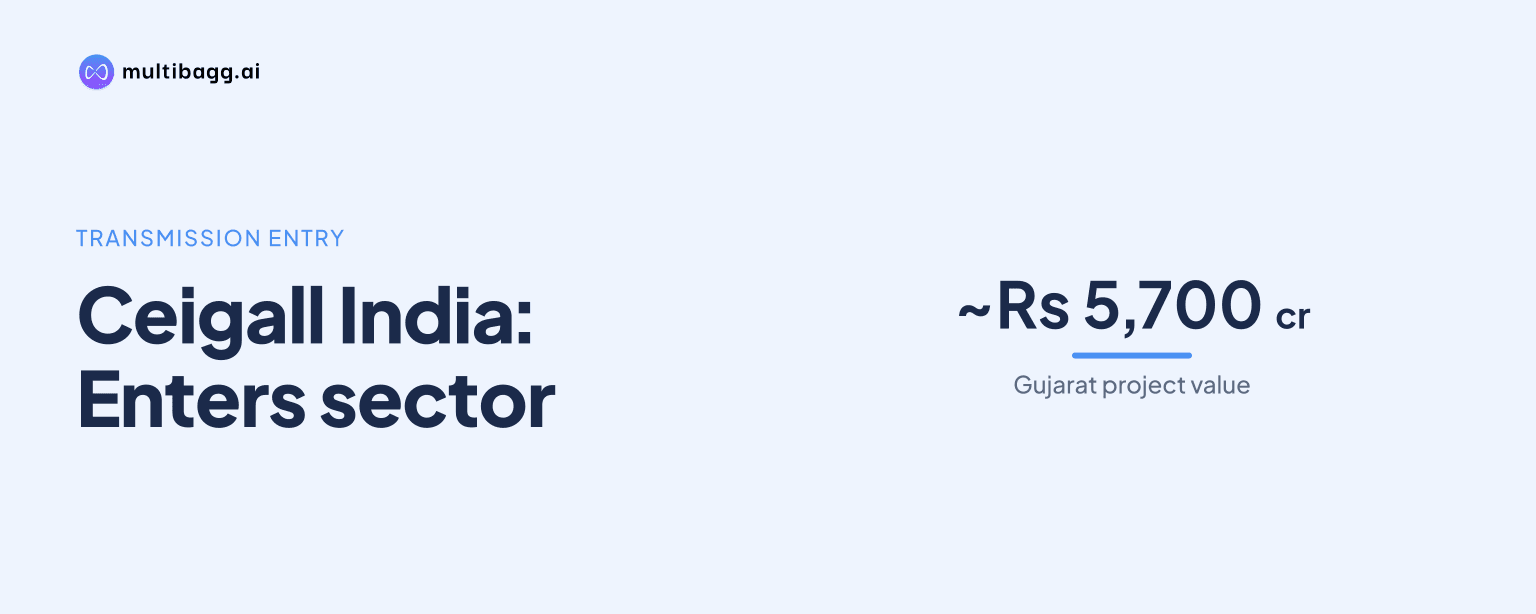
Ceigall India Limited entered the power-transmission segment in Q2 FY2027 after receiving a letter of intent for a Gujarat project worth about Rs 5,700 crore, including Goods and Services Tax. The Lakadia-Jam Khambhaliya-Jamnagar project requires 36 months of construction and then carries a 35-year operating period.
Know Ceigall India inside out
Results, valuation, peers and who's buying, in one view.
What is Ceigall India’s new Gujarat transmission project?
Ceigall India’s new project is the Lakadia-Jam Khambhaliya-Jamnagar transmission project in Gujarat, for which it received a letter of intent from REC Power Development and Consultancy Limited. Management put the project value at approximately Rs 5,700 crore, including Goods and Services Tax, or GST, and described it as the company’s entry into power transmission.
The scope includes 765 kilovolt, or kV, and 400 kV substations and approximately 300 kilometres of transmission lines. The project has a 36-month construction period followed by a 35-year operational period, placing an operating asset alongside Ceigall India’s construction-led infrastructure work.
Management said the award was an important diversification milestone and expanded Ceigall India’s presence in long-term infrastructure assets. Before this letter of intent, the company had identified metros, renewable energy, transmission and distribution, and industrial infrastructure as sectors beyond its roads and highways business.
How does the Gujarat project affect Ceigall India’s order-book mix?
Ceigall India’s order book stood at Rs 22,681 crore on September 30, 2026, with transmission and distribution accounting for approximately 21% of the total. Roads and highways remained the largest component at about 55%, while renewable energy represented 16%, showing that roads remained the principal segment despite broader diversification.
The order book comprised 18 engineering, procurement and construction, or EPC, projects, 10 hybrid annuity model, or HAM, projects, one design-build-finance-operate-transfer, or DBFOT, project, and 10 tariff-based projects. The call did not separately identify the contract category or order-book value assigned to the Gujarat transmission project.
The disclosed sector shares indicate that non-road activities represented roughly 44% of the order book, based on management’s rounded percentages. Transmission and distribution was the second-largest disclosed sector, ahead of renewable energy, although the percentages add to 99% because of rounding.
What other non-road projects is Ceigall India progressing?
Ceigall India commissioned 10 megawatts, or MW, of capacity from a 147 MW solar power plant in Maharashtra during Q2 FY2027. Management said its wholly owned subsidiary completed the 10 MW commissioning ahead of schedule and called it the beginning of the company’s operational journey in renewable energy.
In Madhya Pradesh, management said the KUSUM solar project had already started. It said the Morena project had land available and one transmission line completed, but construction depends on the remaining transmission-line work being completed and handed over; management said a start in the current year looked difficult because the contractor was still being finalised.
Ceigall India also continued to add road projects during the quarter. Through a joint venture, it secured five National Highway 913 Frontier Highway packages in Arunachal Pradesh worth approximately Rs 3,128 crore across around 278 kilometres, while three HAM projects that received appointed dates, including Varanasi-Ranchi-Kolkata packages 11 and 12 and Indore-Ujjain, were worth Rs 4,050 crore.
Got a follow-up? Ask IRIS
What financial performance and funding plans did Ceigall India report?
Ceigall India reported consolidated revenue from operations of Rs 1,022.5 crore in Q2 FY2027, up 26.8% from Rs 806.6 crore in Q2 FY2026. Consolidated earnings before interest, tax, depreciation and amortisation, or EBITDA, rose 53.2% to Rs 174 crore, and its EBITDA margin increased to 17% from 14.1% a year earlier.
Consolidated profit after tax rose 64.1% year on year to Rs 92.2 crore in Q2 FY2027 from Rs 56.2 crore. For H1 FY2027, revenue increased 21.1% to Rs 1,992.1 crore, EBITDA rose 42.5% to Rs 317.4 crore, and profit after tax was approximately Rs 156 crore, about 45% above H1 FY2026.
As of September 30, 2026, standalone debt was approximately Rs 436 crore and consolidated debt was approximately Rs 1,730 crore. Management reported standalone debt-to-equity of 0.2 times and consolidated debt-to-equity of 0.8%, and said it intended to maintain financial discipline while executing its diversified pipeline.
Management said HAM asset monetisation could generate around Rs 250 crore of inflow and reduce debt by about Rs 540 crore. It targeted closing the Bathinda-Dabwali transaction in the current quarter and Jalbehra-Shahbad in the next quarter, with the aim of completing both before March 31; Jalbehra-Shahbad received provisional commercial operation date during the quarter.
Conclusion
Ceigall India’s Rs 5,700 crore Gujarat letter of intent gives its diversification strategy a defined transmission project with a 36-month build period and a 35-year operating term. The project comes as transmission and distribution represented 21% of the Rs 22,681 crore order book, while roads and highways remained the largest sector at 55%.
The next developments to watch are progress from the letter of intent into project execution, further commissioning at the 147 MW Maharashtra solar plant after its first 10 MW, and management’s planned HAM monetisations before March 31. Management retained its minimum 15% revenue-growth guidance and identified renewable energy and transmission and distribution as growth drivers.