










Chaman Lal Setia Exports Ltd volume reaches 156,000 tonnes in FY26
Key highlights
- CLSEL exported 156,000 tonnes in FY26, compared with 144,000 tonnes in FY25.
- CLSEL's export sales reached Rs 1,268 crore in FY26, versus Rs 819 crore in FY22.
- Exports contributed approximately 88% of CLSEL's FY26 revenue.
- India exported 6,521,000 tonnes of basmati rice in FY26, up from 6,066,000 tonnes in FY25.
powered by IRIS
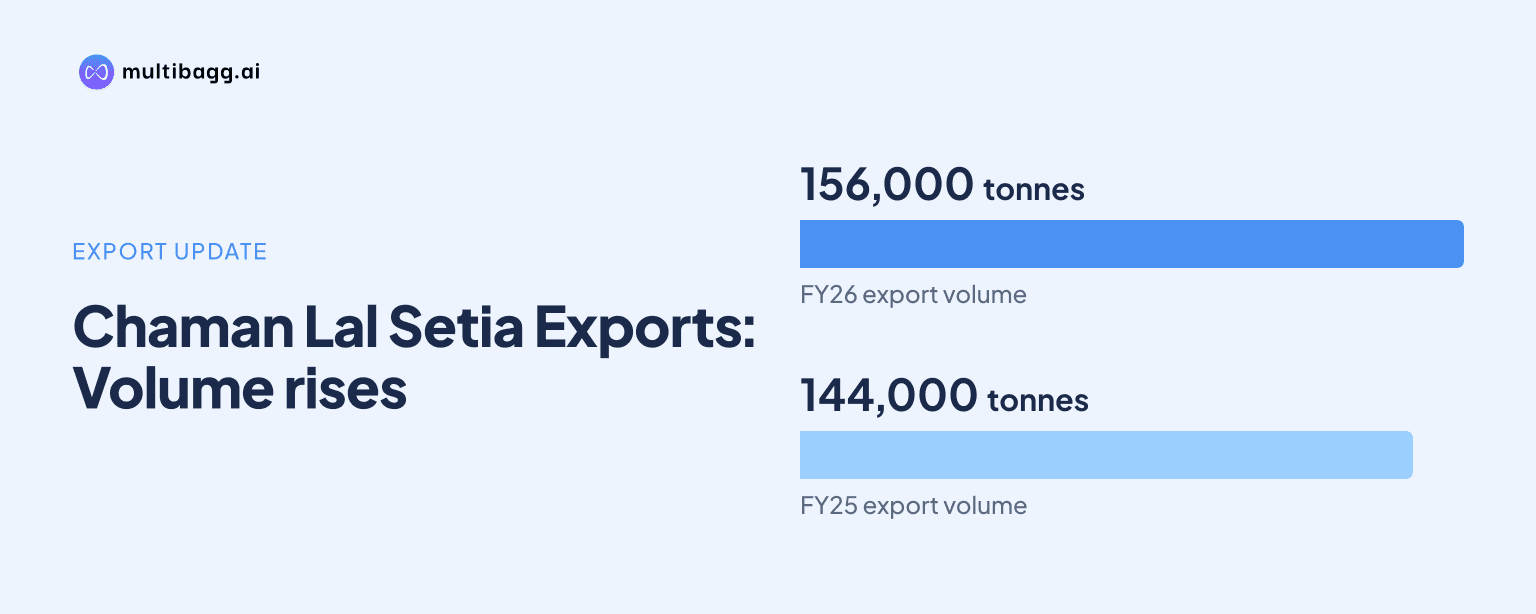
Chaman Lal Setia Exports Ltd (CLSEL) reached export volume of 156,000 tonnes in financial year 2026 (FY26), up from 103,000 tonnes in FY22, while exports supplied about 88% of revenue. Export sales rose to Rs 1,268 crore from Rs 819 crore over those five reported financial years, although growth in both measures slowed in FY26.
Know Chamanlal Setia Exports inside out
Results, valuation, peers and who's buying, in one view.
How fast did CLSEL's export volume grow through FY26?
CLSEL increased export volume to 156,000 tonnes in FY26 from 103,000 tonnes in FY22, a rise of 53,000 tonnes across the five financial years shown. Volume rose every year in the period: to 125,000 tonnes in FY23, 130,000 tonnes in FY24, 144,000 tonnes in FY25 and 156,000 tonnes in FY26. The FY26 increase was 12,000 tonnes from FY25, compared with 14,000 tonnes in the preceding year.
CLSEL's export sales followed the same upward direction over the longer period, reaching Rs 1,268 crore in FY26 from Rs 819 crore in FY22. However, sales increased by Rs 8 crore in FY26 from Rs 1,260 crore in FY25, while volume grew by 12,000 tonnes. This contrasts with FY23, when sales rose by Rs 192 crore and volume increased by 22,000 tonnes over FY22.
The presentation identifies rice exports as an activity CLSEL has conducted since 1982, or for more than four decades. It also states that its Maharani flagship brand is present in more than 40 countries and that the company has more than 440 distributors, whose average relationship with the company is about 15 years. These stated distribution and brand measures provide context for the repeat-business base cited by management.
How dependent was CLSEL on exports in FY26?
CLSEL derived about 88% of its FY26 revenue from exports, making overseas sales the dominant component of its reported revenue mix. The presentation does not provide a corresponding export-revenue share for FY22 through FY25, so the reported 88% figure cannot establish whether dependence on exports rose or fell during those years.
The FY26 export-sales figure of Rs 1,268 crore therefore represents the principal disclosed revenue stream, rather than merely a separate business line. CLSEL states that exports are covered by Export Credit Guarantee Corporation of India (ECGC) insurance, and that it is recognised as a 3 Star Export House. The presentation does not quantify the value insured, the premiums paid or any claims under ECGC cover.
CLSEL says it exports to more than 95 countries, while its Maharani brand is present in more than 40 countries. Those are different measures: the first refers to export destinations, while the second concerns brand presence. The presentation provides no country-by-country sales, volume or distributor data for CLSEL, so it does not identify which markets contributed most to its Rs 1,268 crore of FY26 export sales.
Got a follow-up? Ask IRIS
How did India's basmati export market change in FY26?
India's basmati rice export volume rose to 6,521,000 tonnes in FY26 from 6,066,000 tonnes in FY25, even as export value edged down to Rs 50,138 crore from Rs 50,312 crore. The movement differs from CLSEL's FY26 result because both the company's sales and volume increased, whereas the wider market's volume increased but reported value declined slightly.
The national figures show volume expanded by 2,573,000 tonnes from FY22 to FY26, while CLSEL's exports expanded by 53,000 tonnes over the same FY22-to-FY26 period. India's basmati export value rose from Rs 26,417 crore in FY22 to Rs 50,138 crore in FY26, despite the Rs 174 crore decline between FY25 and FY26. The source identifies the national data as Agricultural and Processed Food Products Export Development Authority data as of March 2026.
The presentation says Indian basmati rice has Geographic Indication recognition and is exported to more than 160 countries, with particular importance in the Middle East. It also states that India is one of the largest basmati producers, alongside balance quantities from Pakistan. These industry descriptions explain the export setting but do not quantify CLSEL's market share of India's FY26 volume of 6,521,000 tonnes.
Which countries matter most in India's basmati trade?
Saudi Arabia was the largest identified importing country for Indian basmati rice in FY26 at 17%, followed by Iran at 14%, Iraq at 11%, the United Arab Emirates (U.A.E.) at 8%, and Yemen Republic at 6%. Together, these five named markets represented 56% of the FY26 country shares displayed in the presentation, while other countries accounted for 44%.
The concentration of the five named markets in the Middle East is consistent with the presentation's statement that Indian basmati has a particularly strong export presence in that region. However, CLSEL's disclosure of exports to more than 95 countries does not specify its sales exposure to Saudi Arabia, Iran, Iraq, the U.A.E. or Yemen Republic. It is therefore not possible from the presentation to match CLSEL's FY26 volume of 156,000 tonnes to those national import shares.
For CLSEL, the difference between national import-market concentration and company geographic exposure remains an unresolved disclosure point. The company reports more than 440 distributors and an average relationship length of about 15 years, but it does not provide the number of distributors by country or the share of export revenue from its Maharani brand. Those missing details limit analysis of how its Rs 1,268 crore of export sales was distributed across destinations.
Conclusion
CLSEL's FY26 data show a five-year increase in export scale, with volume rising from 103,000 tonnes in FY22 to 156,000 tonnes and export sales increasing from Rs 819 crore to Rs 1,268 crore. Exports accounted for about 88% of FY26 revenue, alongside an Indian basmati market in which national export volume rose to 6,521,000 tonnes in FY26.
The presentation leaves several matters unresolved: it gives no FY27 export-volume target, country-level revenue split or CLSEL market-share figure. Future company disclosures would need to show whether export sales increase by more than the Rs 8 crore recorded in FY26 and clarify how the reported 95-plus-country footprint contributes to revenue.