










Chaman Lal Setia says Dubai freight reached Rs 5.76 lakh
Key highlights
- Chaman Lal Setia said Dubai container freight rose to Rs 5.76 lakh from Rs 19,200-Rs 24,000.
- Management said transit times can extend from 30 days to 40, 50 or 60 days.
- Chaman Lal Setia said it passes the complete ocean-freight amount paid to customers.
- Management cited 1509 rice at Rs 84-Rs 85 per kilogram versus Rs 55-Rs 56 a year earlier.
powered by IRIS
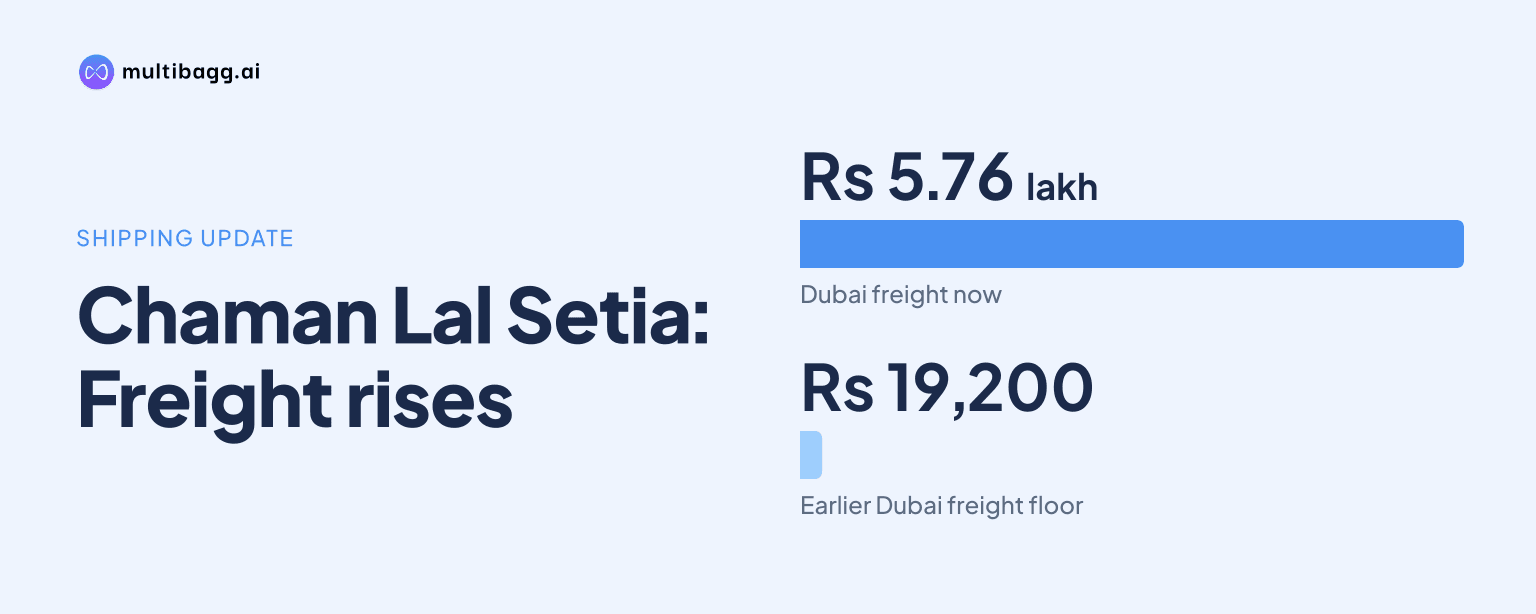
Chaman Lal Setia Exports Limited said during its Q2 and H1 FY27 earnings call that Middle East conflict raised Dubai container freight from Rs 19,200-Rs 24,000 to as much as Rs 5.76 lakh, while transit times could extend from 30 days to 60 days. Management said freight is passed through to customers, but higher transport and rice costs can defer buying.
Know Chamanlal Setia Exports inside out
Results, valuation, peers and who's buying, in one view.
How much has Chaman Lal Setia's Dubai freight increased?
Chaman Lal Setia said Dubai-bound ocean freight rose from Rs 19,200-Rs 24,000 per container to Rs 5.28 lakh-Rs 5.76 lakh per container. Management described the war-linked situation as “catastrophic” and said freight had similarly risen for Saudi Arabia, Oman, Bahrain and Kuwait.
At the top end, the quoted container charge was Rs 5.52 lakh above the earlier Rs 24,000 level. Management said shipping lines sometimes charged buyers at their end as well, although it did not quantify the number of transactions affected or the additional charges involved. Iraq was continuing to buy and pay, according to management, but ocean freight there was also high.
The freight comments relate to transport costs rather than an announced withdrawal from Middle East sales. Chaman Lal Setia said it continues to sell in Dubai and named Nesto as a customer, describing the retail chain as having 151 outlets. Management also said shipments to Israel had continued regularly and in high quantities despite the war.
Does Chaman Lal Setia absorb the higher ocean freight?
Chaman Lal Setia said it passes the complete ocean-freight charge it pays on to customers rather than absorbing it. Management said rice is an essential food product, so buyers have been bearing freight increases, though it acknowledged that the combination of high freight and high rice prices can lead customers to postpone purchases.
Management described its shipping arrangement as selling on Free on Board, or FOB, terms while shipping on Cost, Insurance and Freight, or CIF, terms. It said the quotation and contract are revised so that the prevailing freight amount is added to the FOB value for a CIF shipment. Management said it chooses CIF because it wants insurance protection and does not export without insurance.
This contractual mechanism limits direct exposure to freight paid to shipping lines, based on management’s account. It does not eliminate a demand risk, because customers may wait for 15 to 20 days, a month, or longer if transport and rice prices are both elevated. Management said buyers eventually need to replenish stock and cannot leave their godowns empty.
Are longer transit times delaying Chaman Lal Setia sales?
Chaman Lal Setia said war-related disruption has extended transit periods, with shipments that normally take 30 days potentially taking 40, 50 or 60 days. Management said a slower supply line can delay the arrival of goods even when business continues and customers remain active in the market.
Management did not quantify a Q2 FY27 volume decline caused specifically by freight disruption, shipment delays or buyer deferrals. It said volumes were lower year on year while revenue prices were higher. When asked whether sales could spill into Q3, management said buyers may defer orders when prices rise, but added that buying was still continuing in some locations.
Chaman Lal Setia said it was asking customers to enlarge orders to cover the longer pipeline. Its example was that a customer buying one container could order two, while one buying two could order five. Management said this approach helps customers retain inventory and helps the company maintain sales, but it did not disclose the number of customers taking larger orders.
Management expected transit conditions to become normal, or begin becoming normal, within another fortnight. That expectation was conditional on no further war-related impact on Dubai and other markets. It said the outlook for Saudi Arabia and nearby countries remained uncertain because it did not know whether fighting would continue.
Got a follow-up? Ask IRIS
What else is affecting Chaman Lal Setia orders and margins?
Chaman Lal Setia said high paddy and rice prices are adding to customer caution alongside freight costs. Management compared 1509 rice at Rs 55-Rs 56 per kilogram a year earlier with Rs 84-Rs 85 per kilogram currently, a rise of Rs 29-Rs 30 per kilogram. It said the current season’s paddy prices were low for only about a week before increasing.
Management attributed part of the current price pressure to buying from Iran by other exporters. Chaman Lal Setia said it has not exported to Iran for about 25 years and does not conduct business there through Dubai. It said other exporters were shipping finished, quality rice to Iran, and that this demand was supporting prices in the present period.
The company said it had slowed procurement and was buying where it could see a margin between its production cost and market selling price. Management said strong Q2 profitability reflected, in part, inventory procured at lower prices in the prior period. It did not expect to state that the same profitability ratios would necessarily recur when current procurement costs are higher.
Management said a reasonable profit on sales is 8% to 10%, but did not present that range as formal guidance for the next quarter or year. It also said it had a broad customer base across 95 to 96 countries, which can help redirect sales when buying slows in one geography. The call did not provide a country-wise revenue split or freight exposure by destination.
Is rice supply tight despite the higher paddy prices?
Chaman Lal Setia said the cultivated area in the current year had declined by about 1% to 2%, with Haryana down by as much as 4%, but yields were better. Management illustrated the improvement by saying a field that previously produced 20 quintals could now produce 24 or 25 quintals. It described crop size and crop quality as good because rain arrived before harvesting.
This supply assessment contrasts with the higher paddy and rice prices cited on the call. Management said Iran-linked buying had contributed to elevated prices, but it also questioned whether the wider Basmati industry could sell its entire 7 million-tonne production at higher prices. Its view was that prices could decline if demand slows while supply remains available.
Chaman Lal Setia said lower rice prices could improve procurement margins if the company buys stock at lower costs, while buyers would also benefit. For now, management said it was purchasing regularly only where it considered the economics reasonable. It did not provide a September-end inventory quantity in tonnes during the call.
Conclusion
The main disclosed effect of the Middle East war is a rise in Dubai container freight to as much as Rs 5.76 lakh from Rs 24,000, combined with transit times that can double from 30 to 60 days. Chaman Lal Setia says its CIF process passes freight through to customers, but the commercial consequence can still be delayed ordering when high transport costs coincide with 1509 rice prices of Rs 84-Rs 85 per kilogram.
The next issue to watch is whether transit conditions begin normalising within the fortnight management indicated, subject to no additional conflict disruption. Investors can also monitor procurement discipline and customer demand as management weighs current high prices against its question of whether the industry can sell 7 million tonnes of Basmati rice at elevated levels.