










Chaman Lal Setia’s liquidity rose to Rs 550.9 crore in H1FY27
Key highlights
- Chaman Lal Setia reported Rs 550.9 crore of cash, bank balances and current investments in H1FY27, up 67.7% year on year.
- Inventory declined to Rs 131 crore at September 2026 from Rs 427 crore at March 2026.
- Cash and cash equivalents were Rs 507 crore and total debt was Rs 73 crore at September 2026.
- H1FY27 net sales rose 16.3% to Rs 674.7 crore and PAT increased 117.6% to Rs 88.3 crore.
powered by IRIS
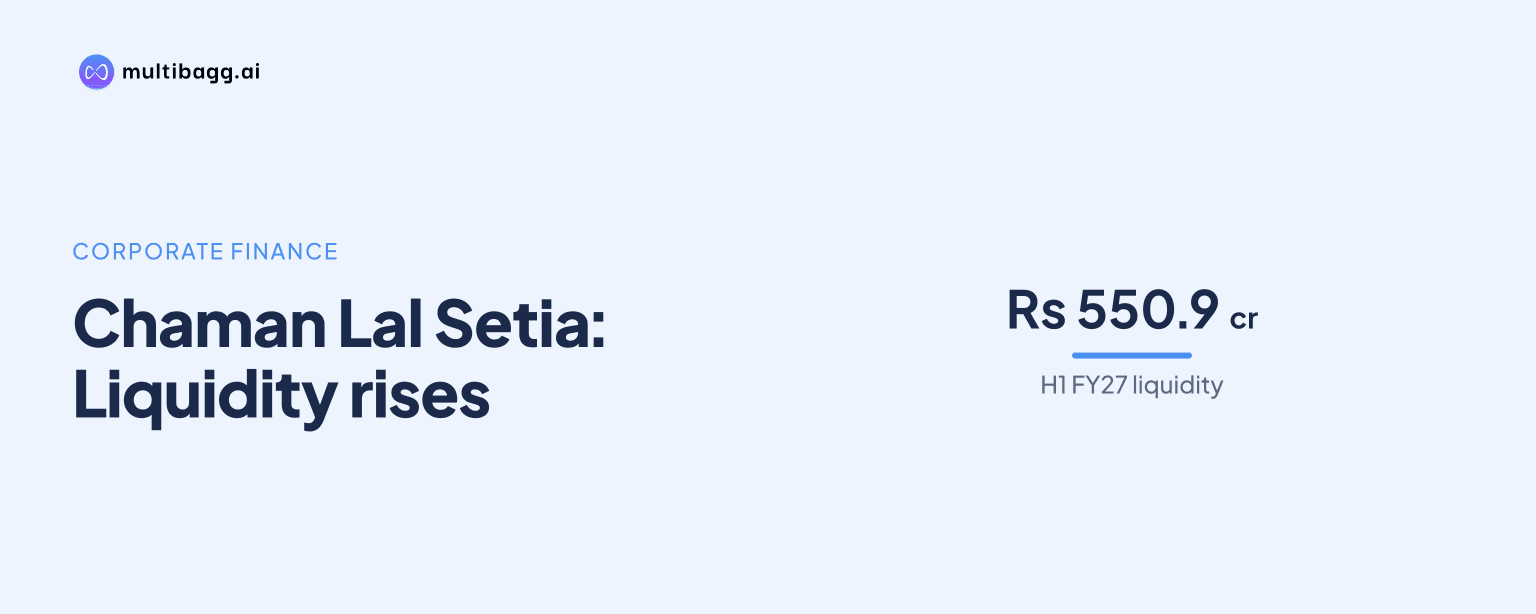
Chaman Lal Setia Exports Ltd reported Rs 550.9 crore of cash, bank balances and current investments in H1FY27, 67.7% above H1FY26, as inventory at September 2026 fell to Rs 131 crore from Rs 427 crore in March 2026 under its disclosed seasonal procurement-and-sales cycle.
Know Chamanlal Setia Exports inside out
Results, valuation, peers and who's buying, in one view.
How did Chaman Lal Setia’s liquidity change in H1FY27?
Chaman Lal Setia’s cash, bank balances and current investments increased by Rs 222.5 crore year on year to Rs 550.9 crore in the first half of FY27, or H1FY27, from Rs 328.4 crore in H1FY26. The company reported the 67.7% increase as its broad liquidity measure, which combines cash, bank balances and current investments without disclosing each component separately.
The increase followed a seasonal reduction in working-capital balances by September 2026. Inventory was Rs 131 crore at September 2026, down Rs 296 crore from Rs 427 crore at March 2026, while receivables fell by Rs 40 crore to Rs 194 crore. Payables increased by Rs 5 crore to Rs 13 crore over the same six-month period.
Management says inventory rises in the second half, or H2, through bulk rice and paddy procurement after the kharif harvest, then is liquidated as sales occur in H1. It says this procurement cycle is funded through internal cash and short-term debt, making the September liquidity position part of the company’s annual operating pattern rather than a standalone cash-flow measure.
Why do Chaman Lal Setia’s two liquidity figures differ?
Chaman Lal Setia reports Rs 550.9 crore for cash, bank balances and current investments in H1FY27, while a separate chart gives cash and cash equivalents of Rs 507 crore at September 2026. The Rs 43.9 crore difference reflects the use of two reported measures, and the presentation does not provide a reconciliation or separate balances for bank deposits and current investments.
Cash and cash equivalents rose by Rs 253 crore year on year, from Rs 254 crore at September 2025 to Rs 507 crore at September 2026. They also increased from Rs 129 crore at March 2026, when inventory stood at Rs 427 crore, illustrating the contrast between the procurement-stage March balance sheet and the post-sales September balance sheet.
Total debt was Rs 73 crore at September 2026, Rs 10 crore below the March 2026 balance of Rs 83 crore but Rs 6 crore above Rs 67 crore at September 2025. The figures show that debt declined during the six months, though it was not lower than a year earlier; management specifically identifies short-term debt as one source of funding when H2 procurement starts.
Got a follow-up? Ask IRIS
Why did Chaman Lal Setia’s inventory fall to Rs 131 crore?
Chaman Lal Setia’s inventory fell to Rs 131 crore at September 2026 because management says H1 sales liquidate stocks accumulated during the previous H2 procurement period. Inventory was also Rs 84 crore below the Rs 215 crore recorded at September 2025, while the company said paddy procurement starts again in October-November.
The company states that most production begins with procurement of semi-finished rice, followed by conversion into finished rice, principally requiring Sortex processing. Management says this keeps the processing cycle short, and says it does not engage in ageing, which it associates with moderate inventory holding and lower inventory risk.
Receivables moved in the same direction as inventory during H1FY27, declining from Rs 234 crore at March 2026 to Rs 194 crore at September 2026. However, the presentation includes no cash-flow statement, so it does not quantify how much of the increase in liquidity came from lower working capital, earnings, investment movements or other cash-flow items.
The company has 82,500 metric tonnes of warehouse capacity in Karnal and says its packaging capacity ranges from 0.5 kilograms to 1 metric tonne. Its operating model also states that most procurement is made on a cash basis to obtain cash discounts, a mechanism relevant to the cash requirement when the October-November buying season begins.
What sales and earnings accompanied Chaman Lal Setia’s inventory conversion?
Chaman Lal Setia reported H1FY27 net sales of Rs 674.7 crore, up 16.3% from Rs 580.2 crore in H1FY26, while cost of goods sold increased 5.1% to Rs 470.9 crore. Gross profit consequently rose 54.0% to Rs 203.8 crore and gross margin expanded to 30.2% from 22.8%, an increase of 740 basis points, where one basis point is one-hundredth of a percentage point.
Earnings before interest, tax, depreciation and amortisation, or EBITDA, rose 108.6% to Rs 112 crore in H1FY27 from Rs 53.7 crore a year earlier. Profit after tax, or PAT, increased 117.6% to Rs 88.3 crore from Rs 40.6 crore, with EBITDA margin rising to 16.6% from 9.3% and PAT margin reaching 13.1% from 7.0%.
Management attributed the margin improvement in H1FY27 and Q2FY27 to favourable procurement costs from earlier buying cycles, inventory gains and a higher contribution from branded sales. In Q2FY27, net sales were Rs 328.8 crore, 20.4% above Rs 273 crore in Q2FY26 but 5.0% below Rs 345.9 crore in Q1FY27; quarterly EBITDA was Rs 68.4 crore compared with Rs 24.3 crore a year earlier.
Export revenue increased to Rs 583 crore in H1FY27 from Rs 495.6 crore in H1FY26, although export volume declined to 57,700 metric tonnes from 62,100 metric tonnes. Management reported Q2FY27 export realisation of Rs 105 per kilogram and said it expected realisations to remain at higher levels in coming quarters; this is management’s outlook rather than a stated target.
Conclusion
Chaman Lal Setia’s September 2026 balance sheet reflects the sales stage of its disclosed annual cycle: inventory declined to Rs 131 crore, receivables fell to Rs 194 crore and cash, bank balances and current investments reached Rs 550.9 crore. Higher H1FY27 sales and profitability coincided with that conversion, while total debt stood at Rs 73 crore.
The next item to watch is the October-November start of paddy procurement, which management says will increase inventory and be funded through internal cash and short-term debt. The subsequent movement in cash, inventory and debt will show whether the H2 balance sheet follows the seasonal pattern described by management.